Leapton LP182*182-M-60-NB-490W

LP182*182-M-60-NB-490W

490 Wp N-type Bifacial 80%
ComparePV verdict

Middle of its segment, weak in heat

Rank 5,338 of 14,005
Compare panels Datasheet PDF
Power (Wp)
490
Strong · top 13%
Efficiency (%)
22.10
Weak · bottom 21%
Density (Wp/m²)
221.0
Weak · bottom 21%
Temp (%/°C)
-0.300
Weak · bottom 5%
Weight (kg)
27.0
Weak · 3.3 kg above median
Warranty (yrs)
30
Typical · median 30 yrs

The Leapton LP182*182-M-60-NB (N-Type Double Glass) series are modules designed for maximum energy yield in environments where reliability and stable performance over many years are crucial. The use of N-type cells in MBB technology minimizes internal losses and improves performance under partial shading, which effectively helps maintain production in typical Polish roof and ground-mounted conditions.

A key advantage is the double-sided (bifacial) glass-to-glass construction - the panel can also utilize reflected light from the ground, which increases profitability, for example, on bright roofs, on the ground, on elevated structures, and in carports. The glass on both sides also provides higher resistance to moisture and environmental factors, and additional PID-resistant features support long-term power stability.

This is a good choice for installers and investors who are looking for modules that stand out for their durability, better performance in low light conditions, and greater tolerance to harsh working conditions.

Ranking

301 panels in the segment N-type 450-500 W
Metric This panel Median Position in segment Overall rank
Module efficiency 22.10% 22.52% Weak · bottom 21% 6,012
Power density 221.0 225.2 Weak · bottom 21% 5,998
Temperature coefficient -0.300 -0.290 Weak · bottom 5% 6,093
Weight per kWp 55.1 49.5 Weak · bottom 17% 9,526
Performance warranty 30 yrs 30 yrs Typical 21
Colour key Strong - top 25% Typical - middle 50% Weak - bottom 25%

Signals from the data

5 positive · 4 caution
Best for

Residential and commercial.

Not ideal for

Hot climates, weight-limited structures and tight roof space.

Watch-outs
-0.300 %/°C temperature coefficient

Bottom 5% of the N-type 450-500 W segment, against a median of -0.290. Ranked 6,093rd in the whole database.

55.1 kg per kWp

Bottom 17% of the N-type 450-500 W segment, against a median of 49.5.

22.10% module efficiency

Bottom 21% of the N-type 450-500 W segment, against a median of 22.52%.

What owners get
N-type cells with MBB technology

N-type cells in a multi-busbar (MBB) configuration reduce resistive losses and improve performance under low-irradiance and partial-shading conditions, translating into higher annual energy yield compared to conventional PERC modules.

Bifacial glass-glass construction

The bifacial glass-glass design captures light reflected from the ground surface, boosting output by an estimated 5-25% depending on albedo - a real advantage for installations on light-colored roofs, ground mounts, and carports.

High mechanical durability

TÜV Nord-tested to withstand wind loads up to 2400 Pa and snow loads up to 5400 Pa, providing a safety margin that matters for demanding climate conditions, including roofs exposed to heavy snowfall.

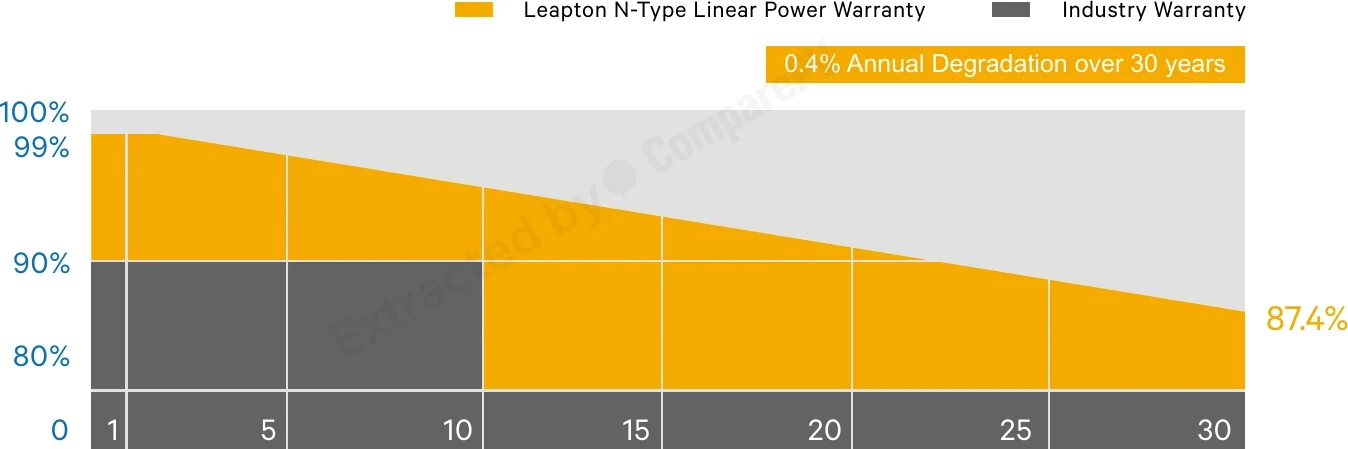
30-year linear power warranty with low degradation

The manufacturer specifies an average annual degradation rate of just 0.4%, alongside a 30-year linear power warranty and 25-year product warranty - placing this series ahead of the standard 25/25-year terms offered by many competitors in the premium N-type segment.

Independently validated reliability via PVEL

Leapton Solar was recognized as a Top Performer in Kiwa PVEL's 2025 PV Module Reliability Scorecard, providing independent confirmation of the durability of the technology used in this series.

Trade-offs
Efficiency trails top-tier competitors

The 22.55% maximum efficiency lags behind comparable models such as the Gokin GK-3-54HGF (24.5%) and Selfa SV120M.2.4 (22.6%) at the same 500 Wp power class, meaning a slightly larger installation area is needed for equivalent energy output.

Notes from the database
  • At 22.1% efficiency, this panel is on par with typical N-type 450-500W modules
  • 221.0 W/m² power density is 4.2 W/m² below N-type 450-500W median (225.2 W/m²) - requires larger installation area
  • At -0.30%/°C, hot weather performance is typical for N-type 450-500W panels
  • Weight of 27.0 kg is 3.3 kg above N-type 450-500W median (23.7 kg) - verify structural support
  • Bifacial design (80% factor) captures reflected light - adds 4-12% yield on ground-mount or white roof

Specifications

Open datasheet PDF
Nominal power (Pmax) 490 Wp Nameplate at 1000 W/m², 25 °C
Module efficiency 22.10 % Weak Segment median 22.52%
Vmpp · Impp 36.19 V · 13.54 A Operating point at max power
Voc · Isc 43.67 V · 14.00 A Sizes the string length
Max system voltage 1500 V Longer strings than 1000 V modules
Dimensions 1955×1134×30 mm · 2.22 m² of roof
Weight 27.0 kg Weak Weak · 3.3 kg above median
Cells 120 · N-type Monocrystalline
Bifaciality 80 % Rear output as a share of front
Coefficient Pmax -0.300 %/°C Weak bottom 5% of its segment
Coefficient Voc · Isc -0.250 · 0.046 %/°C
NOCT 41 °C At 800 W/m², 20 °C ambient
Product warranty 25 years Hardware defects only
Performance warranty 30 years Typical median 30 yrs · median 30 yrs
End-of-warranty output 87.4 % Equals 428 W guaranteed
Degradation 1.00 → 0.40 % First year, then annual

Datasheet charts

Open datasheet PDF

Measured curves published by Leapton in this model's datasheet. A chart carrying a wattage was measured on that variant alone - only the ones that describe 490 Wp appear here. The rest cover the whole series.
Simulations

Live - change any input
Lifetime output & value
30 years at 1200 kWh/kWp/year and €0.50 per kWh
Power in year 30
-
Lifetime energy
-
Energy value
-
With bifacial gain
-

Degradation from this panel's own datasheet figures. No inverter, soiling or shading losses.

Heat losses
-0.300 %/°C against a segment median of -0.290
-
Bifacial gain
Rear gain over light concrete: -
-

Model: bifaciality × albedo × 0.6 view factor. A first-order estimate, not a yield simulation.

Filter these
Size
Panel Power Eff. Temp. Weight Difference
Leapton LP182*182-M-60-NB-490W 490 W 22.10% -0.300 27.0 kg You are here
LR7-54HJD-510M 510 W 25.00% -0.240 23.5 kg Cooler, lighter, +2.9 pp
AIKO-A495-MCE54Mw 495 W 24.80% -0.260 21.0 kg Cooler, lighter, +2.7 pp
LR7-54HJD-505M 505 W 24.70% -0.240 23.5 kg Cooler, lighter, +2.6 pp
AIKO-A490-MCE54Mw 490 W 24.50% -0.260 21.0 kg Cooler, lighter, +2.4 pp
LR7-54HJD-500M 500 W 24.50% -0.240 23.5 kg Cooler, lighter, +2.4 pp
CIPRO-TN9C54M-500W 500 W 24.50% -0.260 21.4 kg Cooler, lighter, +2.4 pp
LP182*182-M-60-NH-480W 480 W 21.65% -0.300 23.5 kg -10 W, lighter, -0.5 pp
LP182*182-M-60-NH-485W 485 W 21.88% -0.300 23.5 kg Lighter, -0.2 pp
LP182*210-M-54-NH-490W 490 W 22.03% -0.300 23.7 kg Lighter
LP182*182-M-60-NB-495W 495 W 22.33% -0.300 27.0 kg +0.2 pp
LP182*210-M-54-NH-495W 495 W 22.26% -0.300 23.7 kg Lighter
LR7-60HVH-560M 560 W 24.80% -0.260 25.0 kg +70 W, cooler, +2.7 pp
LR7-60HVH-555M 555 W 24.60% -0.260 25.0 kg +65 W, cooler, +2.5 pp
LR7-60HVHL-550M 550 W 24.40% -0.260 16.3 kg +60 W, lighter, +2.3 pp
JAT60S40-540/LR 540 W 24.40% -0.260 23.5 kg +50 W, cooler, +2.3 pp
GK-5-60HG-540M 540 W 24.40% -0.260 23.3 kg +50 W, cooler, +2.3 pp

Found 488 panels of the same or similar size to this one, within ±10 mm. See them here Found 512 panels of the same or similar size to this one, within ±25 mm. See them here Found 1080 panels of the same or similar size to this one, within ±50 mm. See them here Found 1471 panels of the same or similar size to this one, within ±100 mm. See them here

Common questions

6 answered
What warranty does the Leapton LP182*182-M-60-NB series come with and what does it cover?
The LP182*182-M-60-NB series includes a 25-year product warranty and a 30-year linear power warranty. In year one, at least 99% of rated output is guaranteed, and after 30 years the module retains a minimum of 87.4% of its nominal power. Leapton is a Tier 1 manufacturer headquartered in Japan, which adds confidence that warranty claims will be honored throughout the panel's service life.
Do the Leapton LP182*182-M-60-NB panels perform well in winter and on overcast days typical of Central European climates?
Yes. The temperature coefficient of Pmax is -0.3%/°C, one of the best figures in this module class. N-type TOPCon cells exhibit low LID and superior low-irradiance efficiency compared to P-type PERC. In Poland, where a significant share of annual yield comes from diffuse-light days, this advantage results in a measurable increase in total annual energy production.
When does the bifacial design of the LP182*182-M-60-NB actually deliver a meaningful yield gain?
The bifacial design captures reflected irradiance from the rear side, adding 5–25% in additional yield depending on ground albedo. Gains are highest on ground-mount systems, carports, elevated racking structures, and roofs with bright gravel or white membranes beneath the array. On a conventional pitched roof with dark tiles, rear-side contribution is minimal, so the bifacial advantage is best exploited in open-field installations.
Can the LP182*182-M-60-NB modules handle heavy snow and strong wind loads on Central European rooftops?
Yes. The double-glass construction has been TÜV Nord certified for a snow load of 5400 Pa (approximately 550 kg/m²) and a wind load of 2400 Pa, both exceeding standard requirements for most locations in Poland. The glass-glass encapsulation also provides significantly better moisture resistance and mechanical integrity compared to glass-backsheet modules.
What is the practical difference between N-type TOPCon and standard P-type PERC cells, and why does it matter for the system owner?
N-type TOPCon cells in the LP182*182-M-60-NB series reach efficiency up to 22.55% and exhibit substantially lower LID than P-type PERC. This means more kilowatt-hours per square meter of roof space over the full system lifetime. Combined with the 30-year power warranty, the resulting LCOE of an installation built on this series is typically lower than equivalent capacity using conventional P-type modules.
What are the dimensions and weight of the Leapton LP182*182-M-60-NB panel, and will it fit on a standard pitched roof?
The module measures 1955 × 1134 × 30 mm and weighs 27 kg. This is a standard 60-cell format using 182 mm half-cut cells. A 30 m² south-facing pitched roof can accommodate approximately 14–16 panels. The weight is compatible with standard aluminum racking systems, though for systems above 10 kW it is advisable to verify roof load capacity with a structural engineer.
Add to compare