Jolywood JW-HD108N-430

JW-HD108N-430

430 Wp TOPCon Bifacial 80%
ComparePV verdict

Middle of its segment, heavy for its output

Rank 7,643 of 14,005
Compare panels Datasheet PDF
Power (Wp)
430
Typical for its class
Efficiency (%)
22.02
Typical · median 22.00%
Density (Wp/m²)
220.2
Typical · median 220.2
Temp (%/°C)
-0.300
Typical · median -0.290
Weight (kg)
24.5
Weak · 2.5 kg above median
Warranty (yrs)
30
Typical · median 30 yrs

The Jolywood NIWA Pro series redefines efficiency standards thanks to the use of innovative second-generation N-type TOPCon cells. This solution directly eliminates light-induced degradation (LID), which translates to significantly higher long-term power stability compared to traditional P-type modules. Thanks to the unique J-TOPCon 2.0 cell structure, these modules are characterized by excellent efficiency in low-light conditions, which is crucial in the Polish climate, especially during autumn-winter periods. Investors appreciate this series for its very low temperature coefficient, allowing high energy yields to be maintained even during hot days when standard panels lose efficiency. The NIWA Pro series was designed for demanding rooftop installations and professional photovoltaic farms, where maximizing power density per square meter is essential. The use of modern SMBB technology further increases light absorption and the reliability of internal connections. It is an ideal choice for those looking for exceptional durability and a faster return on investment by maximizing energy self-consumption. By choosing these modules, you gain the certainty of stable system operation in all weather conditions, which places the NIWA Pro series at the forefront of technological solutions available on the Polish market.

Ranking

1,218 panels in the segment TOPCon 400-450 W
Metric This panel Median Position in segment Overall rank
Module efficiency 22.02% 22.00% Typical 6,329
Power density 220.2 220.2 Typical 6,481
Temperature coefficient -0.300 -0.290 Typical 6,093
Weight per kWp 57.0 51.4 Weak · bottom 14% 10,964
Performance warranty 30 yrs 30 yrs Typical 21
Colour key Strong - top 25% Typical - middle 50% Weak - bottom 25%

Signals from the data

5 positive · 2 caution
Best for

Residential, commercial and hot-climate.

Not ideal for

Weight-limited structures.

Watch-outs
57.0 kg per kWp

Bottom 14% of the TOPCon 400-450 W segment, against a median of 51.4.

What owners get
J-TOPCon 2.0 – zero LID and LeTID

Second-generation N-type cells fully eliminate light-induced degradation (LID) and light & elevated temperature induced degradation (LeTID), which can cost P-type PERC modules 2-3% of rated power in the first years of operation. Jolywood, a TOPCon pioneer since the NIWA series launch in 2020, has been recognized by PVEL in N-type TOPCon reliability testing.

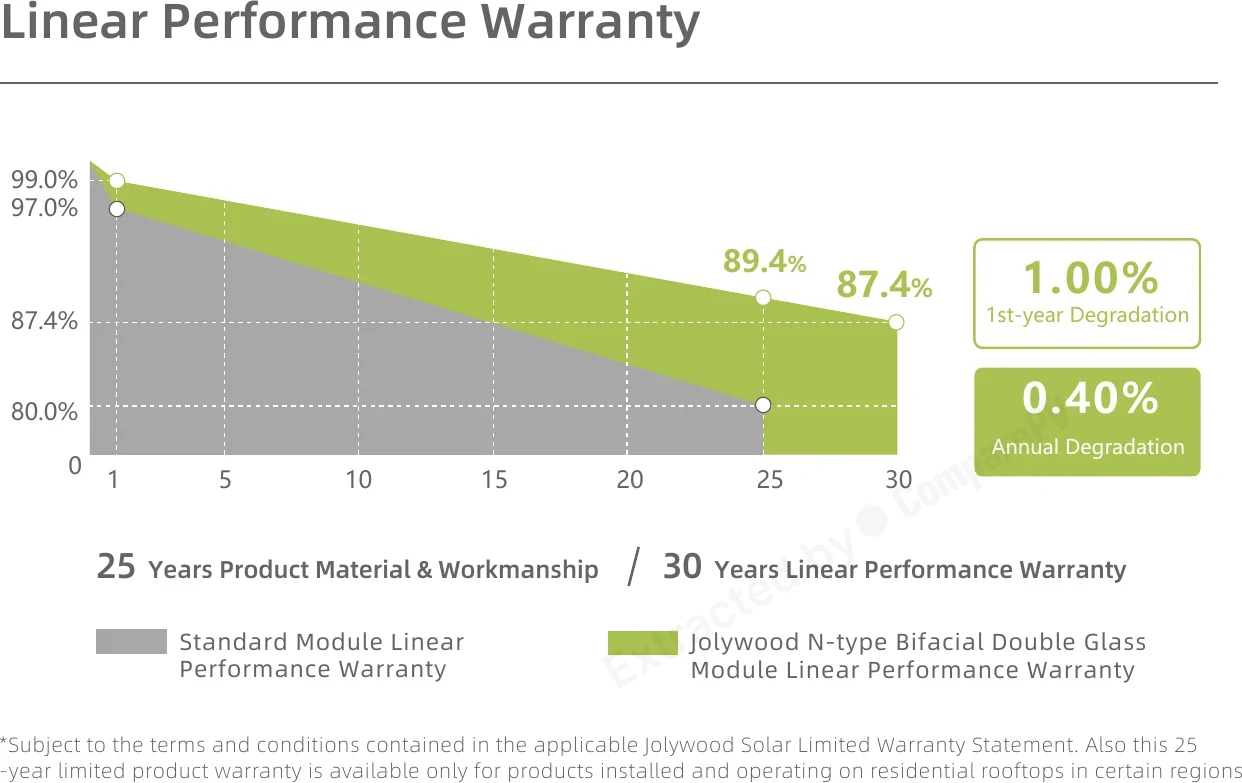
30-year linear power warranty

The manufacturer guarantees ≥87.4% Pmax after 30 years of operation (linear degradation curve), backed by a 25-year product warranty. Tier-1 peers in the same 415-440 Wp class — Seraphim Nebula and KDM Kingdom Solar — offer a 25-year power warranty, making Jolywood NIWA Pro's coverage 5 years longer.

Bifacial design – rear-side energy gain

Glass-glass bifacial construction enables an additional energy yield of 10-30% over monofacial modules, depending on ground albedo (light gravel, white TPO membrane, snow cover). This directly reduces the LCOE of ground-mount and high-albedo rooftop installations.

BNEF Tier-1 bankability since 2008

Jolywood appears on the current BNEF Tier-1 bankable manufacturer list (methodology updated March 18, 2026), enabling debt-financed project acceptance by leading financial institutions without additional collateral. The manufacturer has been active since 2008 with a declared production capacity of ~10 GW/year.

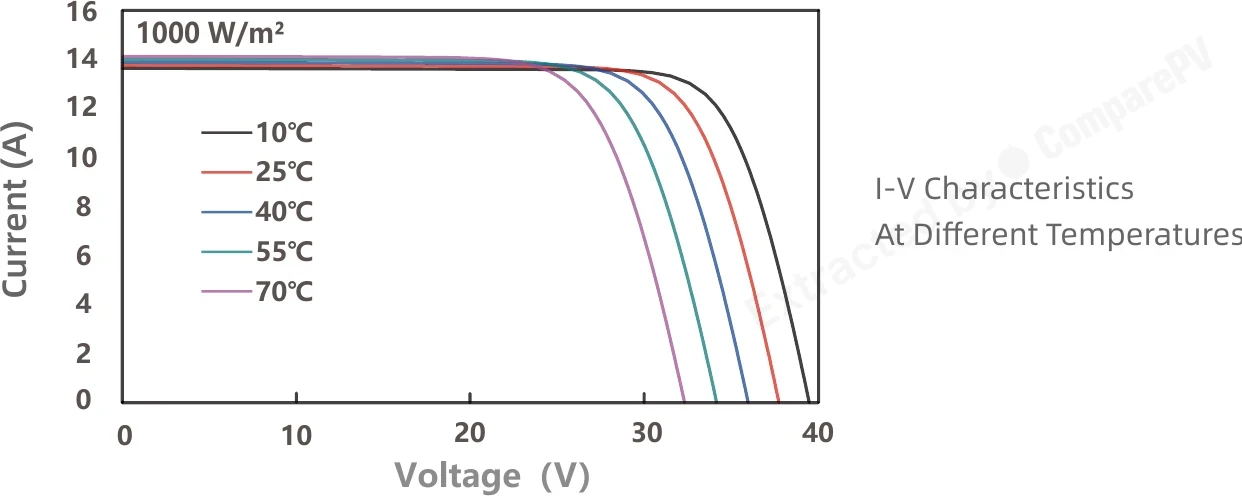
Low temperature coefficient of -0.30%/°C

The temperature coefficient of Pmax is -0.30%/°C per the official datasheet (JW-HD108N). At a cell temperature of 65°C (Δ40°C above STC), power loss reaches approximately 12%, compared to 14-16% for typical P-type PERC modules — a tangible advantage during hot summer days above 30°C.

Trade-offs
Efficiency below segment leader

The top-variant (440 Wp) maximum efficiency is 22.53%, while Luxor Solar ECO LINE N-TYPE TOPCon Non-Reflect achieves 22.86% at the same power rating. The 0.33 percentage-point gap translates to approximately 6.5 W less per square meter — a meaningful difference for installations with critically constrained roof area.

Notes from the database
  • Efficiency of 22.0% matches the TOPCon 400-450W median
  • At 220.2 W/m² power density, roof space requirements are typical for TOPCon 400-450W panels
  • At -0.30%/°C, hot weather performance is typical for TOPCon 400-450W panels
  • At 24.5 kg, this panel is 2.5 kg heavier than the TOPCon 400-450W median (22.0 kg) - more demanding for installation crews
  • Bifacial design (80% factor) captures reflected light - adds 4-12% yield on ground-mount or white roof

Specifications

Open datasheet PDF
Nominal power (Pmax) 430 Wp Nameplate at 1000 W/m², 25 °C
Module efficiency 22.02 % Typical Segment median 22.00%
Vmpp · Impp 32.30 V · 13.32 A Operating point at max power
Voc · Isc 38.30 V · 14.12 A Sizes the string length
Max system voltage 1500 V Longer strings than 1000 V modules
Dimensions 1722×1134×30 mm · 1.95 m² of roof
Weight 24.5 kg Weak Weak · 2.5 kg above median
Cells 108 · TOPCon Monocrystalline
Bifaciality 80 % Rear output as a share of front
Coefficient Pmax -0.300 %/°C Typical median -0.290 of its segment
Coefficient Voc · Isc -0.250 · 0.045 %/°C
NOCT 42 °C At 800 W/m², 20 °C ambient
Product warranty 25 years Hardware defects only
Performance warranty 30 years Typical median 30 yrs · median 30 yrs
End-of-warranty output 87.4 % Equals 376 W guaranteed
Degradation 1.00 → 0.40 % First year, then annual

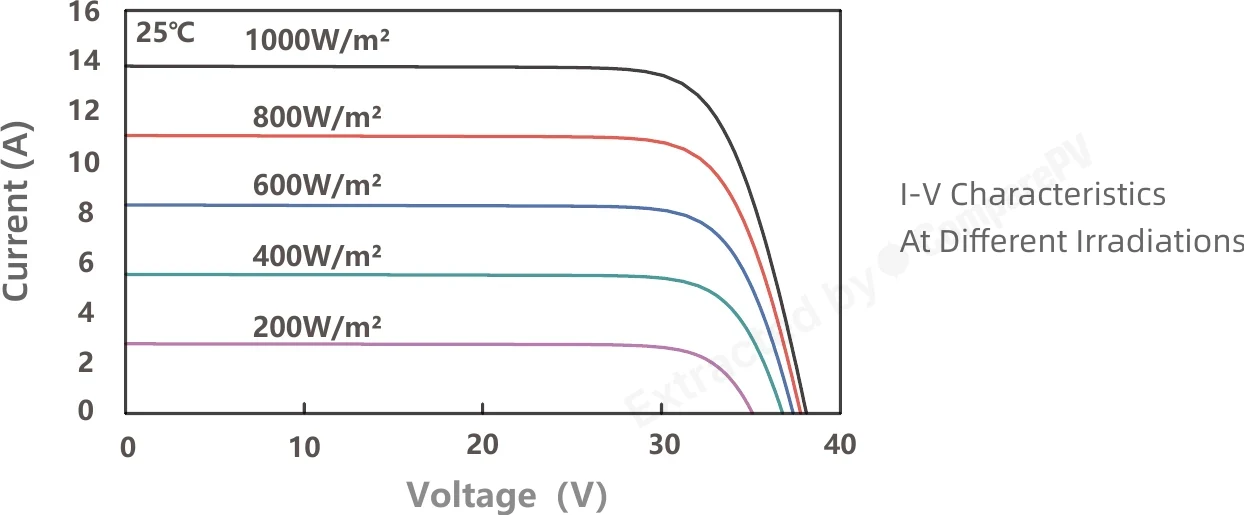
Datasheet charts

Open datasheet PDF

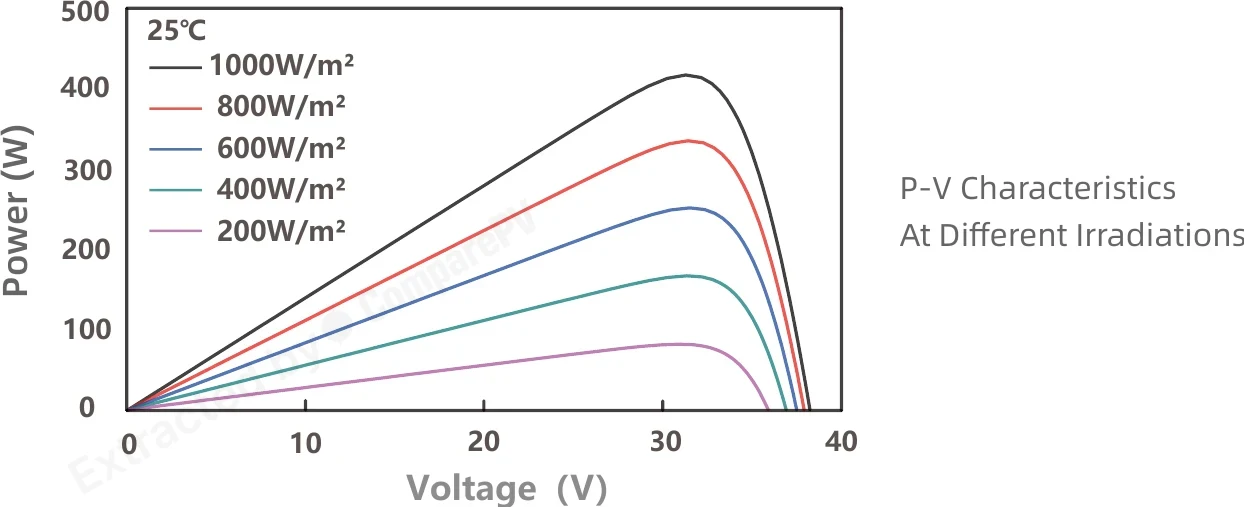
Measured curves published by Jolywood in this model's datasheet. A chart carrying a wattage was measured on that variant alone - only the ones that describe 430 Wp appear here. The rest cover the whole series.
Simulations

Live - change any input
Lifetime output & value
30 years at 1200 kWh/kWp/year and €0.50 per kWh
Power in year 30
-
Lifetime energy
-
Energy value
-
With bifacial gain
-

Degradation from this panel's own datasheet figures. No inverter, soiling or shading losses.

Heat losses
-0.300 %/°C against a segment median of -0.290
-
Bifacial gain
Rear gain over light concrete: -
-

Model: bifaciality × albedo × 0.6 view factor. A first-order estimate, not a yield simulation.

Filter these
Size
Panel Power Eff. Temp. Weight Difference
Jolywood JW-HD108N-430 430 W 22.02% -0.300 24.5 kg You are here
AIKO-A480-MAH54Mw 480 W 24.10% -0.260 21.5 kg +50 W, cooler, +2.1 pp
GK-5-54HG-480M 480 W 24.10% -0.260 21.0 kg +50 W, cooler, +2.1 pp
JKM480N-48QL6-DB-F2-EU 480 W 24.02% -0.260 24.4 kg +50 W, cooler, +2.0 pp
GKA96N-PRO-480W 480 W 24.02% -0.300 21.0 kg +50 W, lighter, +2.0 pp
JW-HD108N-415 415 W 21.25% -0.300 24.5 kg -15 W, -0.8 pp
JW-HD108N-420 420 W 21.51% -0.300 24.5 kg -10 W, -0.5 pp
JW-HD108N-425 425 W 21.76% -0.300 24.5 kg -0.3 pp
JW-HD108N-435 435 W 22.27% -0.300 24.5 kg +0.2 pp
JW-HD108N-440 440 W 22.53% -0.300 24.5 kg +10 W, +0.5 pp
LR7-54HJD-510M 510 W 25.00% -0.240 23.5 kg +80 W, cooler, +3.0 pp
AIKO-A495-MCE54Mw 495 W 24.80% -0.260 21.0 kg +65 W, cooler, +2.8 pp
LR7-54HJD-505M 505 W 24.70% -0.240 23.5 kg +75 W, cooler, +2.7 pp
AIKO-A490-MCE54Mw 490 W 24.50% -0.260 21.0 kg +60 W, cooler, +2.5 pp
LR7-54HJD-500M 500 W 24.50% -0.240 23.5 kg +70 W, cooler, +2.5 pp
CIPRO-TN9C54M-500W 500 W 24.50% -0.260 21.4 kg +70 W, cooler, +2.5 pp

Found 1783 panels of the same or similar size to this one, within ±10 mm. See them here Found 1914 panels of the same or similar size to this one, within ±25 mm. See them here Found 3392 panels of the same or similar size to this one, within ±50 mm. See them here Found 3970 panels of the same or similar size to this one, within ±100 mm. See them here

Common questions

6 answered
What warranties come with Jolywood NIWA Pro panels and what exactly do they cover?
The Jolywood NIWA Pro Series includes a 25-year product warranty covering manufacturing defects and a 30-year linear power output warranty. The power warranty caps first-year degradation at 1%, followed by a maximum of 0.4% per year, guaranteeing at least 87.4% of rated power at year 30. As a Tier 1 manufacturer, Jolywood's financial stability reinforces the credibility of these long-term warranty commitments.
Are Jolywood NIWA Pro panels suitable for Central European climate conditions and do they perform well on overcast winter days?
Yes, the NIWA Pro Series is well-suited for climates with significant seasonal variation. The second-generation N-type J-TOPCon 2.0 cell structure delivers excellent weak-light response during overcast autumn and winter conditions. The zero-LID design ensures stable power output throughout the module's lifetime, while the low temperature coefficient of -0.30%/°C minimizes losses on hot summer days, maximizing annual energy yield.
How does the TOPCon technology in the NIWA Pro Series compare to standard PERC panels?
TOPCon (Tunnel Oxide Passivated Contact) is an N-type cell technology that fully eliminates LID (light-induced degradation) — a known weakness of P-type PERC modules. The NIWA Pro Series achieves module efficiency above 22.5%, surpassing most PERC alternatives. N-type TOPCon cells also provide superior weak-light response and a lower temperature coefficient, resulting in higher annual energy yield under real-world operating conditions.
What does bifacial mean for the NIWA Pro panel and does it matter for a standard rooftop installation?
Bifacial means the NIWA Pro module harvests sunlight through both the front and rear glass surfaces. With a reflective substrate — such as light-colored roofing membrane or gravel — the rear side can contribute an additional 5–15% of energy output. On a standard dark roof the bifacial gain is lower, but the dual-glass construction significantly improves moisture resistance and mechanical durability, supporting a service life well beyond 30 years.
What is the peak output of the Jolywood NIWA Pro panel and how many modules are needed for a 10 kW system?
The NIWA Pro Series reaches a peak output of up to 440 Wp with module efficiency exceeding 22.5%. A 10 kW system therefore requires approximately 23 modules. The SMBB (Super Multi Busbar) technology combined with the J-TOPCon 2.0 cell structure maximizes power density per square meter, making this series an efficient choice for space-constrained rooftop installations or utility-scale PV farms targeting maximum LCOE reduction.
Are Jolywood NIWA Pro panels compatible with standard string inverters available on the European market?
Yes, NIWA Pro modules are compatible with all major inverter brands available in Europe, including Fronius, SMA, Huawei, Solis, and SolarEdge. The panels produce voltages and currents typical of premium N-type modules, so the installer should verify the inverter's MPPT input voltage range and design string configurations accordingly. Commissioning by a certified PV installer is recommended to ensure optimal system performance.
Add to compare