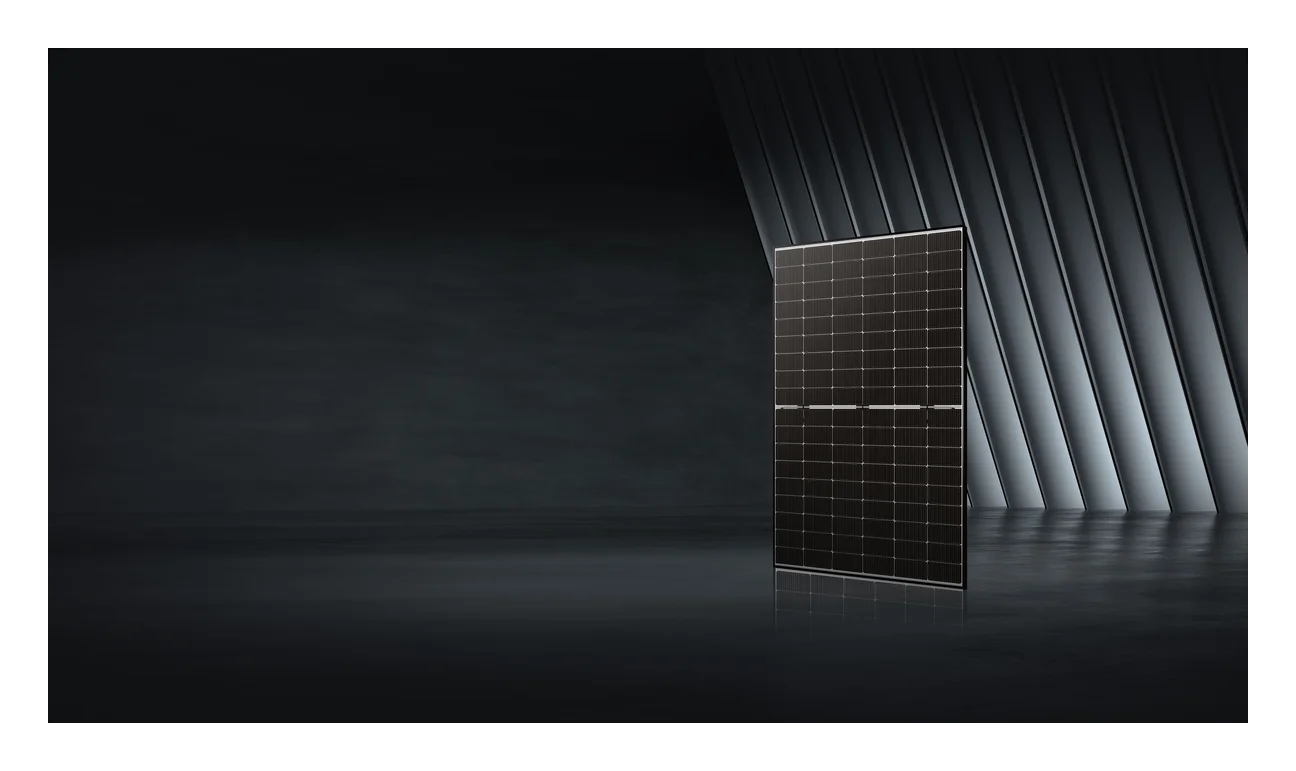
Middle of its segment, heavy for its output
The Jolywood NIWA Pro series redefines efficiency standards thanks to the use of innovative second-generation N-type TOPCon cells. This solution directly eliminates light-induced degradation (LID), which translates to significantly higher long-term power stability compared to traditional P-type modules. Thanks to the unique J-TOPCon 2.0 cell structure, these modules are characterized by excellent efficiency in low-light conditions, which is crucial in the Polish climate, especially during autumn-winter periods. Investors appreciate this series for its very low temperature coefficient, allowing high energy yields to be maintained even during hot days when standard panels lose efficiency. The NIWA Pro series was designed for demanding rooftop installations and professional photovoltaic farms, where maximizing power density per square meter is essential. The use of modern SMBB technology further increases light absorption and the reliability of internal connections. It is an ideal choice for those looking for exceptional durability and a faster return on investment by maximizing energy self-consumption. By choosing these modules, you gain the certainty of stable system operation in all weather conditions, which places the NIWA Pro series at the forefront of technological solutions available on the Polish market.
Ranking
Signals from the data
Residential, commercial and hot-climate.
Weight-limited structures.
Bottom 10% of the TOPCon 400-450 W segment, against a median of 51.4. Ranked 11,325th in the whole database.
Second-generation N-type cells fully eliminate light-induced degradation (LID) and light & elevated temperature induced degradation (LeTID), which can cost P-type PERC modules 2-3% of rated power in the first years of operation. Jolywood, a TOPCon pioneer since the NIWA series launch in 2020, has been recognized by PVEL in N-type TOPCon reliability testing.
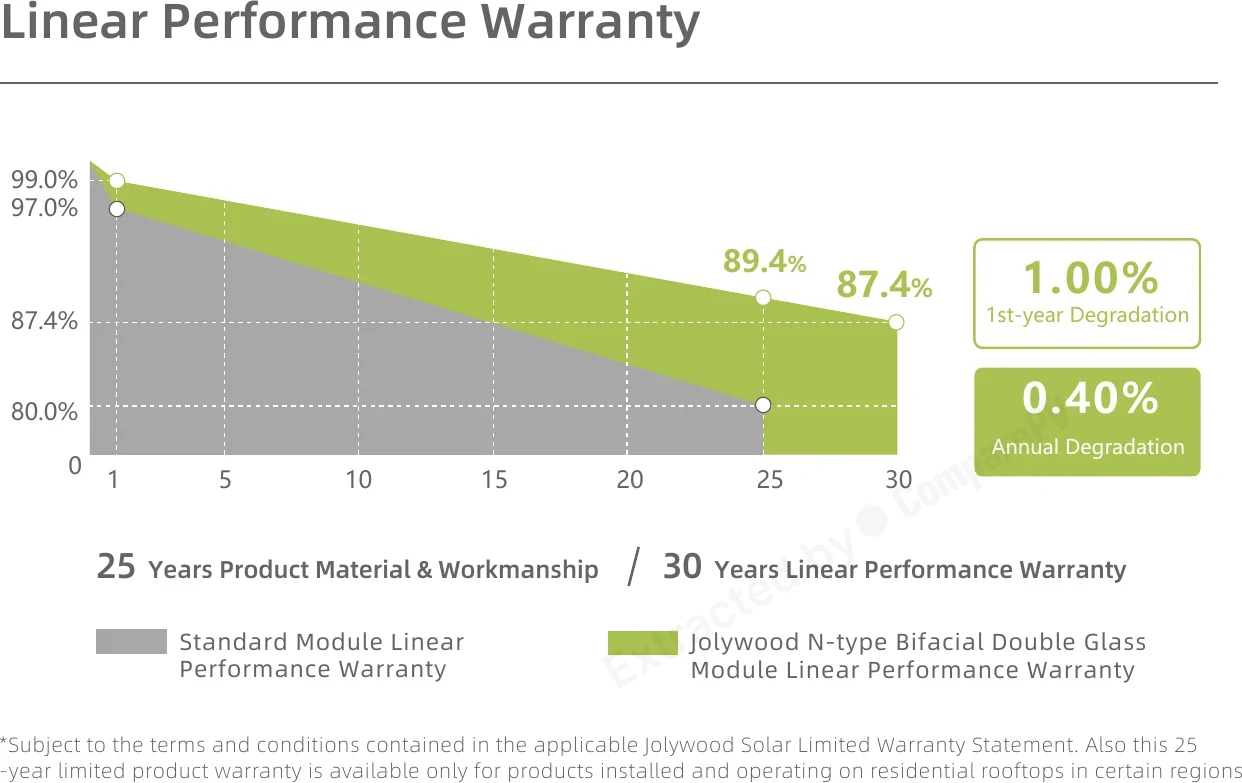
The manufacturer guarantees ≥87.4% Pmax after 30 years of operation (linear degradation curve), backed by a 25-year product warranty. Tier-1 peers in the same 415-440 Wp class — Seraphim Nebula and KDM Kingdom Solar — offer a 25-year power warranty, making Jolywood NIWA Pro's coverage 5 years longer.
Glass-glass bifacial construction enables an additional energy yield of 10-30% over monofacial modules, depending on ground albedo (light gravel, white TPO membrane, snow cover). This directly reduces the LCOE of ground-mount and high-albedo rooftop installations.
Jolywood appears on the current BNEF Tier-1 bankable manufacturer list (methodology updated March 18, 2026), enabling debt-financed project acceptance by leading financial institutions without additional collateral. The manufacturer has been active since 2008 with a declared production capacity of ~10 GW/year.
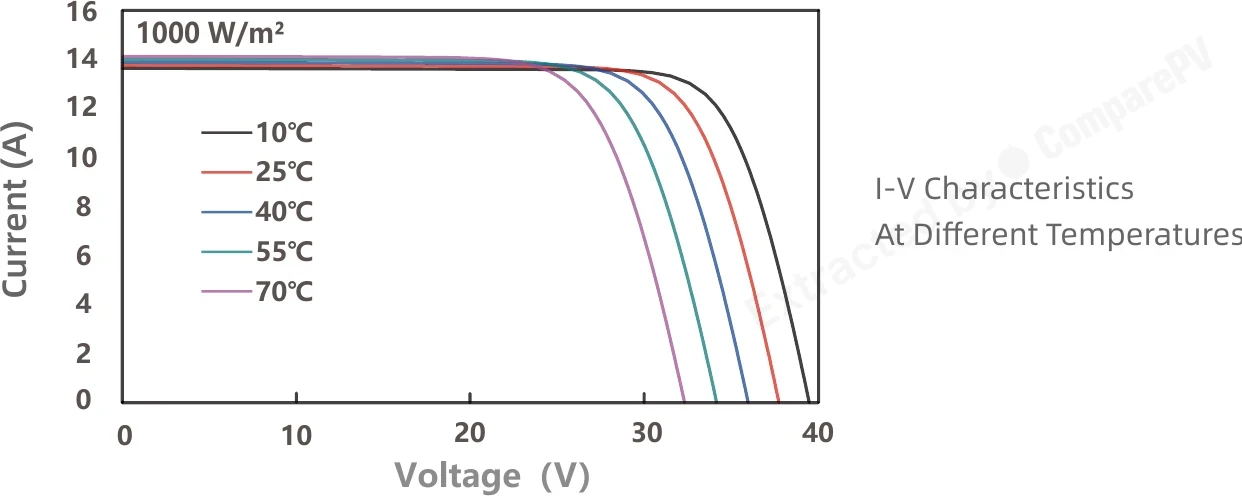
The temperature coefficient of Pmax is -0.30%/°C per the official datasheet (JW-HD108N). At a cell temperature of 65°C (Δ40°C above STC), power loss reaches approximately 12%, compared to 14-16% for typical P-type PERC modules — a tangible advantage during hot summer days above 30°C.
The top-variant (440 Wp) maximum efficiency is 22.53%, while Luxor Solar ECO LINE N-TYPE TOPCon Non-Reflect achieves 22.86% at the same power rating. The 0.33 percentage-point gap translates to approximately 6.5 W less per square meter — a meaningful difference for installations with critically constrained roof area.
- Efficiency of 21.8% matches the TOPCon 400-450W median
- At 217.6 W/m² power density, roof space requirements are typical for TOPCon 400-450W panels
- At -0.30%/°C, hot weather performance is typical for TOPCon 400-450W panels
- Weight of 24.5 kg is 2.5 kg above TOPCon 400-450W median (22.0 kg) - verify structural support
- Bifacial design (80% factor) captures reflected light - adds 4-12% yield on ground-mount or white roof
Specifications
Datasheet charts
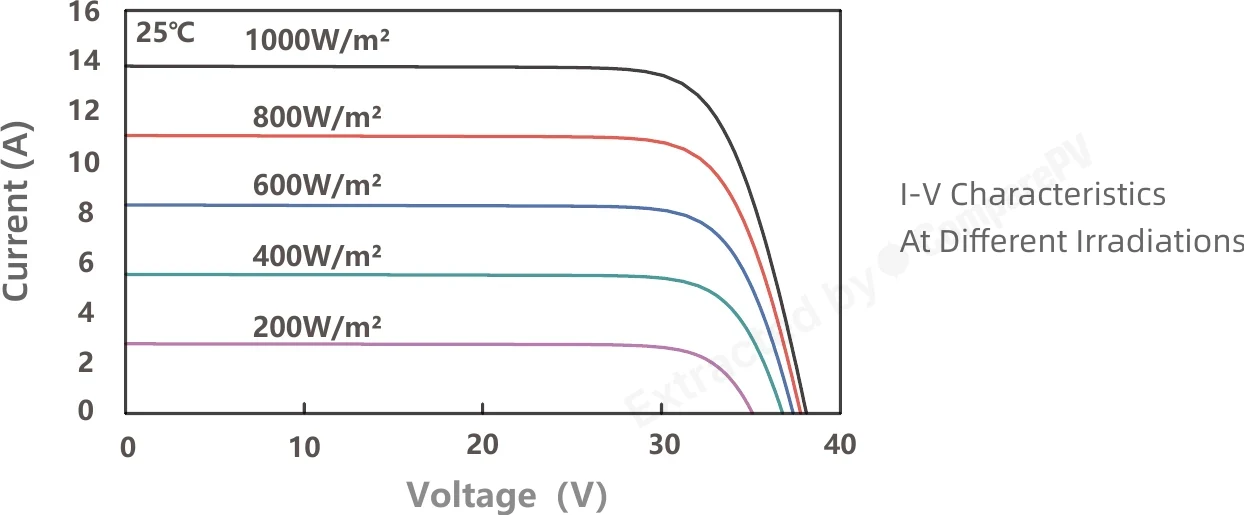
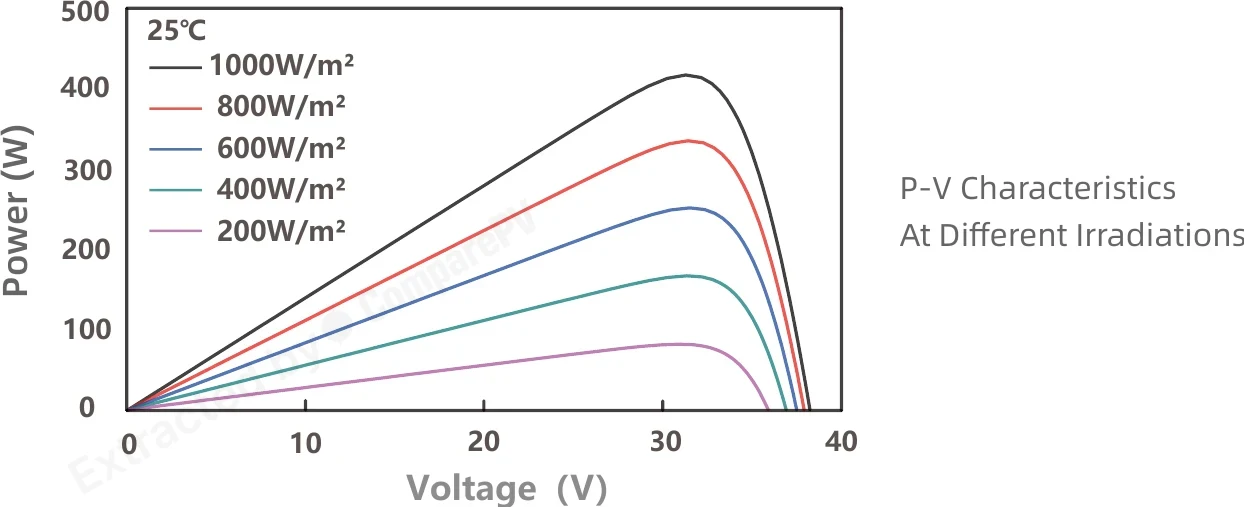
Measured curves published by Jolywood in this model's datasheet. A chart carrying a wattage was measured on that variant alone - only the ones that describe 425 Wp appear here. The rest cover the whole series.
Simulations
Degradation from this panel's own datasheet figures. No inverter, soiling or shading losses.
Model: bifaciality × albedo × 0.6 view factor. A first-order estimate, not a yield simulation.








Found 1783 panels of the same or similar size to this one, within ±10 mm. See them here Found 1914 panels of the same or similar size to this one, within ±25 mm. See them here Found 3392 panels of the same or similar size to this one, within ±50 mm. See them here Found 3970 panels of the same or similar size to this one, within ±100 mm. See them here