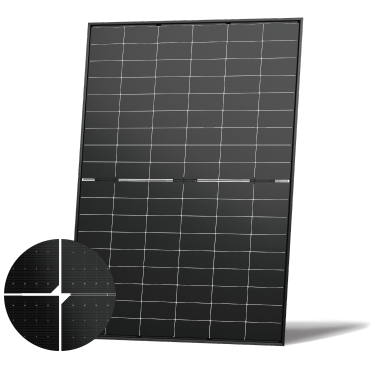
Jinko Solar JKM425-445N-54HL4R-BDB (STC column: 425W)
Middle of its segment, heavy for its output
The Jinko Solar Tiger Neo 54HL4R-BDB series are bifacial glass-glass modules engineered for maximum yield under real-world conditions-including when operating under partial shade, with diffuse light, or on less-than-ideal rooftops. The application of N-type TOPCon technology enhances operational stability over time and reduces sensitivity to common degradation phenomena, ensuring sustained high energy production levels for years.
The dual-glass construction improves mechanical durability and weather resistance, making it an ideal choice for demanding installation environments. This also represents an excellent option for systems where rear-side module gain is critical-ideal for installations on light-colored roofs, ground-mounted structures, carports, or farms with optimal light reflection.
The BDB variant additionally features a sleek black aesthetic, complementing modern architectural designs. Its high resistance to PID and minimized hot-spot losses further enhance installation safety and operational predictability.
Ranking
Signals from the data
Residential, commercial, shaded-installations and hot-climate.
Weight-limited structures, tight roof space and roofs where every square metre has to count.
Bottom 5% of the TOPCon 400-450 W segment, against a median of 51.5. Ranked 12,355th in the whole database.
Bottom 10% of the TOPCon 400-450 W segment, against a median of 22.00%.
Bottom 13% of the TOPCon 400-450 W segment, against a median of 220.2.
N-type TOPCon cells exhibit a linear annual degradation rate of 0.4%/yr and are free from LID (Light-Induced Degradation) common in legacy P-type PERC. The temperature coefficient of -0.29%/°C outperforms typical PERC values (-0.34 to -0.37%/°C), delivering measurably higher energy yield on hot summer days.
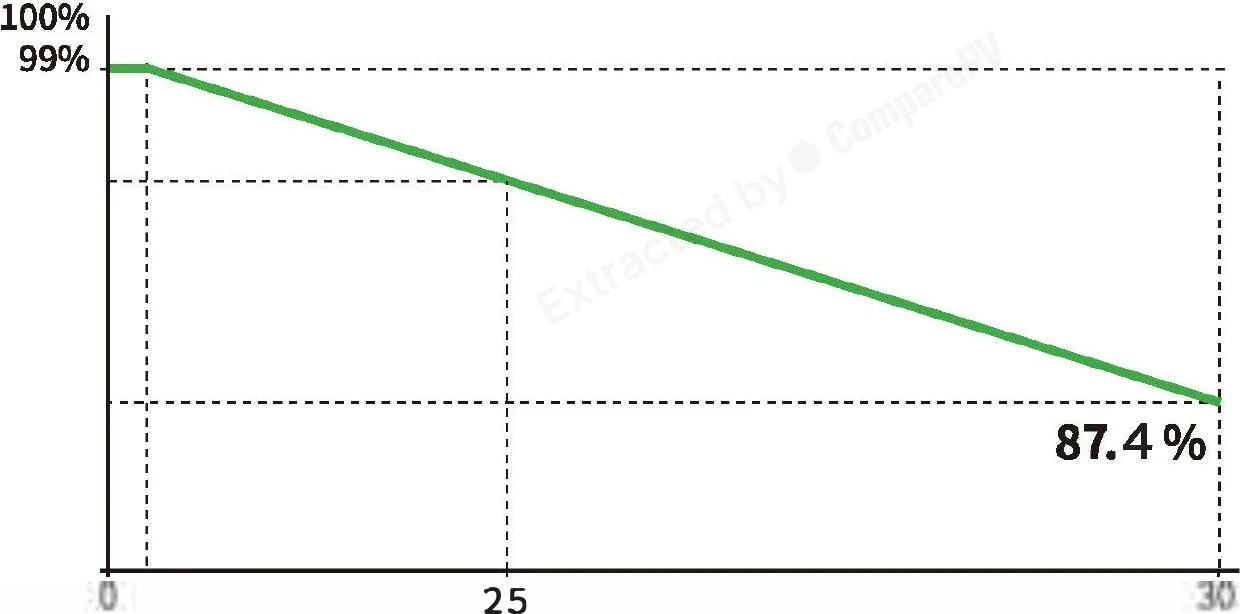
Jinko guarantees a minimum of 87.4% rated power after 30 years, with 1% first-year degradation and 0.4%/yr thereafter. Peer comparable SunEvo Solar SE6-46SC covers only a standard 25-year power warranty - Jinko Tiger Neo's extended horizon provides a real LCOE advantage for long-term project finance models.
The BDB glass-glass series delivers a bifacial factor up to 85%, with rear-side energy gains of 5-15% in ground-mount, carport, and white-roof installations. The dual 2.0 mm tempered glass simultaneously provides mechanical resistance: 6000 Pa snow load (front) and 4000 Pa wind load (rear), meeting structural requirements typical of central European climates.
In the Bloomberg NEF 2024 PV Module Bankability Survey, Jinko Solar was the only manufacturer to achieve 100% bankability, with BNEF Tier-1 status confirmed in Q3 2025 and Q1 2026. For institutional investors or retail borrowers, this minimizes project financing risk and simplifies non-recourse loan qualification.
The BDB variant combines a black frame and dark cells with full bifacial N-type TOPCon specifications. Unlike conventional all-black panels that rely on P-type PERC and sacrifice efficiency for aesthetics, this series achieves 21.27-22.27% module efficiency without downgrading cell technology - premium appearance and high performance are delivered simultaneously.
The glass-glass dual-pane construction raises module weight to 24.5-25.4 kg versus ~20-21 kg for equivalent backsheet modules (e.g., JKM440N-54HL4R-B in the same power class). Rooftop retrofits may require a structural load assessment and heavier-duty racking hardware, adding to balance-of-system (BoS) costs.
Effective rear-side energy gain depends on surface albedo. On common dark ceramic or asphalt tile roofs, albedo is typically 0.10-0.15, limiting the real bifacial bonus to 1-3% rather than the 10-15% achievable in ground-mount installations with high-reflectance surfaces. For standard residential rooftop systems on dark-colored tiles, a monofacial module may offer a more cost-optimal BoS configuration.
- Module efficiency of 21.3% is 0.7pp below average for TOPCon 400-450W panels (median: 22.0%)
- At 212.7 W/m², this panel generates 7.5 W/m² less per unit area than TOPCon 400-450W median (220.2 W/m²)
- At -0.29%/°C, hot weather performance is typical for TOPCon 400-450W panels
- At 25.4 kg (3.4 kg above TOPCon 400-450W median of 22.0 kg), requires checking roof load capacity
- 80% bifaciality enables rear-side power generation, boosting yield by 4-12% on reflective surfaces
Specifications
Datasheet charts
Measured curves published by Jinko Solar in this model's datasheet. A chart carrying a wattage was measured on that variant alone - only the ones that describe 425 Wp appear here. The rest cover the whole series.
Simulations
Degradation from this panel's own datasheet figures. No inverter, soiling or shading losses.
Model: bifaciality × albedo × 0.6 view factor. A first-order estimate, not a yield simulation.









Found 1402 panels of the same or similar size to this one, within ±10 mm. See them here Found 1432 panels of the same or similar size to this one, within ±25 mm. See them here Found 3651 panels of the same or similar size to this one, within ±50 mm. See them here Found 3999 panels of the same or similar size to this one, within ±100 mm. See them here
About the Tiger Neo 54HL4R-BDB series
These answers cover the whole series. Where a figure differs, the specification above is this module's own.