
Middle of its segment, needs the roof space
Jinko Solar's Tiger Pro 72HC series is designed for locations where every watt per square meter counts - commercial rooftops, utility-scale farms, and large residential installations. The key difference lies in combining half-cut cell technology with Multi Busbar (MBB), which genuinely improves module performance under partial shading and minimizes internal resistance losses. In practice, this translates to more stable energy production throughout the day, especially under challenging installation conditions (chimneys, hips, infrastructure elements).
This series also employs Tiling Ribbon (TR), a cell-bonding method that reduces gaps between cells and supports higher module efficiency without artificial "parameter boosting." For investors, reduced hot-spot risk is also crucial, translating to safer long-term operation.
The Tiger Pro 72HC stands out from the competition by combining high power density with a refined mounting structure for large-area installations - where low energy costs and consistent installation quality are priorities.
Ranking
Signals from the data
Commercial, utility-scale and shaded-installations.
Roofs where every square metre has to count, tight roof space and owners who want a long output guarantee.
Bottom 8% of the 430-630 W band, against a median of 221.8. Ranked 11,268th in the whole database.
Bottom 8% of the 430-630 W band, against a median of 22.19%. Ranked 11,289th in the whole database.
Bottom 11% of the 430-630 W band, against a median of 30 yrs.
144 half-cut cells combined with Multi Busbar (9 BB) design reduce internal resistance losses and mitigate the impact of partial shading on total module output. This is a critical advantage in commercial rooftop installations with obstructions such as chimneys, parapets, and infrastructure elements where conventional full-cell modules lose disproportionate amounts of energy.
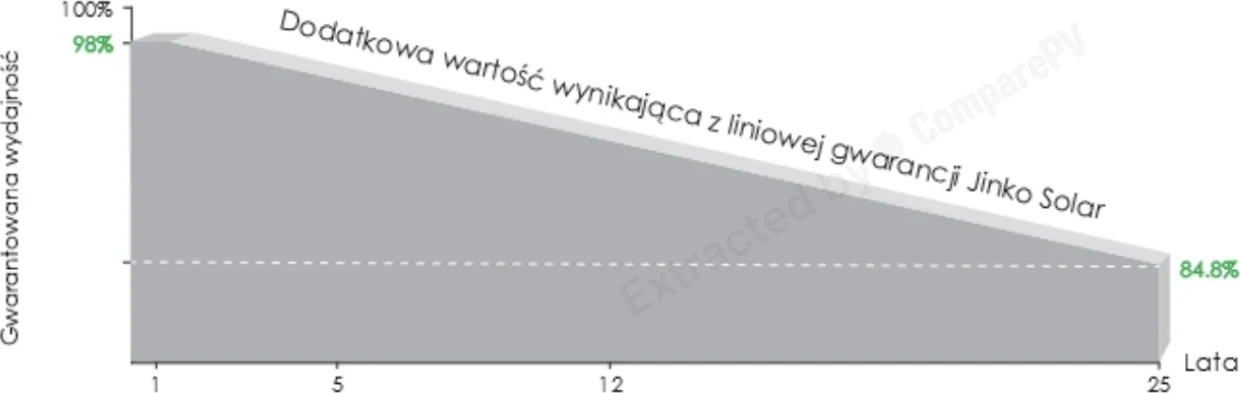
The manufacturer guarantees ≤2% first-year degradation and ≤0.55%/year thereafter, resulting in a minimum 84.8% of rated power output after 25 years - a figure confirmed in the official series datasheets (JKM530-570M-72HL4). This figure is on par with top-tier PERC modules available between 2020 and 2023.
Top variants in the series reach 22.07% module efficiency, matching the segment's PERC efficiency leader among peer comparables (Silfab Commercial NTC: 22.1%) and clearly outperforming typical 540+ Wp PERC modules of the same era. For large-area installations this translates to reduced rooftop footprint and lower BoS costs.
JinkoSolar has maintained Tier-1 BNEF status continuously for many years, reconfirmed in the Q1 2026 ranking (JinkoSolar and LONGi tied at #1 with 120,000 MW/year of installed capacity). For investors and lenders financing utility-scale PV farms, this translates directly to easier access to project finance and lower collateral requirements.
A broad portfolio of 20 variants spanning 530-570 Wp gives system designers the flexibility to match module power to specific string configurations and MPPT inverter inputs without electrical design compromises. Multi-bin availability simplifies layout optimization in large prosumer and utility-scale PV installations.
Tiger Pro 72HC is no longer manufactured - production ended around 2023 and the line was superseded by the Tiger Neo with N-type TOPCon technology. This means limited new-module availability on the secondary market, risk of production lot mismatches during system expansion, and potential challenges in enforcing the 12-year product warranty and 25-year power warranty over the long term.
While PERC was the market standard during the series' production window (2020-2023), direct peer comparables (Horay Solar HS 191R-132 TC-D Basin: 23% efficiency, 570 Wp) now leverage TOPCon/HJT, delivering higher conversion efficiency, lower LID degradation, and a better power temperature coefficient. Tiger Pro 72HC is therefore technologically outpaced by the newer generation of modules in the same power class.
The series is strictly monofacial (is_bifacial: false), while at least two direct peer comparables (Horay Solar HS 191R-132 TC-D Basin and HS 191R-132 TC Basin, both 570 Wp, 23%) are bifacial, enabling an additional 5-25% energy yield gain on trackers and high-albedo ground surfaces. In ground-mount installations, this difference has a measurable impact on LCOE.
- Efficiency of 20.6% is 1.3pp below the database median (21.8%)
- 205.5 W/m² power density is 12.6 W/m² below database median (218.1 W/m²) - requires larger installation area
- -0.35%/°C temperature coefficient - 0.05pp worse than database median (-0.30%/°C), expect higher hot weather losses
- Weight of 28.9 kg is 2.4 kg above database median (26.5 kg) - verify structural support
- Ranked #11289 out of 14129 panels for efficiency in the database
Specifications
Datasheet charts
Measured curves published by Jinko Solar in this model's datasheet. A chart carrying a wattage was measured on that variant alone - only the ones that describe 530 Wp appear here. The rest cover the whole series.
Simulations
Degradation from this panel's own datasheet figures. No inverter, soiling or shading losses.




Found 2338 panels of the same or similar size to this one, within ±10 mm. See them here Found 2369 panels of the same or similar size to this one, within ±25 mm. See them here Found 2383 panels of the same or similar size to this one, within ±50 mm. See them here Found 2541 panels of the same or similar size to this one, within ±100 mm. See them here
About the Tiger Pro 72HC series
These answers cover the whole series. Where a figure differs, the specification above is this module's own.