Middle of its segment, needs the roof space
The Jinko Solar Tiger Pro 72HC 530-550W (Monofacial) series is designed for high energy production on limited space - particularly in locations where stable performance under varying conditions is crucial. The modules utilize half-cell (HC) technology, which improves tolerance to partial shading and helps maintain output when shadows from chimneys, antennas, or trees intermittently "cut through" the string. Thanks to Multi Busbar (MBB) technology, current is collected more efficiently from the cells, which translates to better performance under lower sunlight and increased connection reliability over time.
In practice, this series addresses common issues with rooftop and ground-mounted installations: it reduces the risk of losses due to localized overheating and also supports predictable output in hot weather thanks to favorable temperature characteristics. It is a good choice for homes, businesses, and PV farms that want to invest in environmentally resilient (e.g., high-humidity, dusty, or industrial areas) without paying a premium for dual-sided constructions. Compared to many competing modules in this class, the Tiger Pro 72HC stands out with its refined connection architecture and focus on long-term parameter stability.
Ranking
Signals from the data
Residential, commercial and shaded-installations.
Roofs where every square metre has to count, tight roof space and owners who want a long output guarantee.
Bottom 8% of the 430-630 W band, against a median of 221.8. Ranked 11,268th in the whole database.
Bottom 8% of the 430-630 W band, against a median of 22.19%. Ranked 11,289th in the whole database.
Bottom 11% of the 430-630 W band, against a median of 30 yrs.
JinkoSolar appears on the BNEF Tier-1 module manufacturer list for Q2 2026 and shipped 86.8 GW of modules in 2025 (7th consecutive year ranked #1 globally). The manufacturer's bankability facilitates non-recourse project financing and reduces the risk of losing technical support over the 25-year system lifetime.
The half-cut cell design (144 cells vs. 72) isolates the shading impact to half the module, while Multi Busbar (MBB) distributes current across multiple collection paths, reducing hot spot risk. The practical result is lower losses under partial shading from chimneys, antennas, or trees, and improved performance under diffuse irradiance.
Peak efficiency of 21.33% matches or exceeds direct peer comparables: Goldi Solar GS10-B144-TF (21.3%), IBC Solar 182M Half Cell (21.28%), and S-Energy SL65-72BGJ (21.3%). This translates to higher energy yield from the same roof or ground footprint.
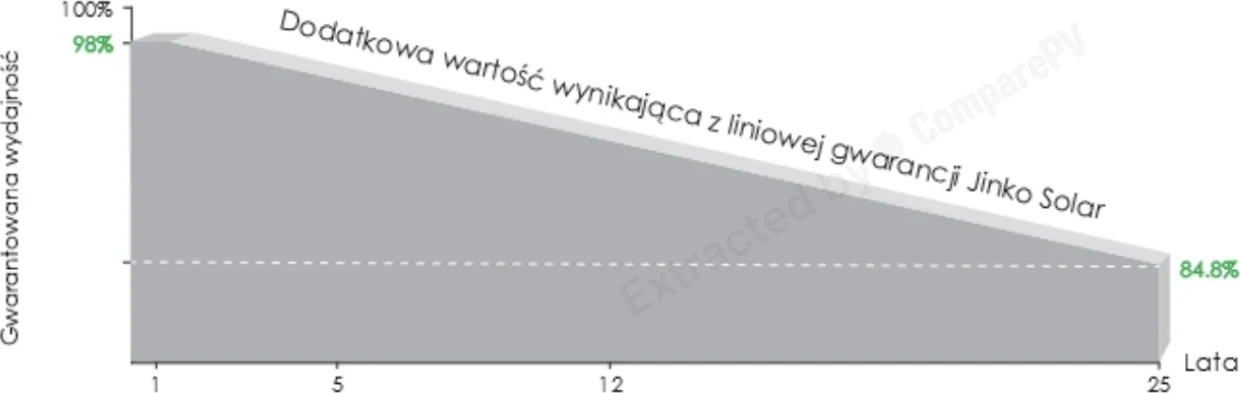
The temperature coefficient of Pmax is -0.35%/°C - better than the typical -0.37 to -0.40%/°C range for P-type PERC modules. On hot summer days (e.g., 65°C module surface temperature), this translates to a few percent higher yield versus weaker-performing competitors. This is complemented by a 25-year linear power warranty with degradation ≤0.55%/year (>84.8% after 25 years).
The Tiger Pro 72HC series (launched 2020) was discontinued in 2024. Availability of new units is increasingly limited, making it difficult to expand existing installations with identical modules and potentially driving up prices on remaining stock. The risk of being unable to source a matching replacement module grows each year.
This module uses P-type PERC cells, which exhibit higher light-induced degradation (LID) than newer N-type TOPCon cells (e.g., JinkoSolar's own Tiger Neo series, released 2022). Over a 25-year system lifetime, the cumulative energy yield difference is estimated at 2-4 percentage points in favor of N-type, at a comparable purchase price point.
The monofacial design captures no energy from ground-reflected irradiance. Competing bifacial modules in the same power class (530-550 W) can achieve an additional 5-15% energy production in ground-mount installations with light-colored gravel surfaces or white roofing membranes, without a significant difference in BoS cost.
- At 20.6% efficiency, this panel is 1.3pp below the database median of 21.8%
- 205.5 W/m² power density is 12.6 W/m² below database median (218.1 W/m²) - requires larger installation area
- At -0.35%/°C, loses 0.05pp more power per degree than database median (-0.30%/°C)
- At 28.9 kg (2.4 kg above database median of 26.5 kg), requires checking roof load capacity
- In the top 80% for efficiency among all N-type panels
Specifications
Datasheet charts
Measured curves published by Jinko Solar in this model's datasheet. A chart carrying a wattage was measured on that variant alone - only the ones that describe 530 Wp appear here. The rest cover the whole series.
Simulations
Degradation from this panel's own datasheet figures. No inverter, soiling or shading losses.




Found 2338 panels of the same or similar size to this one, within ±10 mm. See them here Found 2369 panels of the same or similar size to this one, within ±25 mm. See them here Found 2383 panels of the same or similar size to this one, within ±50 mm. See them here Found 2541 panels of the same or similar size to this one, within ±100 mm. See them here
About the Tiger Pro 72HC 530-550W (Monofacial) series
These answers cover the whole series. Where a figure differs, the specification above is this module's own.