Jinko Solar JS410M108

410 Wp PERC
ComparePV verdict

Strong in heat, no clear weak spot

Rank 12,641 of 14,129
Compare panels Datasheet PDF
Power (Wp)
410
Typical for its class
Efficiency (%)
20.97
Typical · median 20.60%
Density (Wp/m²)
210.0
Strong · top 24%
Temp (%/°C)
-0.300
Strong · top 3%
Weight (kg)
19.0
Strong · 3.0 kg below median
Warranty (yrs)
25
Typical · median 25 yrs

The Jinko Solar JS-PERC series is designed to genuinely increase energy yield under typical operating conditions - even when the weather is variable and sunlight is lower. The modules utilize mono PERC cells, which allow them to better "collect" light and operate more stably under weaker illumination. In practice, this means higher energy production in the morning, evening, and on cloudy days, as well as improved overall system profitability without the need to add more panels.

The JS-PERC series stands out for its focus on quality: multiple electroluminescence (EL) tests help detect microcracks and reduce the risk of power loss over time. Additionally, the module design supports lower losses in partially shaded conditions, which is important on roofs with chimneys, skylights, or trees nearby.

This series is particularly suitable for individuals and businesses that want predictable yields and durability - whether in residential or commercial installations, where energy cost and reliability are key factors.

Ranking

954 panels in the segment PERC 400-450 W
Metric This panel Median Position in segment Overall rank
Module efficiency 20.97% 20.60% Typical 10,044
Power density 210.0 206.2 Strong · top 24% 9,843
Temperature coefficient -0.300 -0.350 Strong · top 3% 6,152
Weight per kWp 46.3 53.0 Strong · top 4% 1,120
Performance warranty 25 yrs 25 yrs Typical 9,912
Colour key Strong - top 25% Typical - middle 50% Weak - bottom 25%

Signals from the data

7 positive · 2 caution
Best for

Residential and commercial.

Strengths
-0.300 %/°C temperature coefficient

Top 3% of the PERC 400-450 W segment, against a median of -0.350. Ranked 6,152nd in the whole database.

46.3 kg per kWp

Top 4% of the PERC 400-450 W segment, against a median of 53.0. Ranked 1,120th in the whole database.

210.0 watts per square metre

Top 24% of the PERC 400-450 W segment, against a median of 206.2.

What owners get
BNEF Tier-1 & PVEL Top Performer

JinkoSolar has maintained BNEF Tier-1 bankability status for over 8 consecutive quarters and earned PVEL Top Performer recognition across all 7 reliability categories in the 2025 PV Module Reliability Scorecard - for the 11th year in a row. This is one of the strongest combined signals of financial and technical credibility in the market.

Up to 21.7% efficiency - above all peer comparables

Peak module efficiency of 21.7% exceeds every listed peer: Shinson S-Max (21.48%), Phono Solar Bifacial Twinplus (21.48%), and Boviet VEGA (21.3%). Within the mono PERC technology class, this positions the JS-PERC Series at the top of the segment.

Broad power range: 330-555 Wp across 9 variants

Nine variants span both residential prosumer systems and commercial or utility-scale arrays. A unified brand and PERC technology stack across the full range simplifies BoS standardization and service procurement.

Multiple in-process EL testing

Multiple electroluminescence (EL) inspections during manufacturing detect microcracks before shipment. This is above-standard QC practice in mass-production PERC, reducing the risk of early in-field power degradation.

Trade-offs
P-type PERC: higher LID degradation

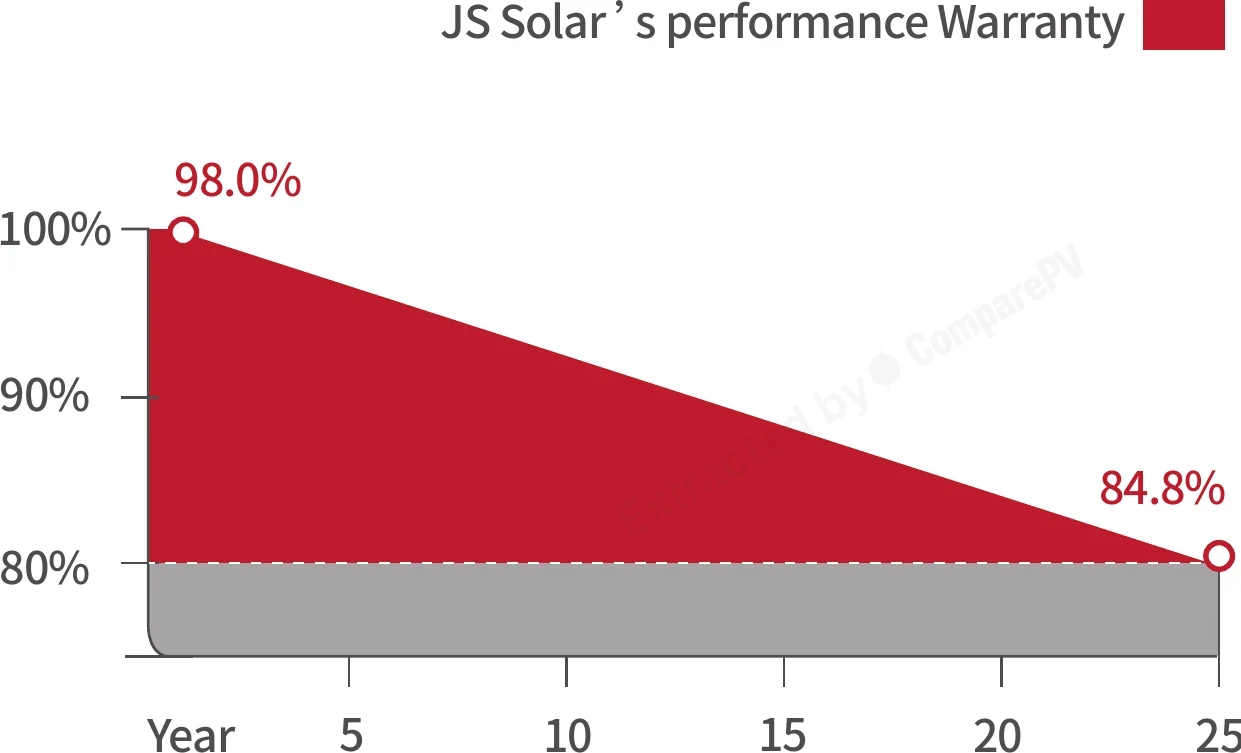
P-type PERC cells exhibit LID of 1.5-3% in year one and annual degradation of ~0.6-0.8% vs ~0.4-0.5% for N-type TOPCon (PVEL 2025 dataset). Over 25 years, PERC modules retain ~82-84% of nameplate power, while N-type TOPCon retains 85-87%. The warranted floor of 83.1% at year 25 leaves a very narrow margin.

Monofacial only - no bifacial option

The JS-PERC Series is strictly monofacial (is_bifacial: false). The direct competitor Phono Solar Bifacial Twinplus (up to 555 Wp, 21.48% efficiency) adds 5-15% energy yield from reflected irradiance. On installations with high-albedo surfaces (gravel ballast, snow, white TPO membrane), this represents a real missed yield opportunity.

Notes from the database
  • At 21.0% efficiency, this panel is on par with typical PERC 400-450W modules
  • 210.0 W/m² power density - 3.8 W/m² more than PERC 400-450W median (206.2 W/m²), more power per roof area
  • Temperature coefficient of -0.30%/°C vs median -0.35%/°C means ~2% less power loss at 65°C
  • At 19.0 kg, this panel is 3.0 kg lighter than PERC 400-450W median (22.0 kg) - easier handling during installation
  • Ranked #10044 out of 14129 panels for efficiency in the database

Specifications

Open datasheet PDF
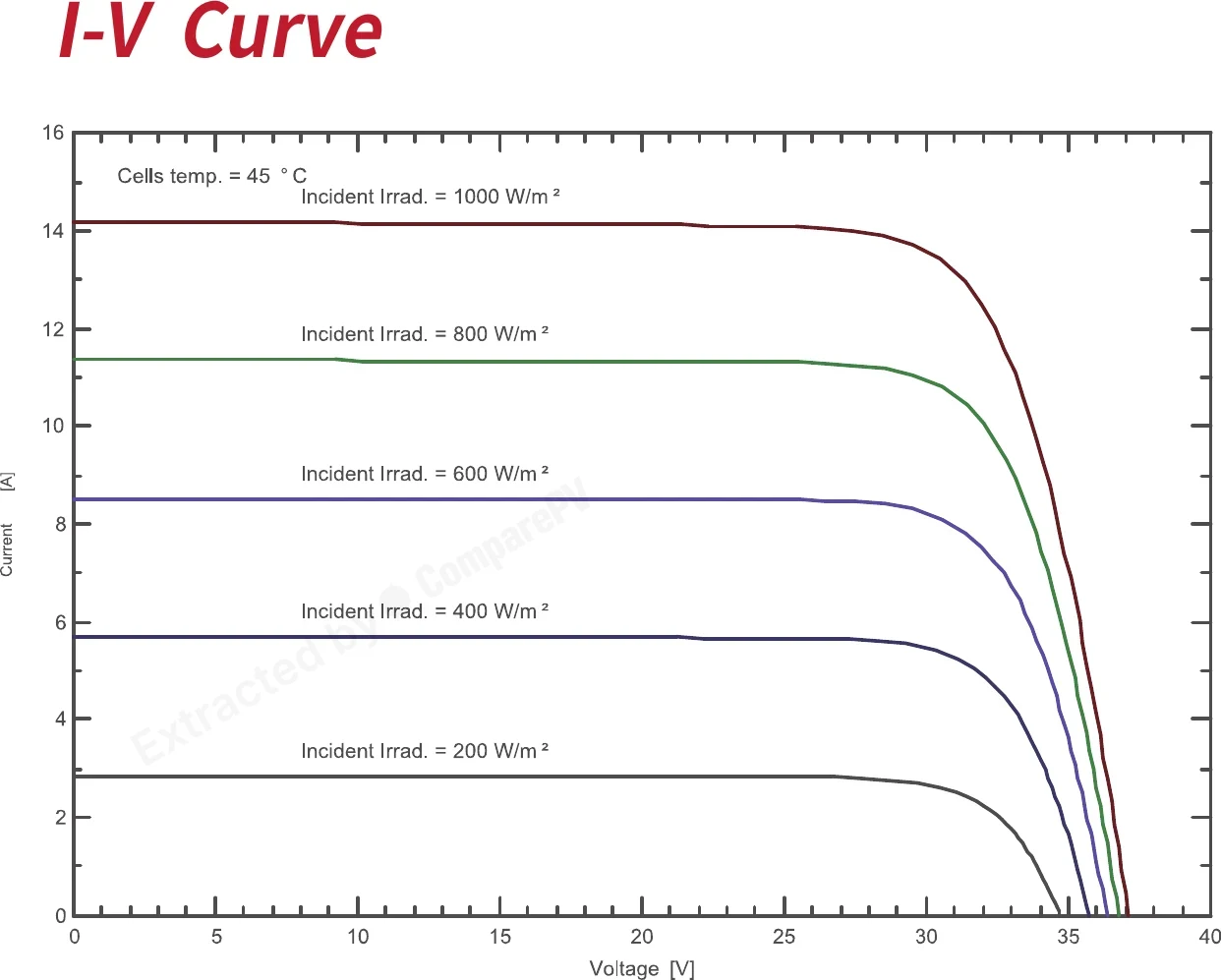
Nominal power (Pmax) 410 Wp Nameplate at 1000 W/m², 25 °C
Module efficiency 20.97 % Typical Segment median 20.60%
Vmpp · Impp 31.08 V · 13.19 A Operating point at max power
Voc · Isc 37.44 V · 13.75 A Sizes the string length
Max system voltage 1500 V Longer strings than 1000 V modules
Dimensions 1722×1134×30 mm · 1.95 m² of roof
Weight 19.0 kg Strong Strong · 3.0 kg below median
Cells 108 · PERC Monocrystalline
Coefficient Pmax -0.300 %/°C Strong top 3% of its segment
Coefficient Voc · Isc -0.250 · 0.046 %/°C
NOCT 45 °C At 800 W/m², 20 °C ambient
Performance warranty 25 years Typical median 25 yrs · median 25 yrs
End-of-warranty output 84.8 % Equals 336 W guaranteed
Degradation 2.00 % First year

Datasheet charts

Open datasheet PDF

Measured curves published by Jinko Solar in this model's datasheet. A chart carrying a wattage was measured on that variant alone - only the ones that describe 410 Wp appear here. The rest cover the whole series.
Simulations

Live - change any input
Lifetime output & value
30 years at 1200 kWh/kWp/year and €0.50 per kWh
Power in year 30
-
Lifetime energy
-
Energy value
-

Degradation from this panel's own datasheet figures. No inverter, soiling or shading losses.

Heat losses
-0.300 %/°C against a segment median of -0.350
-
Filter these
Size
Panel Power Eff. Temp. Weight Difference
Jinko Solar JS410M108 410 W 20.97% -0.300 19.0 kg You are here
AIKO-A460-MAH54Mb 460 W 23.60% -0.290 20.5 kg +50 W, +2.6 pp, +5 yr warranty
JST-EDMH-(445-465)W-TD (460W class) 460 W 23.56% -0.300 20.5 kg +50 W, +2.6 pp, +5 yr warranty
LX-460M/182R-96+ GG 460 W 23.55% -0.260 23.5 kg +50 W, +2.6 pp, +5 yr warranty
PS-MNB108(HCBF)-460W 460 W 23.53% -0.290 20.5 kg +50 W, +2.6 pp, +5 yr warranty
JAT54S40-460/LR 460 W 23.50% -0.260 19.3 kg +50 W, +2.5 pp, +5 yr warranty
LX-460M/182R188-108+ GG 460 W 23.35% -0.290 24.5 kg +50 W, heavier, +2.4 pp
AIKO-455-MAH54Db 455 W 23.30% -0.260 24.0 kg Heavier, +2.3 pp, +5 yr warranty
LR5-54HTH-455M 455 W 23.30% -0.290 20.8 kg +45 W, heavier, +2.3 pp
JS182MHC108-390 390 W 20.00% -0.340 21.5 kg Hotter, heavier, -1.0 pp
JKM395M-54HL4-V 395 W 20.23% -0.350 22.0 kg Hotter, heavier, -0.7 pp
JS182MHC108-395 395 W 20.20% -0.340 21.5 kg Hotter, heavier, -0.8 pp
JKM400M-54HL4-V 400 W 20.48% -0.350 22.0 kg Hotter, heavier, -0.5 pp
JS182MHC108-400 400 W 20.50% -0.340 21.5 kg Hotter, heavier, -0.5 pp
JKM405M-54HL4-V 405 W 20.74% -0.350 22.0 kg Hotter, heavier, -0.2 pp
LR7-54HJD-510M 510 W 25.00% -0.240 23.5 kg +100 W, cooler, +4.0 pp
AIKO-A495-MCE54Mw 495 W 24.80% -0.260 21.0 kg +85 W, +3.8 pp, +5 yr warranty

Found 1797 panels of the same or similar size to this one, within ±10 mm. See them here Found 1928 panels of the same or similar size to this one, within ±25 mm. See them here Found 3413 panels of the same or similar size to this one, within ±50 mm. See them here Found 4007 panels of the same or similar size to this one, within ±100 mm. See them here

About the JS-PERC SERIES series

6 answered

These answers cover the whole series. Where a figure differs, the specification above is this module's own.

What is the power output warranty for Jinko Solar JS-PERC SERIES panels?
The Jinko Solar JS-PERC SERIES comes with a 25-year linear power output warranty, with annual degradation capped at 0.55%. A separate 12-year product warranty covers material and workmanship defects. These are standard Tier 1 warranty terms from Jinko Solar, confirming the manufacturer's long-term after-sales reliability.
Do Jinko Solar JS-PERC SERIES panels perform well on cloudy days and in low-light conditions?
Yes, the mono PERC cells used in the JS-PERC SERIES respond better to diffuse and low-intensity light than standard polycrystalline cells. In practice this means higher energy output in the morning, in the evening, and on overcast days. The annual energy yield from a JS-PERC SERIES system is measurably higher even in regions with variable irradiance, with no need to add extra panels.
What is PERC technology and why should I choose Jinko Solar JS-PERC SERIES?
PERC, or Passivated Emitter and Rear Cell, is a cell technology where a passivation layer on the rear surface reflects light back into the cell for a second absorption pass. The mono PERC cells in the JS-PERC SERIES achieve higher efficiency than standard monocrystalline modules and deliver better output at reduced irradiance, translating into real financial gains without increasing the installation footprint.
Is Jinko Solar JS-PERC SERIES suitable for a roof partially shaded by a chimney or trees?
The JS-PERC SERIES features a design that reduces partial shading losses, which is especially relevant on roofs with chimneys, dormers, or nearby trees. Multiple EL (electroluminescence) tests during production minimize the risk of microcracks that can amplify shading effects. For severe or persistent shading, adding power optimizers or microinverters is still advisable.
What is the maximum power of a JS-PERC SERIES panel and how many modules do I need for a home installation?
The maximum rated power of a Jinko Solar JS-PERC SERIES module is 555 Wp. For a typical residential system in the 6-10 kWp range, you would need between approximately 11 and 19 panels. The high per-panel wattage means fewer modules for the same system size, simplifying installation and reducing racking and BoS costs.
Are Jinko Solar JS-PERC SERIES panels bifacial?
No, Jinko Solar JS-PERC SERIES modules are monofacial and capture light only from the front side. They do not generate additional power from ground-reflected irradiance. This is perfectly adequate for typical rooftop installations where rear-side gain would be negligible. Bifacial configurations are generally advantageous only in ground-mount or elevated systems with highly reflective surfaces.
Add to compare