
JLSJG-D-465NB

465 Wp TOPCon Bifacial
ComparePV verdict

Space saver, weak in heat

Rank 6,832 of 14,005
Compare panels Datasheet PDF
Power (Wp)
465
Typical for its class
Efficiency (%)
23.27
Strong · top 12%
Density (Wp/m²)
232.7
Strong · top 10%
Temp (%/°C)
-0.300
Weak · bottom 20%
Weight (kg)
22.0
Strong · 2.0 kg below median
Warranty (yrs)
30
Typical · median 30 yrs

The Jinergy ZHU series is designed for installations where maximizing energy yield from a limited area and stable performance in varying weather conditions are crucial. The modules utilize modern n-type cell technology in TOPCon, which helps maintain parameters over time and operate more efficiently in lower light conditions - particularly important in the Polish climate. ZHU also features a refined design that supports high reliability and resistance to typical operational risks, such as microcracks and faster degradation. Depending on the variant, the series can offer bifacial operation, which allows for the utilization of reflected light and improves the system's energy balance. This makes it a good choice for investors focused on lower energy costs over the system's lifespan, whether in large-scale farms or C&I projects. ZHU stands out from many competing series due to its low degradation, robust materials, and high level of craftsmanship, which translates directly into predictable energy production.

Ranking

1,089 panels in the segment TOPCon 450-500 W
Metric This panel Median Position in segment Overall rank
Module efficiency 23.27% 22.52% Strong · top 12% 1,202
Power density 232.7 225.2 Strong · top 10% 1,115
Temperature coefficient -0.300 -0.290 Weak · bottom 20% 6,093
Weight per kWp 47.3 52.2 Strong · top 23% 1,632
Performance warranty 30 yrs 30 yrs Typical 21
Colour key Strong - top 25% Typical - middle 50% Weak - bottom 25%

Signals from the data

7 positive · 3 caution
Best for

Commercial and shaded-installations.

Not ideal for

Hot climates.

Strengths
232.7 watts per square metre

Top 10% of the TOPCon 450-500 W segment, against a median of 225.2.

23.27% module efficiency

Top 12% of the TOPCon 450-500 W segment, against a median of 22.52%.

47.3 kg per kWp

Top 23% of the TOPCon 450-500 W segment, against a median of 52.2.

Watch-outs
-0.300 %/°C temperature coefficient

Bottom 20% of the TOPCon 450-500 W segment, against a median of -0.290.

What owners get
Up to 23.27% efficiency – segment leader

The ZHU series reaches a maximum module efficiency of 23.27%, outperforming peer comparable Jinko Solar JS182MHC120 (21.48%) by 1.79 pp and Vikram SOMERA (20.91%) by 2.36 pp. This translates to a smaller module footprint at equivalent power output: ~2.0 m² for ZHU vs ~2.16 m² for Jinko at 465 Wp — a meaningful advantage for space-constrained rooftop and C&I projects.

N-type TOPCon – low degradation, no LID

N-type cells eliminate boron-oxygen related LID inherent to p-type PERC. TOPCon annual degradation rates run at approximately 0.4%/year from year 2 onward, versus ~0.55%/year for PERC (NREL 2026). Over a 30-year horizon, this compounds to several percentage points of additional energy yield — particularly relevant in the Polish climate where diffuse irradiance conditions are common.

Bifacial TOPCon – superior bifaciality factor

TOPCon-based bifacial modules achieve a bifaciality factor of 80–85%, higher than bifacial PERC (~70%), as confirmed by Fraunhofer ISE data and independent market tests. Under typical ground-mounted conditions with reflective surfaces (light gravel, concrete, high-albedo roofing), rear-side gain adds 5–15% to total energy yield, improving LCOE without increasing the module count.

30-year linear power warranty

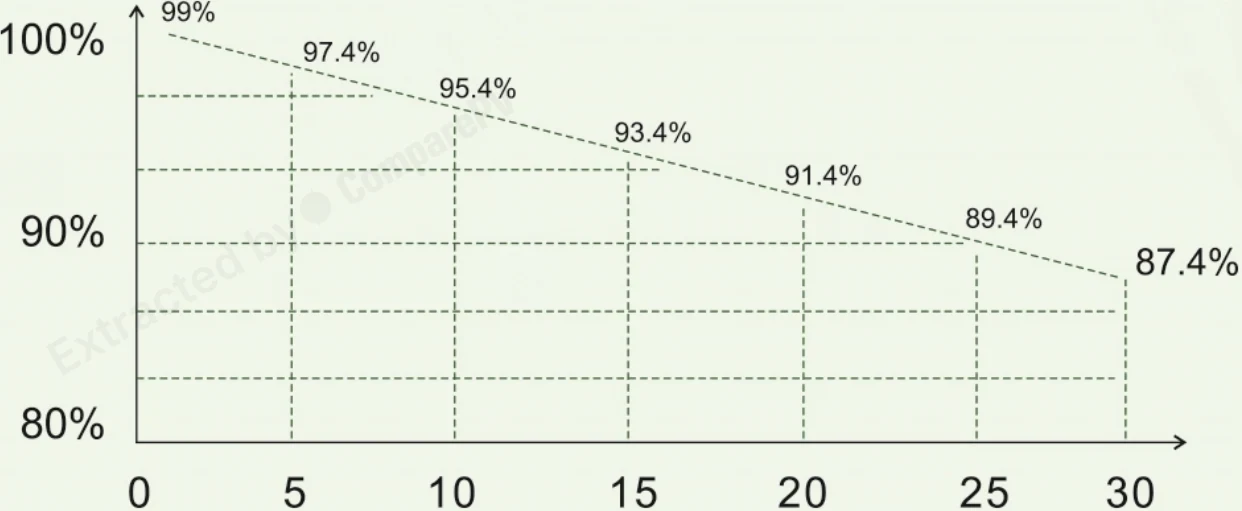
Jinergy provides a 30-year linear performance warranty, standardly guaranteeing ≥87.4% of rated power after 30 years — matching the terms offered by Tier-1 leaders such as Jinko Solar and Trina Solar. The 12+15-year product warranty aligns with the premium Chinese manufacturer standard. By comparison, peer comparable Vikram SOMERA (20.91% efficiency) does not match ZHU's output parameters over this time horizon.

Trade-offs
Not on BNEF Tier-1 list

Per the supplied data (tier_1_bankable: false), Jinergy does not currently appear on BloombergNEF's Tier-1 PV module list (March 2026 methodology). Tier-1 status is typically required by lenders financing utility-scale projects above 10 MW. Its absence may complicate project bankability, extend lender due diligence, or necessitate additional credit enhancements — materially increasing the cost of capital.

Limited track record vs. 30-year warranty

Jinergy has been operating since 2014 (~10 years) compared to Jinko Solar (est. 2006) and Trina Solar (est. 1997). The ZHU series launched in 2024 with no documented long-term field performance history. The financial continuity risk for the warranty guarantor over a 30-year period is objectively higher than for established manufacturers — a material factor in investment risk assessments for projects with 25–30 year payback horizons.

Notes from the database
  • At 23.3% efficiency, this panel is 0.8pp above typical TOPCon 450-500W modules (median: 22.5%)
  • 232.7 W/m² power density - 7.5 W/m² more than TOPCon 450-500W median (225.2 W/m²), more power per roof area
  • At -0.30%/°C, hot weather performance is typical for TOPCon 450-500W panels
  • Weight of 22.0 kg (2.0 kg below TOPCon 450-500W median of 24.0 kg) allows easier transport and roof mounting
  • Ranked #1202 out of 14005 panels for efficiency in the database

Specifications

Open datasheet PDF
Nominal power (Pmax) 465 Wp Nameplate at 1000 W/m², 25 °C
Module efficiency 23.27 % Strong Segment median 22.52%
Vmpp · Impp 34.80 V · 13.41 A Operating point at max power
Voc · Isc 42.53 V · 14.30 A Sizes the string length
Max system voltage 1500 V Longer strings than 1000 V modules
Dimensions 1762×1134×30 mm · 2.00 m² of roof
Weight 22.0 kg Strong Strong · 2.0 kg below median
Cells 192 · TOPCon Monocrystalline
Coefficient Pmax -0.300 %/°C Weak bottom 20% of its segment
Coefficient Voc · Isc -0.240 · 0.046 %/°C
NOCT 45 °C At 800 W/m², 20 °C ambient
Product warranty 15 years Hardware defects only
Performance warranty 30 years Typical median 30 yrs · median 30 yrs
Degradation 0.40 % Per year after the first

Datasheet charts

Open datasheet PDF

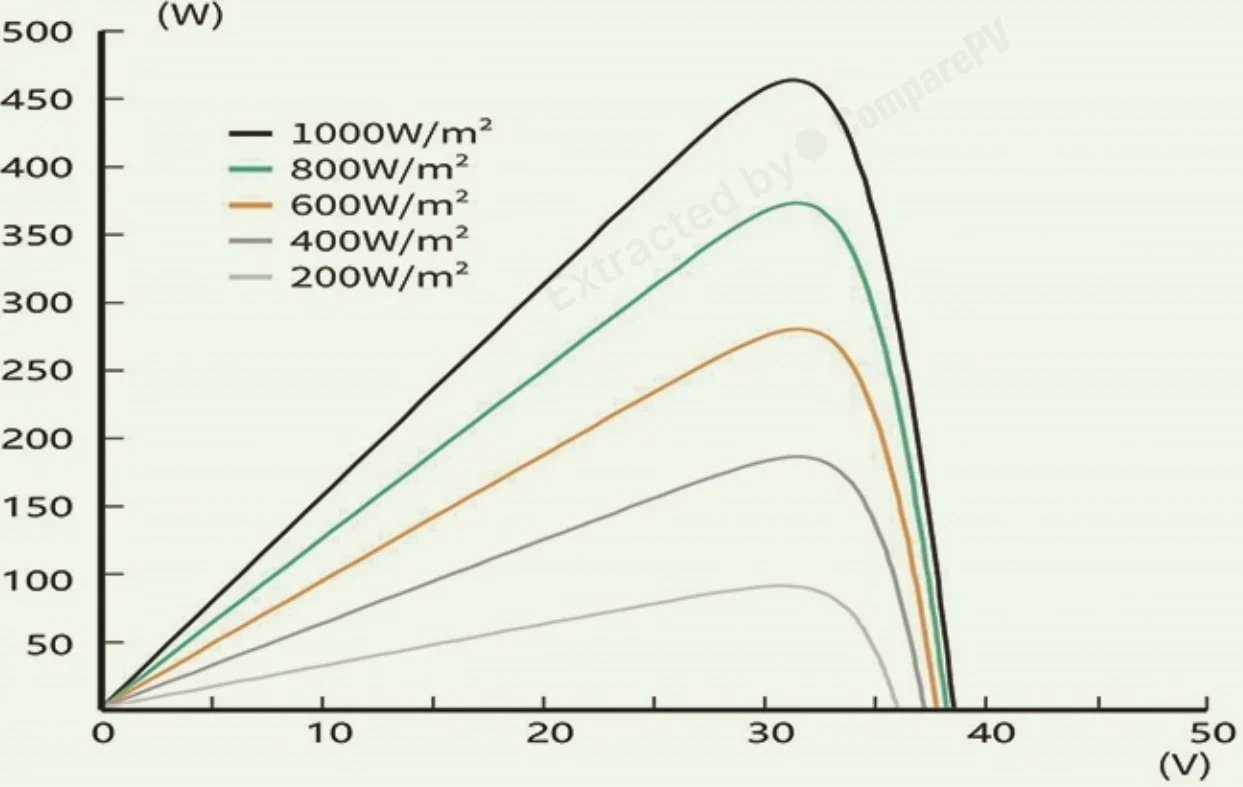
Measured curves published by Jinergy in this model's datasheet. A chart carrying a wattage was measured on that variant alone - only the ones that describe 465 Wp appear here. The rest cover the whole series.
Simulations

Live - change any input
Lifetime output & value
30 years at 1200 kWh/kWp/year and €0.50 per kWh
Power in year 30
-
Lifetime energy
-
Energy value
-

Degradation from this panel's own datasheet figures. No inverter, soiling or shading losses.

Heat losses
-0.300 %/°C against a segment median of -0.290
-
Filter these
Size
Panel Power Eff. Temp. Weight Difference
Jinergy JLSJG-D-465NB 465 W 23.27% -0.300 22.0 kg You are here
LR7-54HJD-510M 510 W 25.00% -0.240 23.5 kg +45 W, cooler, +1.7 pp
AIKO-A495-MCE54Mw 495 W 24.80% -0.260 21.0 kg +30 W, cooler, +1.5 pp
LR7-54HJD-505M 505 W 24.70% -0.240 23.5 kg +40 W, cooler, +1.4 pp
AIKO-A490-MCE54Mw 490 W 24.50% -0.260 21.0 kg +25 W, cooler, +1.2 pp
LR7-54HJD-500M 500 W 24.50% -0.240 23.5 kg +35 W, cooler, +1.2 pp
CIPRO-TN9C54M-500W 500 W 24.50% -0.260 21.4 kg +35 W, cooler, +1.2 pp
JLSJG-D-445NB 445 W 22.27% -0.300 22.0 kg -20 W, -1.0 pp
JLSJG-D-450NB 450 W 22.52% -0.300 22.0 kg -15 W, -0.8 pp
JLSJG-D-455NB 455 W 22.77% -0.300 22.0 kg -10 W, -0.5 pp
JLSJG-D-460NB 460 W 23.02% -0.300 22.0 kg -0.2 pp

Found 1395 panels of the same or similar size to this one, within ±10 mm. See them here Found 1425 panels of the same or similar size to this one, within ±25 mm. See them here Found 3614 panels of the same or similar size to this one, within ±50 mm. See them here Found 3962 panels of the same or similar size to this one, within ±100 mm. See them here

Common questions

6 answered
What is the TOPCon technology used in the Jinergy ZHU series and does it actually result in higher energy output?
TOPCon (Tunnel Oxide Passivated Contact) is an n-type cell architecture that reduces recombination losses at the silicon surface. In practice this means higher efficiency under low-irradiance conditions and slower long-term degradation compared to standard P-type PERC cells. For installations in climates with frequent overcast days, ZHU modules should deliver more annual energy yield than older cell generations.
How does the bifacial design of Jinergy ZHU panels work and when does it make sense to use it?
Bifacial modules in the ZHU series capture sunlight from both the front side and the rear side, using irradiance reflected from the ground or mounting surface. The bifacial gain is highest over white gravel, white roofing membranes, or snow. In a typical rooftop installation the additional yield is roughly 3 to 8 percent per year. For ground-mounted systems or carport installations the rear-side contribution can be significantly higher, directly lowering the system's LCOE.
What warranty does the Jinergy ZHU series come with and what exactly does it cover?
The ZHU series comes with a 15-year product warranty covering material and manufacturing defects, and a 30-year linear power output warranty. The power warranty guarantees that the module will still produce a defined percentage of its rated output after 30 years, with annual degradation capped at a predetermined rate. Exact degradation thresholds should be confirmed in the datasheet for the specific ZHU variant purchased.
Will Jinergy ZHU panels perform well in climates with many cloudy days, such as in Central Europe?
Yes. N-type TOPCon cells demonstrate better low-light performance compared to P-type PERC cells, meaning they convert diffuse and low-irradiance light more efficiently. This is a meaningful advantage in climates with significant cloud cover. N-type cells also have a lower temperature coefficient, which reduces power losses on hot summer days when module surface temperatures rise well above the standard test condition of 25 degrees Celsius.
Is Jinergy a Tier 1 manufacturer and does that matter when buying ZHU panels?
Jinergy (Jinneng Clean Energy Technology) does not currently appear on the BloombergNEF Tier 1 list, which rates manufacturers primarily on their ability to obtain project finance from commercial banks rather than on product quality. BloombergNEF itself cautions against using the list as a quality benchmark. When evaluating ZHU panels, the more relevant criteria are warranty terms, local service availability, and independent lab certifications from institutes such as TÜV or UL.
What is the maximum power output of a Jinergy ZHU panel and what types of installations is it designed for?
The top variant in the ZHU series reaches 465 Wp. The series is primarily aimed at installations where high yield from limited roof or land area is critical, including commercial and industrial (C&I) rooftops and utility-scale PV farms. The combination of n-type TOPCon cells and the optional bifacial design makes the ZHU a strong candidate for projects focused on minimizing LCOE over the full system lifetime.
Add to compare