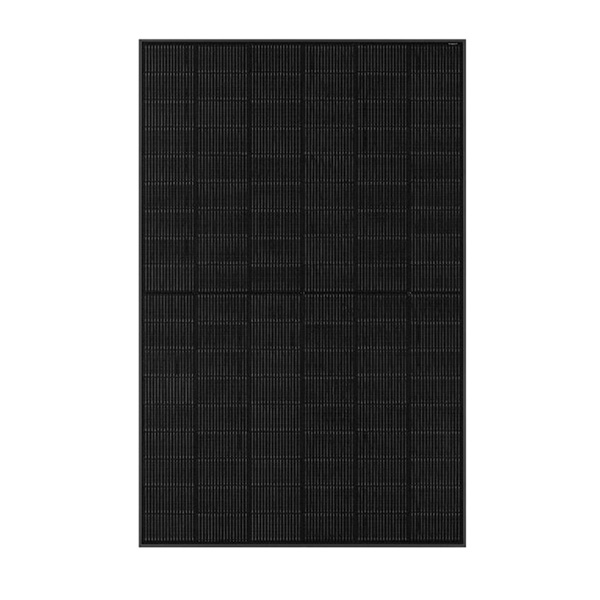
Middle of its segment, heavy for its output
The JA Solar JAM60D41 LB series are bifacial glass-glass modules designed to genuinely increase energy yield in locations where reflected light from the ground surface is significant. The application of n-type TOPCon cells helps minimize typical degradation-related losses over time and maintains stable performance for years. The half-cell architecture with multiple current conductor busbars improves performance under partial shading and reduces module electrical losses. The key advantage of this series is bifaciality - the rear side operates on both diffuse and reflected light, offering additional potential generation without increasing roof or ground footprint. Thanks to the glass-glass construction, panels withstand moisture, UV exposure, and mechanical stress better, making them ideal for flat roofs, carports, and installations near coastlines or agricultural areas. In practice, the JAM60D41 LB modules are chosen by investors seeking greater yield per square meter and a durable module - without compromising aesthetics, as the LB variant features a refined, dark appearance.
Ranking
Signals from the data
Residential, commercial and shaded-installations.
Weight-limited structures, roofs where every square metre has to count and tight roof space.
Bottom 7% of the TOPCon 450-500 W segment, against a median of 52.2. Ranked 10,551st in the whole database.
Bottom 14% of the TOPCon 450-500 W segment, against a median of 225.2.
Bottom 14% of the TOPCon 450-500 W segment, against a median of 22.52%.
The 510 Wp variant reaches 23% module efficiency, outperforming the direct peer Trina Solar Vertex Backsheet (21.2%) by 1.8 percentage points and matching Sunlike SKT510 (22.93%). In practice, this means higher energy yield per unit of roof or ground area.
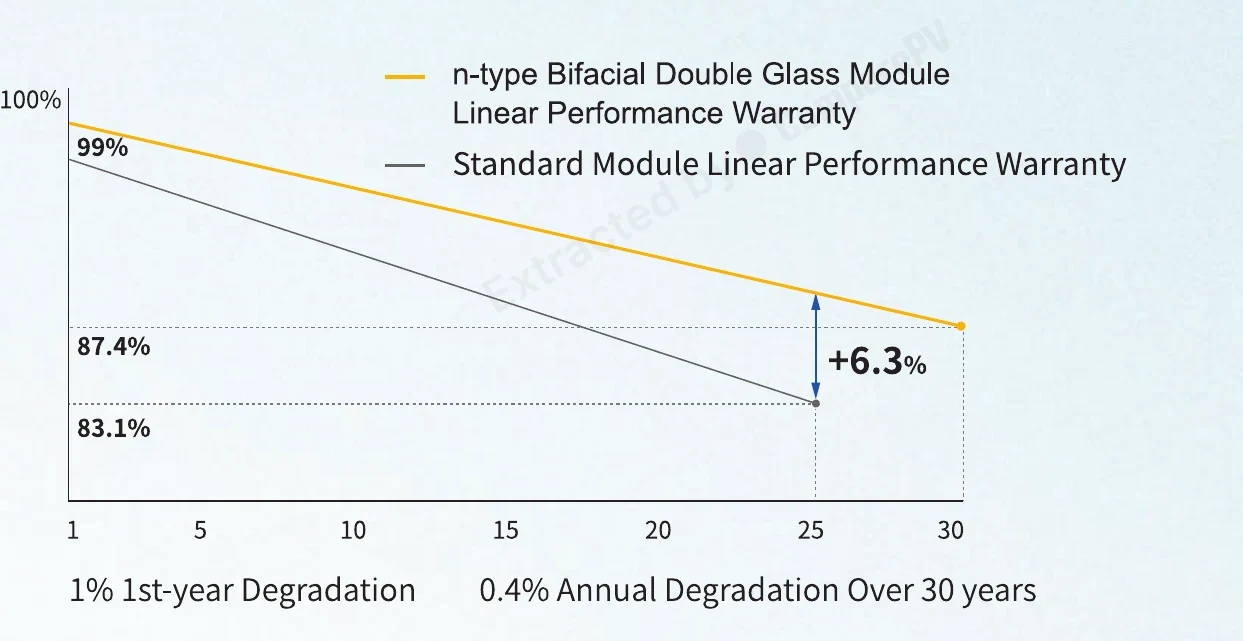
N-type TOPCon cells exhibit first-year LID degradation of just 1%, followed by only 0.4%/year for the remaining 29 years. The Pmax temperature coefficient is −0.29%/°C, better than typical PERC modules (−0.34 to −0.36%/°C), translating to higher summer yield.
The rear side contributes an additional 4–12% energy output depending on ground albedo (snow, light gravel, white membrane), without increasing footprint. The glass-glass encapsulation (30 mm) provides superior moisture and corrosion protection for n-type TOPCon cells compared to standard backsheets — particularly valuable in flat-roof, carport, and coastal installations.
JA Solar guarantees at least 87% of rated power after 30 years of operation, consistent with a 0.4%/year degradation rate. Most backsheet-based peer comparables (e.g., Trina Vertex) offer a standard 25-year warranty with 84.8% retention, making this series stronger for long-term yield certainty.
JA Solar appears on the BNEF Tier-1 Q2 2026 list as one of the largest manufacturers exceeding 80 GW annually. Tier-1 status enables non-recourse project financing by banks and ensures warranty enforceability — critical for commercial investors and prosumers requiring installation insurance.
The glass-glass construction weighs 27.3 kg, approximately 25–35% heavier than comparable glass-backsheet modules (~20–22 kg). On rooftops with limited load-bearing capacity, this may require structural reinforcement or a reduced module count, increasing BoS costs.
- At 21.9% efficiency, this panel is 0.6pp below the TOPCon 450-500W median of 22.5%
- At 219.0 W/m², this panel generates 6.2 W/m² less per unit area than TOPCon 450-500W median (225.2 W/m²)
- Temperature coefficient of -0.29%/°C matches the TOPCon 450-500W median
- Weight of 27.3 kg is 3.3 kg above TOPCon 450-500W median (24.0 kg) - verify structural support
- 80% bifaciality enables rear-side power generation, boosting yield by 4-12% on reflective surfaces
Specifications
Datasheet charts
Measured curves published by JA Solar in this model's datasheet. A chart carrying a wattage was measured on that variant alone - only the ones that describe 485 Wp appear here. The rest cover the whole series.
Simulations
Degradation from this panel's own datasheet figures. No inverter, soiling or shading losses.
Model: bifaciality × albedo × 0.6 view factor. A first-order estimate, not a yield simulation.






Found 488 panels of the same or similar size to this one, within ±10 mm. See them here Found 507 panels of the same or similar size to this one, within ±25 mm. See them here Found 1260 panels of the same or similar size to this one, within ±50 mm. See them here Found 1469 panels of the same or similar size to this one, within ±100 mm. See them here