Solid all-round for its segment
The JA Solar DeepBlue 4.0 series introduces a new quality to the renewable energy sector through the use of innovative N-type cells. The use of proprietary Bycium+ Cell technology allows for exceptionally high conversion efficiency while almost completely eliminating light-induced degradation. This solves the key problem of performance loss over time, offering users stable energy production for decades. Thanks to the SMBB (Super Multi-Busbar) architecture, these modules show significantly better resistance to micro-cracks and conduct current more efficiently, which sets them apart from competitors- standard products based on older p-type solutions. This series also stands out for its excellent temperature coefficient, guaranteeing high energy yields on hot days, when traditional panels lose their efficiency. It is an ideal solution for both individual prosumers and large photovoltaic farms, where maximizing power density per square meter of surface area is of key business importance. DeepBlue 4.0 is proof that advanced n-type technology is becoming the new standard, offering real savings through better performance in diffused light conditions, which is extremely important in the specific Polish climate.
Ranking
Signals from the data
Residential, commercial, shaded-installations and hot-climate.
N-type TOPCon cells with JA Solar's proprietary Bycium+ architecture virtually eliminate light-induced degradation (LID) and achieve an annual degradation rate of ~0.40%/yr - measurably better than standard PERC (~0.45%/yr). Over a 25-year horizon, this translates to a meaningfully higher cumulative energy yield with no early-life degradation spike.
The highest-binned variants reach 22.3% module efficiency, outperforming direct peer comparables: ZNShine ZXM7-UHLDD108 (22.28%), Luxen LUXPOWER N5 (22.28%), and Solitek SOLID Blackstar (22.27%). The higher power density delivers more energy from constrained rooftop areas - a critical factor for typical Polish residential rooftops of 20-40 m².
At -0.29%/°C, the module delivers ~88.5% of rated power at 65 °C cell temperature. Standard PERC modules at -0.35%/°C yield only ~86.5% under the same conditions - a real-world advantage during summer peaks that improves annual energy yield and LCOE in warm-weather operating conditions.
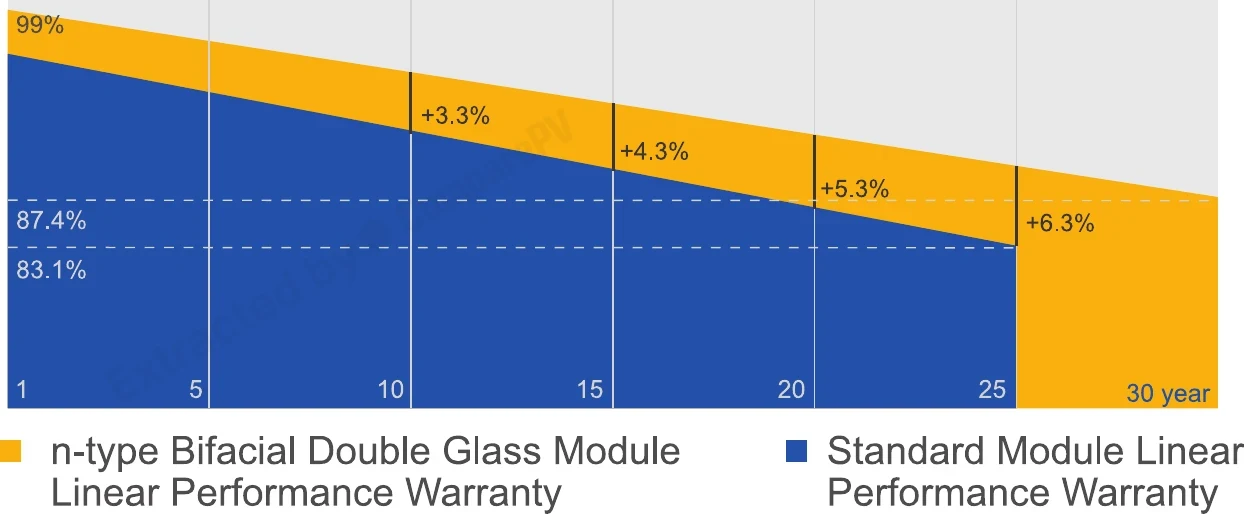
JA Solar backs select variants with a 30-year linear power warranty guaranteeing >87.4% of nameplate power at end-of-warranty and annual degradation ≤0.4%/yr after year one. Some variants within the 12-model series carry a 25-year warranty; the applicable term must be verified in the model-specific datasheet.
JA Solar is listed on the BNEF Tier-1 panel in Q2 2026 with >100 GW/yr global production capacity, confirming bankability for project financing, sustained warranty coverage, and supply continuity. Founded in 2005, the company's established market position eliminates orphan-warranty risk for installations targeting a 20+ year service life.
The materials and workmanship warranty covers only 12 years - historically the Chinese Tier-1 baseline, but below what LONGi (25 years, Hi-MO X6), REC Group (25 years), and Trina Solar (15 years, Vertex S+) now offer. For residential installations targeting a 20-25 year service life, the shorter product warranty represents a quantifiable risk factor should latent manufacturing defects emerge after year 12.
- Efficiency of 22.0% matches the TOPCon 400-450W median
- At 220.2 W/m² power density, roof space requirements are typical for TOPCon 400-450W panels
- Temperature coefficient of -0.30%/°C matches the TOPCon 400-450W median
- 80% bifaciality enables rear-side power generation, boosting yield by 4-12% on reflective surfaces
- In the top 47% for efficiency among all TOPCon panels
Specifications
Datasheet charts
Measured curves published by JA Solar in this model's datasheet. A chart carrying a wattage was measured on that variant alone - only the ones that describe 430 Wp appear here. The rest cover the whole series.
Simulations
Degradation from this panel's own datasheet figures. No inverter, soiling or shading losses.
Model: bifaciality × albedo × 0.6 view factor. A first-order estimate, not a yield simulation.







Found 1797 panels of the same or similar size to this one, within ±10 mm. See them here Found 1928 panels of the same or similar size to this one, within ±25 mm. See them here Found 3413 panels of the same or similar size to this one, within ±50 mm. See them here Found 4007 panels of the same or similar size to this one, within ±100 mm. See them here
About the DeepBlue 4.0 series
These answers cover the whole series. Where a figure differs, the specification above is this module's own.