
Light for its output, no clear weak spot
The Isola New Energy 166M HALF CELL series is an advanced solution based on M6 monocrystalline cells, which optimize power density while maintaining standard module dimensions. The use of half-cut cell technology allows for a significant reduction in resistive losses, which directly translates to higher energy yields even in less favorable weather conditions. These panels effectively solve the problem of partial shading - thanks to the division into two independent sections, shading the lower part of the module does not completely disable it from operation. The multi-busbar design minimizes the risk of micro-cracks and improves current flow, making these modules exceptionally resistant to PID degradation and extreme mechanical loads caused by snow or strong wind. It is an ideal choice for investors looking for a balance between modern innovation and proven reliability. The 166M HALF CELL series stands out from the competition with an excellent temperature coefficient of power, which guarantees stable operation on hot days. This is a proposal dedicated to both home micro-installations and larger commercial systems, where a quick return on investment and long-term, trouble-free operation without the need for frequent service interventions are key.
Ranking
Signals from the data
Residential, commercial and shaded-installations.
Top 7% of the PERC 450-500 W segment, against a median of 53.1. Ranked 1,924th in the whole database.
Top 18% of the PERC 450-500 W segment, against a median of 208.5.
Top 18% of the PERC 450-500 W segment, against a median of 20.82%.
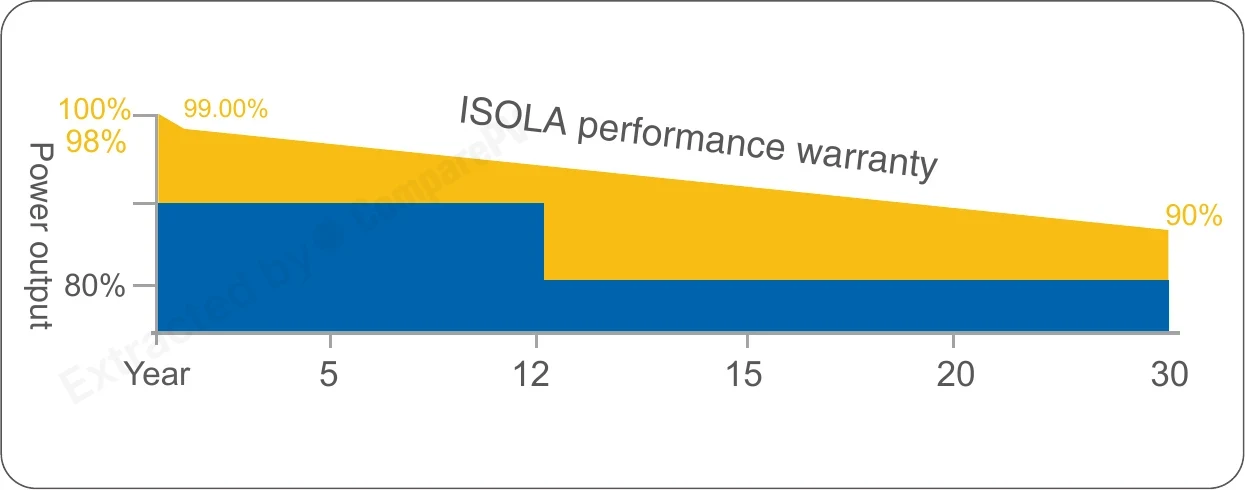
Isola offers a 30-year warranty on both the product and power output – well above the 25-year standard provided by leading PERC suppliers such as JA Solar and Trina Solar. For residential prosumer installations, this extends the bankable revenue horizon by an additional five years.
Splitting M6 (166 mm) cells in half reduces string current by ~50%, cutting I²R resistive losses. The module is divided into two independent sections, so shading the lower half does not disable the upper section – a meaningful yield advantage for rooftops with chimneys or facades with partial obstructions.
The multi-busbar architecture minimizes micro-crack propagation area, while the frame and glass construction meets extreme snow and wind load ratings. Strong PID resistance is especially relevant in transformerless string inverter systems where DC string voltage exceeds 1,000 V.
Peak efficiency of 21.16% (460 Wp variant) matches the comparable Zonergy ZPM MH3-72 at 21.16%, outperforming mid-range PERC alternatives. For a standard 10 kWp system, a 0.5 pp efficiency advantage over the PERC segment average translates to approximately 25–40 kWh/year of additional generation.
Four power variants (430, 440, 450, 460 Wp) provide flexibility for MPPT string design and inverter sizing, enabling BoS optimization for residential systems from 3–10 kWp up to commercial arrays of ~100 kWp without switching module type.
The 166M HALF CELL series is confirmed discontinued by the manufacturer. This means no new production runs, limited availability of replacement modules for mechanical damage claims, and potential gaps in after-sales technical support beyond 2026 – a material risk for projects with a 25+ year operating horizon.
Peak module efficiency is 21.16%, whereas peer comparables using TOPCon – Risen RSM96-11-440-460BNDG and SunKean SKT440~460M12-96D4 – reach 23.00–23.02% at the same 460 Wp nameplate rating. The ~1.85 pp efficiency gap translates to approximately 8–10% higher annual yield per unit of roof area for TOPCon alternatives.
The module is strictly monofacial (bifacial: false), while comparable models such as the Risen RSM96-11-440-460BNDG offer bifacial capability with bifaciality factors of 70–80%. On installations with white roofing membrane or light-colored substrates, the absence of an active rear surface foregoes a potential 5–15% annual energy gain.
Zhejiang Isola New Energy does not appear on BNEF Tier-1 bankability lists (Q2 2025 / Q4 2025). The absence of Tier-1 classification can complicate project finance arrangements for commercial systems above 100 kWp and may disqualify the series from specifications required by infrastructure funds and certain subsidy programs.
- At 21.2% efficiency, this panel is on par with typical PERC 450-500W modules
- Power density of 211.6 W/m² packs 3.1 W/m² more into the same footprint vs PERC 450-500W median (208.5 W/m²)
- Temperature coefficient of -0.35%/°C matches the PERC 450-500W median
- 22.0 kg weight - 2.5 kg lighter than PERC 450-500W median (24.5 kg), reducing installation effort
- Ranked #9229 out of 14005 panels for efficiency in the database
Specifications
Datasheet charts
Measured curves published by Isola New Energy in this model's datasheet. A chart carrying a wattage was measured on that variant alone - only the ones that describe 460 Wp appear here. The rest cover the whole series.
Simulations
Degradation from this panel's own datasheet figures. No inverter, soiling or shading losses.



Found 234 panels of the same or similar size to this one, within ±10 mm. See them here Found 325 panels of the same or similar size to this one, within ±25 mm. See them here Found 352 panels of the same or similar size to this one, within ±50 mm. See them here Found 1158 panels of the same or similar size to this one, within ±100 mm. See them here