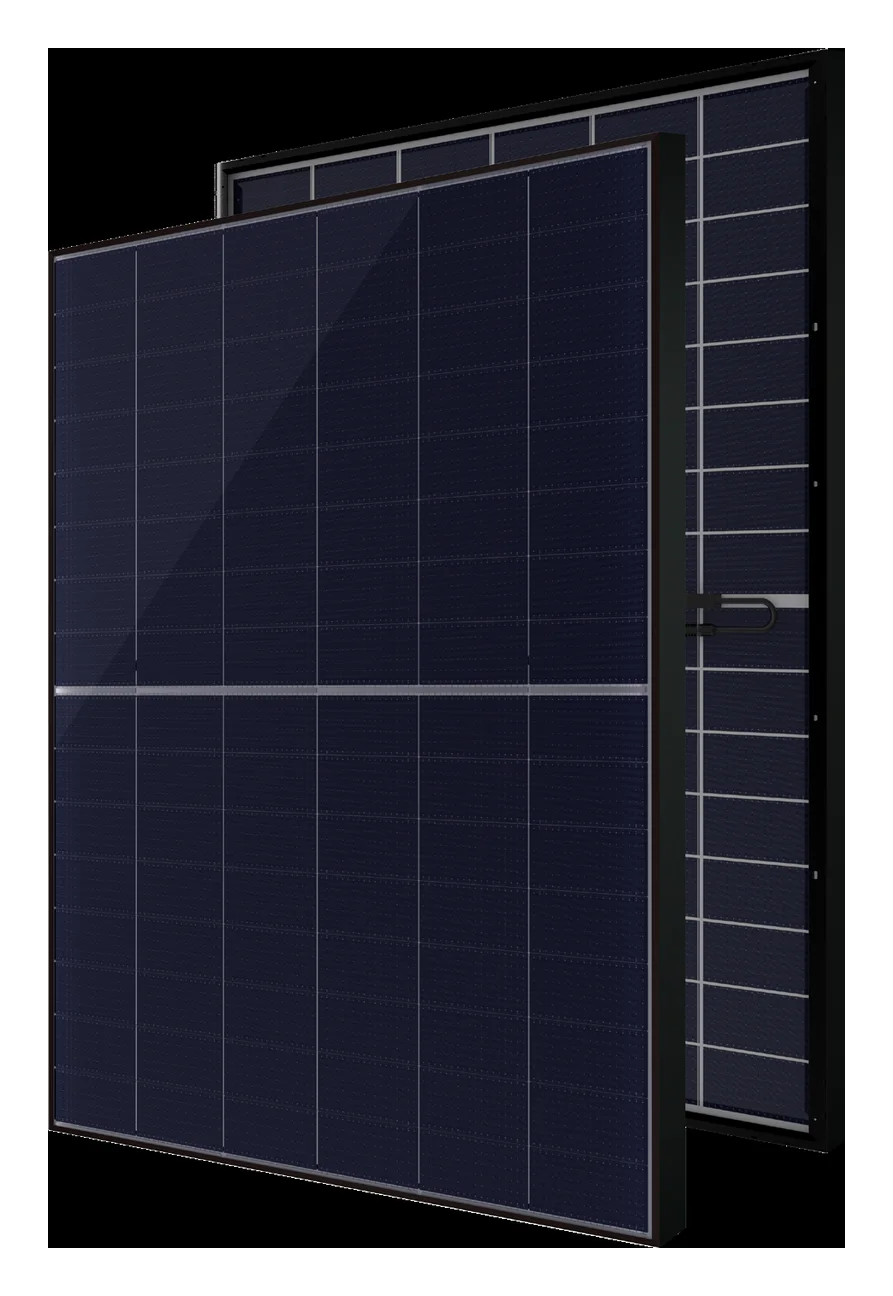
Hyundai HiT-H440CE-BF

HiT-H440CE-BF

440 Wp HJT Bifacial 90%
ComparePV verdict

Light for its output, no clear weak spot

Rank 5,971 of 14,005
Compare panels Datasheet PDF
Power (Wp)
440
Typical for its class
Efficiency (%)
22.00
Typical · median 22.20%
Density (Wp/m²)
220.2
Typical · median 221.6
Temp (%/°C)
-0.240
Typical · median -0.240
Weight (kg)
21.8
Strong · 1.2 kg below median
Warranty (yrs)
30
Typical · median 30 yrs

Hyundai HeteroMax panels from the CE-BF series are an advanced solution based on HJT heterojunction cell technology, setting new standards for efficiency in difficult lighting conditions. Thanks to the unique combination of monocrystalline silicon with a thin amorphous layer, these modules almost completely eliminate the negative effects of LID and PID degradation, which directly translates into the longevity of the installation. Their bifacial glass-glass construction allows for additional energy recovery from reflected light, making them an ideal choice for modern ground-mounted and rooftop systems with light-colored roofing. The HeteroMax series stands out with its minimal temperature coefficient, ensuring the panels operate stably even in extreme sun, offering significantly higher annual yields than standard PERC-type modules. The use of SMBB technology increases resistance to micro-cracks and optimizes electron flow, which is crucial for trouble-free operation for decades. This is a premium solution for investors who demand maximum power density and uncompromising reliability, expecting a product that outclasses the competition in terms of efficiency in real-world, variable weather conditions typical of the Polish climate.

Ranking

113 panels in the segment HJT 400-450 W
Metric This panel Median Position in segment Overall rank
Module efficiency 22.00% 22.20% Typical 6,517
Power density 220.2 221.6 Typical 6,328
Temperature coefficient -0.240 -0.240 Typical 13
Weight per kWp 49.5 52.4 Strong · top 20% 3,108
Performance warranty 30 yrs 30 yrs Typical 21
Colour key Strong - top 25% Typical - middle 50% Weak - bottom 25%

Signals from the data

6 positive · 1 caution
Best for

Residential, commercial and hot-climate.

Strengths
49.5 kg per kWp

Top 20% of the HJT 400-450 W segment, against a median of 52.4.

What owners get
Best-in-class temperature coefficient

The CE-BF HJT cells achieve a Pmax temperature coefficient of -0.24%/°C, compared to approximately -0.35%/°C for PERC and -0.30%/°C for TOPCon modules. Under typical summer conditions with a module temperature of 65°C, this translates to a 2–3% higher daily yield versus a same-wattage PERC module.

Up to 90% bifaciality — segment-leading

The symmetric HJT cell structure delivers bifaciality up to 90%, versus 70–75% for bifacial PERC and 75–80% for TOPCon bifacial modules. On ground-mount systems with light-colored albedo surfaces or white roofing, this yields an additional 4–8% energy harvest from the rear side compared to a typical TOPCon bifacial module.

30-year linear warranty — product and power

Hyundai provides a 30-year product warranty and a 30-year linear power warranty, guaranteeing ≥90.3% of nominal power after 30 years at 0.3%/year annual degradation (after year 1). Peer comparable Risen RSM96-11 offers only a 25-year product warranty with a separate 30-year power warranty — the CE-BF series provides full 30-year product coverage.

Full LID and PID elimination

The HJT structure with amorphous silicon passivation eliminates LID (Light Induced Degradation) inherent in P-type PERC cells. Combined with a dual-glass construction and SMBB metallization that reduces micro-crack risk, the CE-BF series achieves the lowest real-world degradation rates in the 440–460 Wp module class.

22–23% efficiency — top-tier vs. peer set

The 22–23% efficiency range places the series well above the Zonergy ZPM MH3-72 (21.16%) at the same 460 Wp peak power, reducing required roof or ground area for a given system size. The result is on par with Risen RSM96-11 (23%) and SunKean SKT440~460M12-96D4 (23.02%) — positioning the CE-BF firmly in the top tier of 96-cell 460 Wp modules.

Trade-offs
HJT price premium over TOPCon

HJT module manufacturing cost runs approximately $0.14–0.16/W versus $0.11–0.13/W for TOPCon, resulting in a 20–30% higher retail price compared to equivalent TOPCon modules such as the Risen RSM96-11 (identical 23% efficiency). For a typical 10 kWp residential system in Poland, the cost delta can reach €350–600, extending simple payback by 6–10 months under local irradiance conditions.

Notes from the database
  • At 22.0% efficiency, this panel is on par with typical HJT 400-450W modules
  • Power density of 220.2 W/m² matches the HJT 400-450W median
  • At -0.24%/°C, hot weather performance is typical for HJT 400-450W panels
  • At 21.8 kg, this panel is 1.2 kg lighter than HJT 400-450W median (23.0 kg) - easier handling during installation
  • Bifacial design (90% factor) captures reflected light - adds 4-14% yield on ground-mount or white roof

Specifications

Open datasheet PDF
Nominal power (Pmax) 440 Wp Nameplate at 1000 W/m², 25 °C
Module efficiency 22.00 % Typical Segment median 22.20%
Vmpp · Impp 30.61 V · 14.38 A Operating point at max power
Voc · Isc 36.52 V · 15.31 A Sizes the string length
Max system voltage 1500 V Longer strings than 1000 V modules
Dimensions 1762×1134×30 mm · 2.00 m² of roof
Weight 21.8 kg Strong Strong · 1.2 kg below median
Cells 96 · HJT Monocrystalline
Bifaciality 90 % Rear output as a share of front
Coefficient Pmax -0.240 %/°C Typical median -0.240 of its segment
Coefficient Voc · Isc -0.220 · 0.040 %/°C
NOCT 44 °C At 800 W/m², 20 °C ambient
Product warranty 30 years Hardware defects only
Performance warranty 30 years Typical median 30 yrs · median 30 yrs

Datasheet charts

Open datasheet PDF

Measured curves published by Hyundai in this model's datasheet. A chart carrying a wattage was measured on that variant alone - only the ones that describe 440 Wp appear here. The rest cover the whole series.

Simulations

Live - change any input
Lifetime output & value
30 years at 1200 kWh/kWp/year and €0.50 per kWh
Power in year 30
-
Lifetime energy
-
Energy value
-
With bifacial gain
-

Degradation from this panel's own datasheet figures. No inverter, soiling or shading losses.

Heat losses
-0.240 %/°C against a segment median of -0.240
-
Bifacial gain
Rear gain over light concrete: -
-

Model: bifaciality × albedo × 0.6 view factor. A first-order estimate, not a yield simulation.

Filter these
Size
Panel Power Eff. Temp. Weight Difference
Hyundai HiT-H440CE-BF 440 W 22.00% -0.240 21.8 kg You are here
AIKO-A490-MCE54Mw 490 W 24.50% -0.260 21.0 kg +50 W, hotter, +2.5 pp
STP-NT11/48QGSF-490 490 W 24.50% -0.260 21.5 kg +50 W, hotter, +2.5 pp
JAT54S40-485/LR 485 W 24.30% -0.260 19.3 kg +45 W, lighter, +2.3 pp
AIKO-A485-MCE54Mw 485 W 24.30% -0.260 21.0 kg +45 W, hotter, +2.3 pp
AIKO-A485-MAH54Mw 485 W 24.30% -0.260 21.5 kg +45 W, hotter, +2.3 pp
GK-5-54HG-485M 485 W 24.30% -0.260 21.0 kg +45 W, hotter, +2.3 pp
ZEUS 3.0+ 108 485WP 485 W 24.30% -0.260 24.2 kg +45 W, heavier, +2.3 pp
HiT-H435LE-FB 435 W 21.80% -0.240 21.8 kg Very close match
HiT-H445LE-FB(ZB) 445 W 22.30% -0.240 21.6 kg +0.3 pp
HiT-H450LE-FB(ZB) 450 W 22.50% -0.240 21.6 kg +10 W, +0.5 pp
LR7-54HJD-510M 510 W 25.00% -0.240 23.5 kg +70 W, heavier, +3.0 pp
AIKO-A495-MCE54Mw 495 W 24.80% -0.260 21.0 kg +55 W, hotter, +2.8 pp
LR7-54HJD-505M 505 W 24.70% -0.240 23.5 kg +65 W, heavier, +2.7 pp
LR7-54HJD-500M 500 W 24.50% -0.240 23.5 kg +60 W, heavier, +2.5 pp
CIPRO-TN9C54M-500W 500 W 24.50% -0.260 21.4 kg +60 W, hotter, +2.5 pp

Found 1395 panels of the same or similar size to this one, within ±10 mm. See them here Found 1425 panels of the same or similar size to this one, within ±25 mm. See them here Found 3614 panels of the same or similar size to this one, within ±50 mm. See them here Found 3962 panels of the same or similar size to this one, within ±100 mm. See them here

Common questions

6 answered
How do Hyundai HeteroMax CE-BF panels differ from standard PERC modules?
The HeteroMax CE-BF series uses HJT (heterojunction) cell technology rather than PERC. The key difference is a lower temperature coefficient of -0.24%/°C compared to a typical -0.35%/°C for PERC, resulting in noticeably smaller power losses on hot days. Bifaciality up to 90% (vs. ~70% for bifacial PERC) means the module harvests more energy from reflected light. Additionally, near-zero LID and PID degradation effects ensure stable output throughout the entire 30-year service life.
What exactly does the Hyundai HeteroMax CE-BF warranty cover and for how long?
Hyundai provides two separate 30-year warranties: a product warranty covering physical and manufacturing defects, and a linear power output warranty. First-year degradation is capped at 1%, followed by no more than 0.3% per year thereafter. After the full 30-year period, the module must retain at least 90.3% of its rated power. This is among the longest and most favorable warranties available in the premium module segment.
Does the bifacial design of Hyundai HeteroMax CE-BF panels make sense for a typical roof installation?
Yes, though the gain depends on the surface beneath. On a white or light-gray roofing membrane, concrete, or light gravel, the module can recover 5–15% additional energy from reflected light. The glass-glass construction provides symmetrical light capture from both sides. On a dark membrane or tile the gain will be closer to the lower end, but HJT technology still delivers higher yields than standard mono-PERC thanks to superior performance under the diffuse light conditions common in Central European climates.
How do Hyundai HeteroMax CE-BF panels perform during hot summer days?
The CE-BF series temperature coefficient is -0.24%/°C, one of the lowest figures among commercial modules. At a typical panel operating temperature of 65°C on a sunny day (NOCT ~35°C), the module loses roughly 9.6% of rated power, while a comparable PERC module would lose up to 14%. Over a full year this translates into measurable additional kilowatt-hours without any changes to the system design.
What is the maximum power output and size of Hyundai HeteroMax CE-BF panels?
The HeteroMax CE-BF series reaches up to 460 Wp with module efficiency up to 23%. Standard dimensions are 1762 x 1134 x 30 mm and weight is approximately 21.6 kg. The module fits standard aluminum racking systems used for both rooftop and ground-mount installations, with no need for custom rails or clamps.
Is Hyundai a reliable manufacturer for long-term solar investments like the HeteroMax CE-BF?
HD Hyundai Energy Solutions is a Bloomberg NEF Tier 1 manufacturer headquartered in South Korea with over 30 years of solar industry experience. The company operates its own production lines and is part of the global Hyundai Group. Tier 1 status confirms the financial capacity to honor long-term warranty obligations — a critical factor given the 30-year warranty offered on the HeteroMax CE-BF series.
Add to compare