
Middle of its segment, modest efficiency
The Huasun HSN-210R-B72 series was designed for installations where both energy production and light transmittance are critical - especially in agrivoltaic projects. These modules are based on HJT technology, which combines the benefits of monocrystalline silicon and thin-film layers. This allows the panels to operate stably in high temperatures and better utilize diffuse light, typical of many locations in Poland. The key feature of this series is the bifacial construction, which enables energy recovery from the rear side as well, such as from a light-colored substrate, film, or surface in agricultural and industrial facilities. The use of dual glass enhances resistance to moisture, UV exposure, and micro-cracking, ensuring a longer, predictable lifespan. Additionally, solutions like 0BB shorten the current flow path within the cell, reducing losses and supporting performance under lower irradiance. This makes it an excellent choice for PV farms, carports, and canopy structures over crops, where competitive panels often require compromises between energy and light transmission.
Ranking
Signals from the data
Agrivoltaic, commercial and hot-climate.
Tight roof space, roofs where every square metre has to count and weight-limited structures.
Bottom 14% of the HJT 230-430 W segment, against a median of 20.86%.
Bottom 14% of the HJT 230-430 W segment, against a median of 208.6.
Bottom 20% of the HJT 230-430 W segment, against a median of 57.7.
HJT technology delivers a temperature coefficient of approximately -0.25%/°C, compared to -0.35%/°C for PERC and -0.31%/°C for TOPCon. At a cell operating temperature of 45°C, HJT loses ~1.3% less power than PERC, translating to a measurable gain in annual energy yield even in temperate climates.
HJT modules achieve a bifaciality factor of 80-95%, while standard bifacial PERC panels top out at ~70%. On high-albedo surfaces — mulch film, gravel, snow, concrete — the rear-side generation advantage is directly reflected in higher system yield, making this well-suited for agrivoltaic ground mounts and carports.
The glass-glass construction reduces annual degradation to below 0.4% (vs. 0.55-0.7% typical for backsheet laminates) and eliminates moisture ingress and UV-induced EVA discoloration. The 30-year power warranty exceeds the 25-year standard offered by peer comparables such as Heckert Solar NEMO 2.0.
Eliminating conventional busbars in the 0BB layout shortens current paths, lowers resistive losses, and improves photon collection at low incidence angles and under overcast skies — a meaningful advantage in Central European locations where diffuse radiation constitutes a significant share of annual GHI.
Huasun (founded 2020) achieved BNEF Tier-1 status in Q1 2023, becoming the first dedicated HJT specialist to reach that ranking in record time. The designation confirms that six commercial banks have provided non-recourse financing for projects using Huasun modules, satisfying standard bankability requirements for utility-scale and commercial PV projects.
Peer comparables in the same power bracket (up to 335 Wp) reach 19.9% (Heckert NEMO 2.0) and 20.16% (SunLink LUXMAX), meaning the HSN-210R-B72 requires approximately 33% more surface area per kWp installed. The low efficiency is intentional — wider cell spacing enables light transmission to crops below — but effectively limits this series to agrivoltaic and carport applications, ruling it out for space-constrained rooftop or standard ground-mount projects.
Huasun was founded in 2020 and has only ~5 years of operating history. Issuing a 30-year power warranty without a long-term financial track record introduces counterparty risk for institutional investors and lenders, notwithstanding the BNEF Tier-1 bankability status.
- Efficiency of 14.9% is 5.7pp below the HJT 0-400W median (20.6%)
- Power density of 148.5 W/m² is 57.9 W/m² below HJT 0-400W median (206.4 W/m²) - needs more roof space
- At -0.24%/°C, hot weather performance is typical for HJT 0-400W panels
- Weight of 26.9 kg is 5.4 kg above HJT 0-400W median (21.5 kg) - verify structural support
- 90% bifaciality enables rear-side power generation, boosting yield by 4-14% on reflective surfaces
Specifications
Datasheet charts
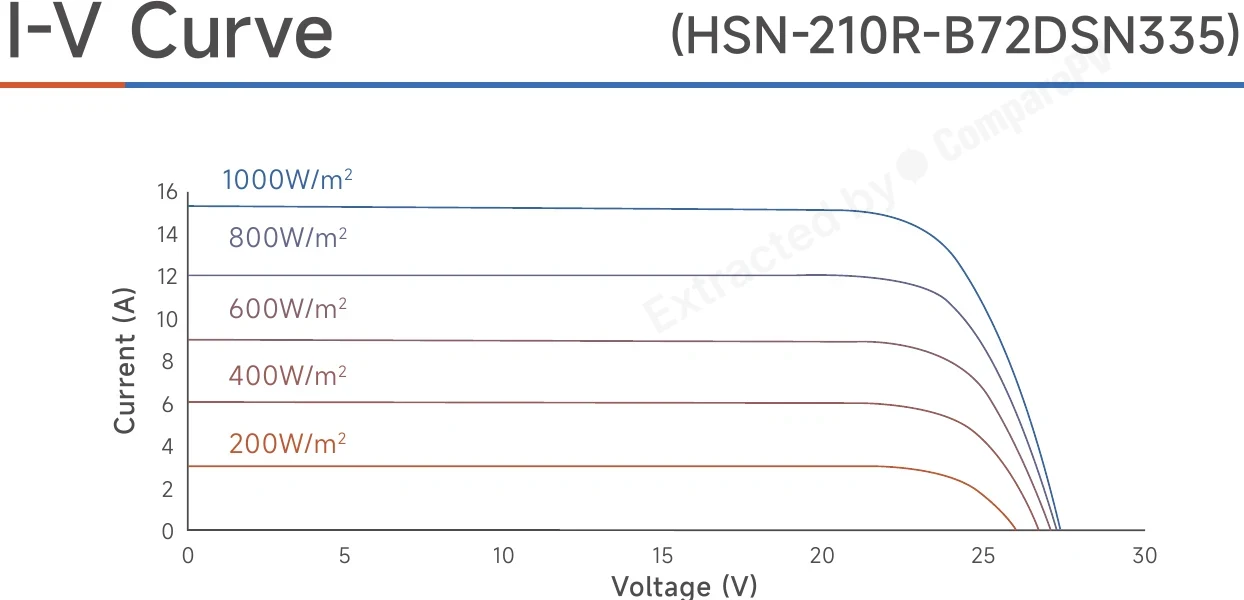
Measured curves published by Huasun in this model's datasheet. A chart carrying a wattage was measured on that variant alone - only the ones that describe 330 Wp appear here. The rest cover the whole series.
Simulations
Degradation from this panel's own datasheet figures. No inverter, soiling or shading losses.
Model: bifaciality × albedo × 0.6 view factor. A first-order estimate, not a yield simulation.






Found 488 panels of the same or similar size to this one, within ±10 mm. See them here Found 508 panels of the same or similar size to this one, within ±25 mm. See them here Found 776 panels of the same or similar size to this one, within ±50 mm. See them here Found 1471 panels of the same or similar size to this one, within ±100 mm. See them here