Middle of its segment, heavy for its output
The Huasun Aurora Pro RS490~515S8R-108GANT series are bifacial modules in a dual-glass configuration, designed to realistically increase energy yield not only in ideal sunlight, but also in typical Polish conditions. The use of n-type cells in the HJT technology results in a <<very low LID degradation>, ensuring predictable performance over the long term. In practice, this means more stable production results and a lower risk of discrepancies between predicted and actual performance.
The <<high PID resistance>> and <<improved performance at elevated temperatures>> are also noteworthy, which helps maintain power output on hot rooftops and in industrial halls. The bifacial design provides <<additional gain from reflected light>, particularly on light-colored roofs, gravel, or when mounted on the ground.
This is a good choice for investors looking for modules for C&I, PV farms, and modern residential rooftops, where durability, stability, and long-term profitability are key.
Ranking
Signals from the data
Residential, commercial, hot-climate and shaded-installations.
Weight-limited structures, hot climates and roofs where every square metre has to count.
Bottom 3% of the TOPCon 450-500 W segment, against a median of 52.2. Ranked 12,616th in the whole database.
Bottom 6% of the TOPCon 450-500 W segment, against a median of -0.290. Ranked 8,005th in the whole database.
Bottom 21% of the TOPCon 450-500 W segment, against a median of 225.2.
HJT technology delivers a Pmax temperature coefficient of -0.26%/°C, versus -0.29% to -0.30%/°C for comparable TOPCon modules (Sunpro Power 210R Bifacial, Canadian Solar TOPBiHiKu6). On hot days (35°C ambient, ~70°C cell temperature), this translates to roughly 1.5–2% higher energy yield compared to TOPCon peers in the same power class.
N-type HJT cells contain no boron, eliminating light-induced degradation (LID) entirely. P-type PERC modules lose 1–3% of rated output within the first hours of sun exposure; the Aurora Pro RS490~515 series is immune to this mechanism, resulting in a stable, predictable power output curve throughout the system's lifetime.
The highest-power variant reaches 23.17% module efficiency, matching the Sunpro Power TOPCon 210R Bifacial (23.17%) and clearly outperforming the Canadian Solar TOPBiHiKu6 (22.8%). Within this peer group, only the Jolywood JW-HD120N Black Series (23.3%) exceeds it — by a margin of just 0.13 percentage points.
The symmetric HJT cell structure (amorphous silicon layers on both sides) enables bifaciality up to 90%, compared to 70–85% typical for TOPCon bifacial modules. The dual-glass encapsulation minimizes PID risk and improves mechanical durability, which is particularly relevant for ground-mount systems and industrial rooftops.
Huasun achieved BNEF Tier 1 PV Module Manufacturer status (Q1 2025) in record time since its founding in 2020. This designation confirms the manufacturer's eligibility for project financing by recognized financial institutions and is a prerequisite for most bank-financed utility-scale and C&I PV projects above 100 kWp.
HJT manufacturing requires costly PECVD/PVD equipment not compatible with existing PERC/TOPCon lines. In 2024–2025, HJT module prices are approximately $0.100/W, while comparable TOPCon peers (Canadian Solar TOPBiHiKu6, Sunpro Power 210R) are available at around $0.087/W. The ~15% cost differential can be difficult to justify in standard residential or prosumer installations where LCOE is the primary metric.
Huasun was founded in 2020, giving the company only 5–6 years of operational history. By comparison, Canadian Solar has operated since 2001 and Jolywood since approximately 2010. With a 30-year power warranty on offer, the absence of long-term field data from the manufacturer's own deployments remains a risk factor that some project insurers and lenders still consider during due diligence.
- At 22.1% efficiency, this panel is on par with typical TOPCon 450-500W modules
- Power density of 220.5 W/m² is 4.7 W/m² below TOPCon 450-500W median (225.2 W/m²) - needs more roof space
- Temperature coefficient of -0.31%/°C is 0.02pp worse than TOPCon 450-500W median (-0.29%/°C) - higher losses in summer heat
- At 30.0 kg, this panel is 6.0 kg heavier than the TOPCon 450-500W median (24.0 kg) - more demanding for installation crews
- Ranked #6233 out of 14005 panels for efficiency in the database
Specifications
Datasheet charts
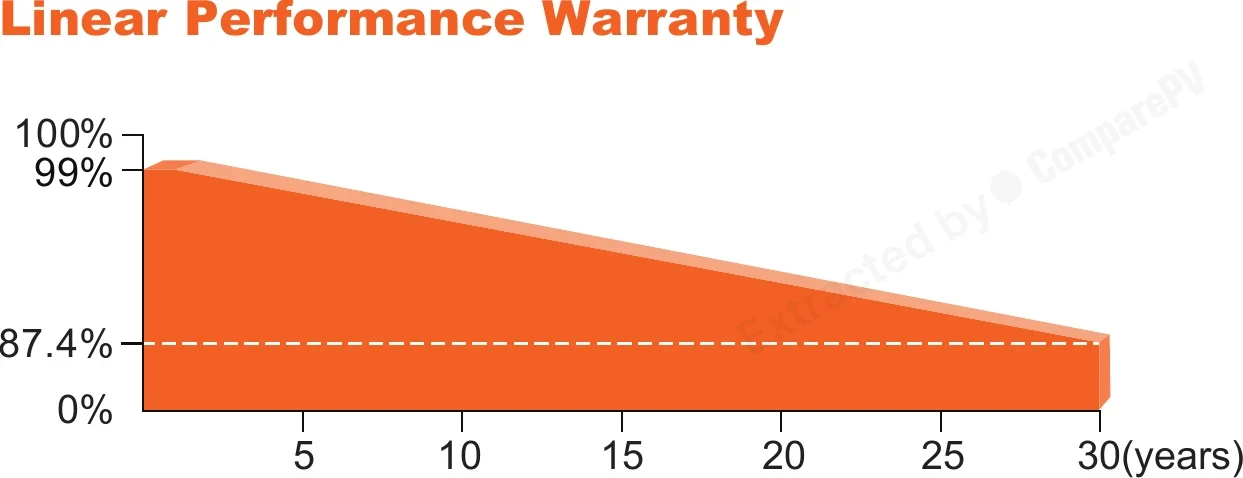
Measured curves published by Huasun in this model's datasheet. A chart carrying a wattage was measured on that variant alone - only the ones that describe 490 Wp appear here. The rest cover the whole series.
Simulations
Degradation from this panel's own datasheet figures. No inverter, soiling or shading losses.





Found 488 panels of the same or similar size to this one, within ±10 mm. See them here Found 508 panels of the same or similar size to this one, within ±25 mm. See them here Found 776 panels of the same or similar size to this one, within ±50 mm. See them here Found 1471 panels of the same or similar size to this one, within ±100 mm. See them here