
Middle of its segment, modest efficiency
The Huasun Kunlun G12R series was designed for vertical installations, where maximizing land use and ensuring stable energy production throughout the day are key. Its main advantage is ultrahigh bifaciality approaching 100%, supported by light conversion film and anti-reflective glass-this allows the modules to effectively capture radiation from both sides, even at less-than-ideal light incidence angles.
In practice, the Kunlun G12R helps address typical challenges faced by conventional PV farms: limited land availability, conflicts with agriculture, and yield losses due to accumulated snow and dust. Vertical installation reduces soiling, simplifies maintenance, and supports dual-generation profiles, better suited to morning and afternoon energy demands.
This solution is ideal for agro-PV projects, installations along infrastructure (roads, screens, railway lines), and applications near industrial sites, where land efficiency and predictable yields are crucial.
Ranking
Signals from the data
Agrivoltaic and commercial.
Tight roof space, roofs where every square metre has to count and weight-limited structures.
Bottom 1% of the HJT 450-500 W segment, against a median of 22.77%. Ranked 10,072nd in the whole database.
Bottom 1% of the HJT 450-500 W segment, against a median of 227.7. Ranked 10,081st in the whole database.
Bottom 1% of the HJT 450-500 W segment, against a median of 49.3. Ranked 12,904th in the whole database.
Near-100% bifacial ratio, light-conversion film, and anti-reflective coated front glass work in synergy: the rear side captures albedo irradiance almost as effectively as the front, directly increasing annual energy yield in vertical mounting compared to modules with the 70–80% bifacial ratio typical of TOPCon.
HJT technology delivers a temperature coefficient of -0.24%/°C vs ~-0.30%/°C for TOPCon and ~-0.35%/°C for PERC. At a module temperature of 65°C (typical Central European summer), the difference vs PERC translates to ~3.6 pp less power loss — a real advantage during peak generation hours.
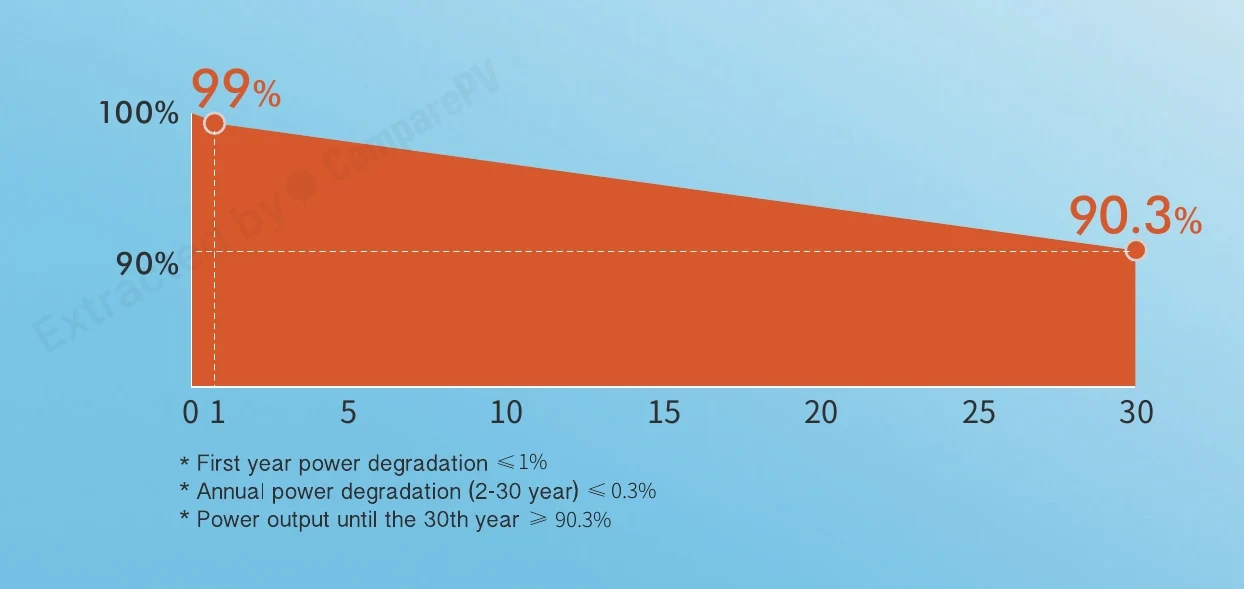
Huasun guarantees >88% of rated power after 30 years and has maintained BNEF Tier 1 status since Q1 2025 — achieved in record time for a company founded in 2020. Tier 1 bankability is a key requirement for project finance on utility-scale PV farms.
Vertical east-west mounting produces two distinct daily generation peaks — morning and afternoon — better matching the load profile of industrial facilities and agrivoltaic sites than a south-facing single-peak system. Research published in Applied Energy (2026) confirms 10–20% higher annual yield for vertical bifacial systems vs monofacial at typical row spacing.
Huasun is the world's largest HJT module manufacturer with 20 GW of installed production capacity (end of 2024) and over 10 GW cumulative shipments. This scale supports consistent quality control and reliable batch availability for large-scale projects.
HJT modules are priced at ~$0.38–0.50/W wholesale vs ~$0.28–0.35/W for TOPCon (a 15–40% gap). In projects where the specific advantages of vertical bifaciality are not technically required, the higher module CAPEX raises LCOE and may not be fully offset by the additional energy yield.
Huasun was founded in 2020 and has approximately 5 years of operational history. The power output warranty covers a 30-year horizon — far exceeding the company's existence. Counterparty risk is higher than with long-established manufacturers such as JA Solar (est. 2005) or Trina Solar (est. 1997), despite confirmed BNEF Tier 1 status.
- Efficiency of 20.9% is 1.9pp below the HJT 450-500W median (22.8%)
- Power density of 209.2 W/m² is 18.5 W/m² below HJT 450-500W median (227.7 W/m²) - needs more roof space
- Temperature coefficient of -0.24%/°C matches the HJT 450-500W median
- At 30.5 kg (7.5 kg above HJT 450-500W median of 23.0 kg), requires checking roof load capacity
- Bifacial design (97% factor) captures reflected light - adds 5-15% yield on ground-mount or white roof
Specifications
Datasheet charts
Measured curves published by Huasun in this model's datasheet. A chart carrying a wattage was measured on that variant alone - only the ones that describe 480 Wp appear here. The rest cover the whole series.
Simulations
Degradation from this panel's own datasheet figures. No inverter, soiling or shading losses.
Model: bifaciality × albedo × 0.6 view factor. A first-order estimate, not a yield simulation.




Found 9 panels of the same or similar size to this one, within ±10 mm. See them here Found 13 panels of the same or similar size to this one, within ±25 mm. See them here Found 25 panels of the same or similar size to this one, within ±50 mm. See them here Found 92 panels of the same or similar size to this one, within ±100 mm. See them here