Light for its output, no clear weak spot
The Alpine HS 186R-132 TC module series defines a new standard of efficiency thanks to the use of advanced N-Type TOPCon cell technology. The use of innovative, rectangular 186R-type cells allows for maximum utilization of the module surface area, which translates into higher energy yields per square meter compared to traditional solutions. A key advantage of this series is its exceptional resistance to LID and LeTID degradation, which guarantees stable power and longevity of the installation even after many years of operation. Thanks to a low temperature coefficient, these panels work more efficiently on hot days, solving the problem of performance drops during summer peak sunlight. The bifacial double glass construction makes the modules an ideal choice for demanding investors building ground-mounted systems and commercial rooftop installations, where mechanical strength and additional gain from reflected radiation are crucial. What sets them apart from the competition is the precise design refinement that minimizes the risk of micro-cracks and ensures maximum efficiency in low light, for example on cloudy days or at dawn. This solution is dedicated to those seeking uncompromising quality and the fastest return on investment in the Polish climate.
Ranking
Signals from the data
Commercial, utility-scale, hot-climate and shaded-installations.
Top 15% of the N-type 500-550 W segment, against a median of 50.0.
Top 23% of the N-type 500-550 W segment, against a median of -0.290.
The series achieves module efficiency up to 23.1%, while all three peer comparables (Exiom, Fellow Energy, Premier Energies) top out at 21.67-21.7%. The 0.6-1.4 pp advantage translates directly into higher energy yield per square meter - for a 10 kWp rooftop system under Polish irradiation conditions, the gain can amount to 300-700 kWh/year over comparable PERC-based peers.
N-type TOPCon cells typically exhibit a Pmax temperature coefficient of approximately -0.30%/°C, versus -0.35 to -0.38%/°C for the PERC technology used in peer comparables (e.g., Premier Energies PERC). On a hot summer day with cell temperature at 65°C, power loss is roughly 1.75 pp lower than an equivalent PERC module - a meaningful advantage during peak Polish summer irradiation (June-August).
N-type cells are inherently immune to light-induced degradation (LID) and light- and elevated temperature-induced degradation (LeTID), which are the primary sources of permanent power loss in P-type PERC modules during the first 1-2 years of operation. Absence of LID means the panel delivers its full nameplate power from day one and follows the power warranty curve more closely throughout its lifetime.
Horay Solar has been listed on the Bloomberg NEF Tier 1 PV Module Manufacturer ranking since Q1 2025, with bankability reconfirmed for Q1 2026. Tier 1 status means the modules satisfy the due-diligence requirements of financial institutions for project-finance deals and can be insured by major brokers - a prerequisite for many commercial and utility-scale PV projects.
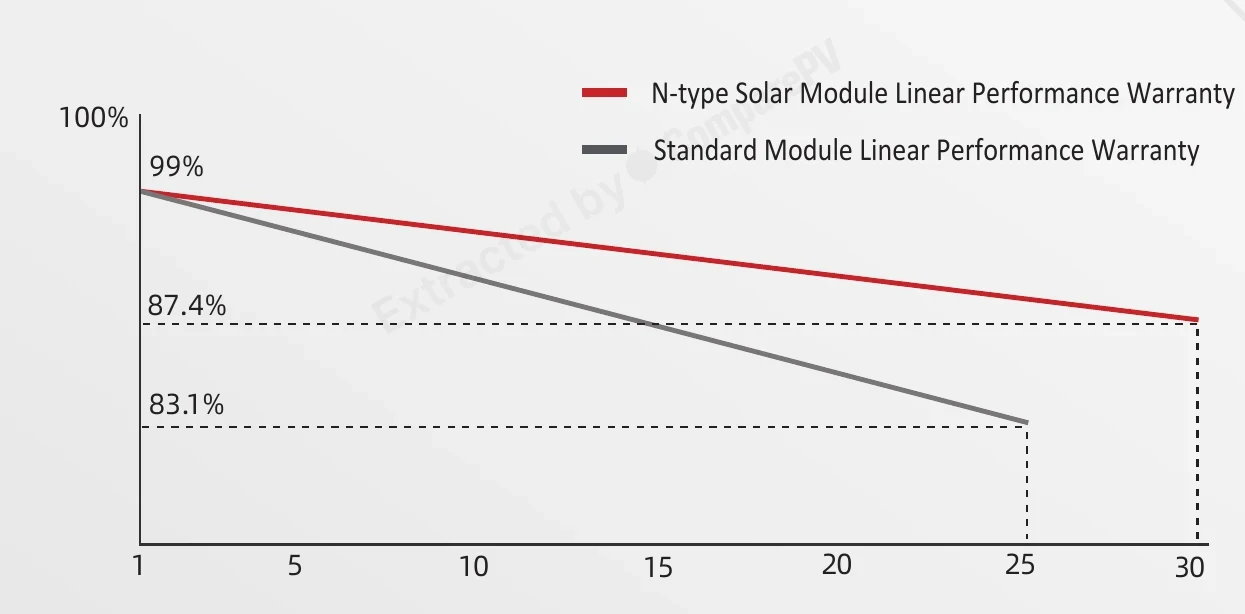
The manufacturer provides a 30-year performance warranty - five years longer than the standard 25-year terms offered by all three peer comparables (Exiom, Fellow Energy, Premier Energies). For commercial systems above 500 kWp, the extended guaranteed power curve materially lowers LCOE in a discounted cash flow model.
The Alpine HS 186R-132 TC series is flagged as discontinued. This creates risk of unavailability of matching replacement modules after individual panel failures (critical for string-level power maintenance), potential difficulty in fulfilling product warranty claims, and the likelihood that the manufacturer will not maintain a full service infrastructure for this cell generation over a 20-30 year system lifetime.
The 12-year workmanship and materials warranty falls below the current premium-segment standard: REC offers 20 years, Qcells 25 years, and many mid-tier Tier-1 manufacturers transitioned to 15-year product warranties in 2024-2025. Combined with the discontinued status, the effective protection horizon is further limited to whatever support window the manufacturer maintains post-EOL.
The module is non-bifacial (is_bifacial: false), whereas the direct peer Premier Energies 144 HALF CUT PERC CELL BIFACIAL DUAL GLASS offers bifacial yield at a comparable 560 Wp nameplate power. In ground-mount systems with light-colored albedo surfaces (sand, concrete, snow), bifacial gain typically ranges from 5-15% additional generation, which can partially or fully offset this series' efficiency advantage over that specific peer.
- Efficiency of 22.3% matches the N-type 500-550W median
- Power density of 222.5 W/m² matches the N-type 500-550W median
- Temperature coefficient of -0.28%/°C matches the N-type 500-550W median
- Weight of 24.5 kg (1.7 kg below N-type 500-550W median of 26.2 kg) allows easier transport and roof mounting
- #5161 for efficiency, #1347 for temperature performance out of 14129 panels
Specifications
Datasheet charts
Measured curves published by Horay Solar in this model's datasheet. A chart carrying a wattage was measured on that variant alone - only the ones that describe 540 Wp appear here. The rest cover the whole series.
Simulations
Degradation from this panel's own datasheet figures. No inverter, soiling or shading losses.
Alternatives





Found 15 panels of the same or similar size to this one, within ±10 mm. See them here Found 21 panels of the same or similar size to this one, within ±25 mm. See them here Found 520 panels of the same or similar size to this one, within ±50 mm. See them here Found 879 panels of the same or similar size to this one, within ±100 mm. See them here
About the Alpine HS 186R-132 TC series
These answers cover the whole series. Where a figure differs, the specification above is this module's own.