Strong in heat, modest efficiency
The DMEGC Greenhouse GHxxxM10T-B44HST-C panel series is a specialized solution designed for the agrivoltaics sector and modern agriculture. Thanks to the use of N-type TOPCon technology, these modules achieve high efficiency with minimal light-induced degradation, guaranteeing stable yields for decades. Their key differentiator is the bifacial glass-glass construction with high light transmittance, which allows for a harmonious combination of agricultural production and electricity generation. These panels effectively solve the problem of limited land availability, enabling dual use of the surface for crops and photovoltaic installations. The specific design provides extreme ammonia resistance and resistance to harsh chemical conditions, making them unrivaled in close proximity to livestock farms. Unlike classic panels, the Greenhouse series protects plants from excessive sunlight and hail while optimizing the light necessary for vegetation. It is a product dedicated to conscious investors and farmers who prioritize maximum durability and production synergy between energy and traditional agricultural activities, providing a high degree of fire safety thanks to the double tempered glass.
Ranking
Signals from the data
Agrivoltaic.
Tight roof space, roofs where every square metre has to count and weight-limited structures.
Top 11% of the N-type 350-400 W segment, against a median of -0.320.
Top 19% of the N-type 350-400 W segment, against a median of 25 yrs.
Bottom 5% of the N-type 350-400 W segment, against a median of 20.00%. Ranked 13,779th in the whole database.
Bottom 5% of the N-type 350-400 W segment, against a median of 200.4. Ranked 13,760th in the whole database.
Bottom 21% of the N-type 350-400 W segment, against a median of 62.0.
The glass-glass construction certified to IEC 62716 guarantees resistance to ammonia-induced corrosion — a critical requirement for installations near livestock facilities. Among peer comparables, only the Exiom AGR series (14.1% efficiency) targets the same market segment; Solaria PowerXT and Sunket SKT345~365M10 carry no dedicated agrivoltaic certifications.
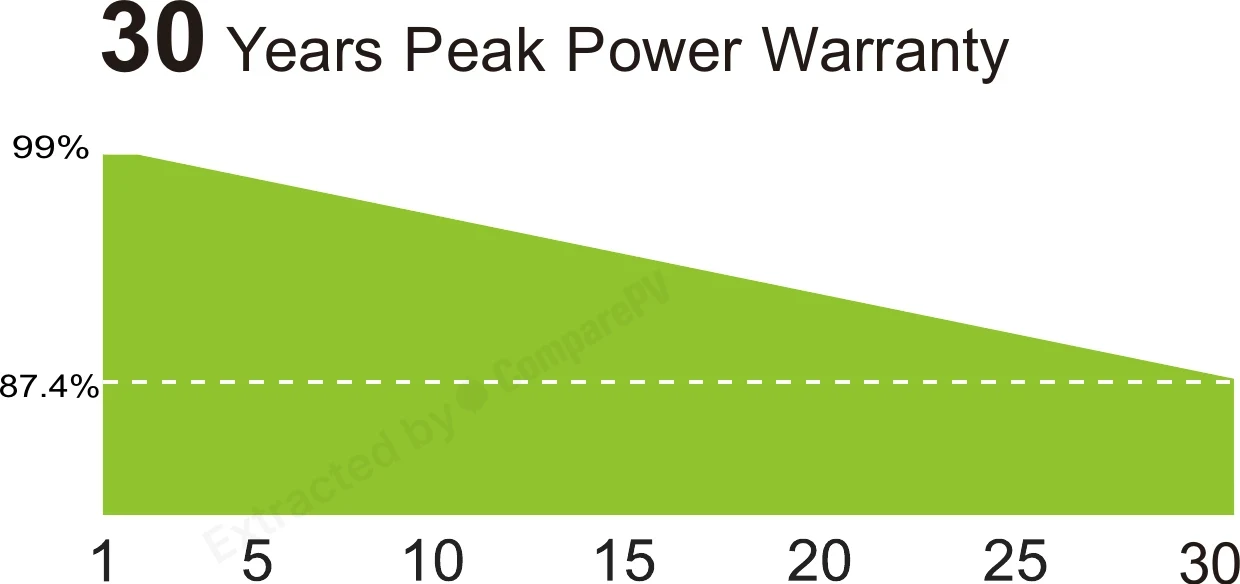
DMEGC guarantees power output for 30 years, exceeding the 25-year standard warranties offered by most manufacturers in this segment. For agrivoltaic projects with long financing horizons (loans, land leases), this is a direct bankability argument during due diligence.
DMEGC Solar maintained Tier-1 status per BloombergNEF (Q3 2025) and received an 'A' rating in the PV ModuleTech Bankability Ratings 2024 Q4. Wood Mackenzie ranked DMEGC 5th among module manufacturers worldwide in its 2025 ranking, with shipments of 13.4 GW in H1 2025 (+64% YoY). This significantly reduces manufacturer risk for long-term installations.
The module offers ~35% light transmittance (configurable from 3–48%), enabling adequate crop illumination without excessive shading. The dual tempered glass construction improves the fire safety rating and extends mechanical service life beyond that of standard backsheet modules.
Within the dedicated agrivoltaic module segment, this series achieves 14.74–15.37% efficiency — clearly above its closest comparable, the Exiom EX345-365M AGR (14.1%). Lower values relative to Solaria PowerXT (20.2%) and Sunket SKT345~365M10 (18.7%) result from an intentionally reduced cell density required to achieve the target light transmittance; those comparisons span different product classes.
Per series_info.discontinued = true, production ended in 2026 (released 2023, end-of-life 2026 — a product lifecycle of only three years). This translates to limited module availability for loss replacement, potential difficulties in expanding existing installations, and the risk of inadequate service support and compatible components (optimizers, mounting hardware) once warehouse stock is exhausted.
The 350–365 Wp power range falls well below the current market standard for new utility-scale installations, where 500–600 Wp modules dominate tenders in 2025–2026. For large agrivoltaic farms, this results in higher BoS costs — more modules, more connections, and more mounting structures — per installed MWp.
- Module efficiency of 15.2% is 4.3pp below average for N-type 0-400W panels (median: 19.5%)
- 151.6 W/m² power density is 43.3 W/m² below N-type 0-400W median (194.9 W/m²) - requires larger installation area
- At -0.29%/°C (vs median -0.32%/°C), loses ~1% less power in hot conditions
- Weight of 29.0 kg is 7.0 kg above N-type 0-400W median (22.0 kg) - verify structural support
- Bifacial design (80% factor) captures reflected light - adds 4-12% yield on ground-mount or white roof
Specifications
Datasheet charts
Measured curves published by DMEGC in this model's datasheet. A chart carrying a wattage was measured on that variant alone - only the ones that describe 360 Wp appear here. The rest cover the whole series.
Simulations
Degradation from this panel's own datasheet figures. No inverter, soiling or shading losses.
Model: bifaciality × albedo × 0.6 view factor. A first-order estimate, not a yield simulation.




Found 397 panels of the same or similar size to this one, within ±10 mm. See them here Found 408 panels of the same or similar size to this one, within ±25 mm. See them here Found 425 panels of the same or similar size to this one, within ±50 mm. See them here Found 953 panels of the same or similar size to this one, within ±100 mm. See them here