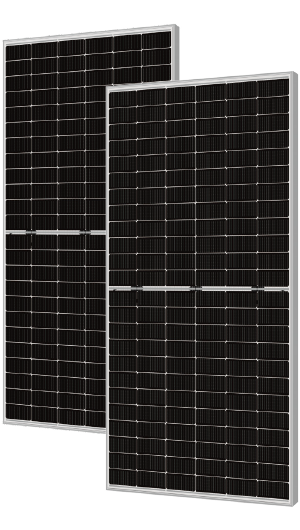
Strong in heat, no clear weak spot
The DAS Solar DAS-DH144PA series is designed as bifacial modules in double-glass construction, enabling them to effectively utilize reflected light and operate more reliably in demanding installation conditions. The glass on both sides increases resistance to environmental factors and minimizes the risk of micro-cracks and accelerated aging - a practical advantage where longevity and predictable energy yields over years are key.
A key feature of this series is the combination of P-type cells with a bifacial generation architecture and half-cut technology, which reduces mismatch losses. In practice, this means better performance under partial shading between rows, greater production stability in varying sunlight conditions, and easier design of large module areas.
The DAS-DH144PA is an excellent choice for ground installations and large commercial rooftops, where the additional yield from the rear side and mechanical durability are crucial. Compared to competitors, this series stands out by emphasizing the long-term reliability of the dual-glass construction and optimizing performance in less-than-ideal conditions.
Ranking
Signals from the data
Commercial, utility-scale and shaded-installations.
Top 23% of the PERC 500-550 W segment, against a median of -0.350.
DAS Solar has maintained BNEF Tier 1 status for four consecutive quarters in 2025, reflecting acceptance of non-recourse project financing by at least six independent banks on projects exceeding 10 MW. For commercial installations and utility-scale PV farms, this is a critical criterion for project finance eligibility.
The manufacturer guarantees a minimum of 84.95% of nominal power output after 30 years, with an annual degradation rate of 0.45% following the first year. Peer comparables in this class (Exiom, Goldi Solar) offer equivalent warranty terms; however, some lower-cost competitors limit coverage to 25 years — a meaningful advantage for projects with a 25+ year investment horizon.
A bifaciality factor of up to 70% translates into additional energy yield of approximately 5–25%, depending on ground albedo (light soil, gravel, snow). Dual-glass encapsulation eliminates the risk of EVA and backsheet degradation and statistically extends module service life — a significant consideration within the 30-year warranty window.
The 144 half-cut cell architecture reduces the operating current in each cell half by 50%, lowering resistive losses and mitigating hot-spot formation. In practice, the modules perform better under partial inter-row shading in large ground-mount arrays, resulting in higher annual energy yield compared to full-cell equivalents.
The top-tier 560 Wp variant achieves 21.7% module efficiency — identical to the best peer comparables in this class (Exiom EX560M, Goldi Solar GS10-B144-GF). The series ranks among the leaders in the P-type bifacial 144HC segment in terms of power density, without the cost premium associated with N-type technology.
The temperature coefficient of P-type PERC cells is -0.35%/°C, compared to -0.31%/°C for TOPCon modules available from competitors at the same price point. In Central European climates, this difference translates to approximately 0.5–1% lower annual energy yield on high-irradiance days when module temperature exceeds 45°C.
P-type PERC cells exhibit first-year light-induced degradation (LID) of approximately 2%, versus ~1% for N-type TOPCon, and a bifaciality factor of up to 70% compared to 80%+ in TOPCon modules at the same price tier. DAS Solar's own portfolio includes newer N-type series (DAS-DH144NA), suggesting the DH144PA series represents previous-generation technology.
DAS Solar has been operating since 2018, representing approximately seven years of operational history. Given a 30-year power warranty, lenders and insurers may require additional credit enhancements — such as a surety bond or parent guarantee — compared to manufacturers with 15–20 years of market presence.
- Efficiency of 20.9% matches the PERC 500-550W median
- At 209.0 W/m² power density, roof space requirements are typical for PERC 500-550W panels
- At -0.34%/°C, hot weather performance is typical for PERC 500-550W panels
- Weight of 31.4 kg is 3.0 kg above PERC 500-550W median (28.4 kg) - verify structural support
- 70% bifaciality enables rear-side power generation, boosting yield by 4-10% on reflective surfaces
Specifications
Simulations
Degradation from this panel's own datasheet figures. No inverter, soiling or shading losses.
Model: bifaciality × albedo × 0.6 view factor. A first-order estimate, not a yield simulation.



Found 2326 panels of the same or similar size to this one, within ±10 mm. See them here Found 2368 panels of the same or similar size to this one, within ±25 mm. See them here Found 2382 panels of the same or similar size to this one, within ±50 mm. See them here Found 2547 panels of the same or similar size to this one, within ±100 mm. See them here