DAS-DH120ND-510W

510 Wp TOPCon Bifacial 80%
ComparePV verdict

Strong in heat, no clear weak spot

Rank 6,085 of 14,005
Compare panels Datasheet PDF
Power (Wp)
510
Typical for its class
Efficiency (%)
22.60
Typical · median 22.73%
Density (Wp/m²)
225.5
Typical · median 227.4
Temp (%/°C)
-0.280
Strong · top 10%
Weight (kg)
27.5
Typical · median 27.0 kg
Warranty (yrs)
30
Typical · median 30 yrs

The DAS Solar DAS-DH120ND Black Pro series is a range of photovoltaic panels based on advanced HJT (Heterojunction Technology) with N-type cells - one of the most efficient and reliable technologies currently available on the market. The bifacial dual glass design allows for the absorption of solar radiation from both the front and back sides, which, under optimal conditions, can result in up to 30% higher energy generation compared to conventional monofacial panels. The double-tempered glass provides exceptional mechanical strength - the modules can withstand snow loads up to 5400 Pa and wind loads up to 2400 Pa, making them an ideal choice for challenging weather conditions typical in Poland. The elegant, fully black Black Pro aesthetic makes this series ideal for roof-mounted installations, where both performance and visual appeal are important. The modules are compatible with 1500 V systems, simplifying the design of large-scale installations. The 30-year performance warranty and 15-year product warranty confirm the high quality of manufacture. The DAS-DH120ND series is a choice for demanding individual customers, installers, and investors undertaking commercial projects.

Ranking

432 panels in the segment TOPCon 500-550 W
Metric This panel Median Position in segment Overall rank
Module efficiency 22.60% 22.73% Typical 3,658
Power density 225.5 227.4 Typical 3,869
Temperature coefficient -0.280 -0.290 Strong · top 10% 1,309
Weight per kWp 53.9 52.4 Typical 8,073
Performance warranty 30 yrs 30 yrs Typical 21
Colour key Strong - top 25% Typical - middle 50% Weak - bottom 25%

Signals from the data

6 positive · 3 caution
Best for

Residential, commercial and cold-climate.

Strengths
-0.280 %/°C temperature coefficient

Top 10% of the TOPCon 500-550 W segment, against a median of -0.290. Ranked 1,309th in the whole database.

What owners get
Superior Temperature Coefficient vs. TOPCon

HJT technology delivers a Voc temperature coefficient of -0.250%/°C, while competing TOPCon modules (Huasun Aurora Pro, Sunpro TOPCon 210R, Canadian Solar TOPBiHiKu6) typically reach -0.30%/°C. In climates with hot summers, this translates into measurably higher energy yield at peak season.

Low Annual Degradation Inherent to HJT Technology

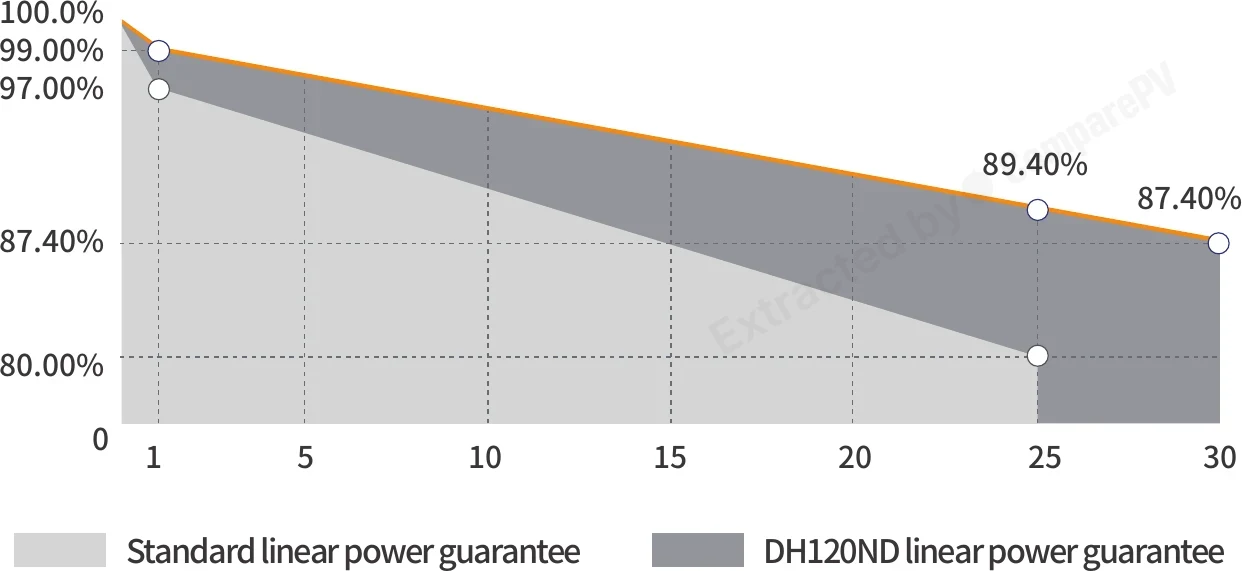
HJT cells degrade at ~0.25–0.30%/year versus ~0.40%/year for TOPCon, resulting in approximately 3–4% higher cumulative energy yield over a 30-year project lifetime. The manufacturer's 30-year power warranty is consistent with these technology-level performance parameters.

Premium-Grade Mechanical Resistance

The dual-glass construction (2×2.0 mm tempered glass) withstands snow loads up to 5,400 Pa and wind loads up to 2,400 Pa — exceeding the IEC baseline of 2,400 Pa / 2,400 Pa. This is a meaningful advantage in regions where heavy snow accumulation poses a real structural risk.

Confirmed Bankability — BNEF Tier 1 for Four Consecutive Quarters

DAS Solar achieved BNEF Tier 1 status for four consecutive quarters in 2025, meaning six independent banks have financed projects using their modules. For commercial investors and prosumers relying on external financing, this is a key credibility indicator for a manufacturer founded in 2018.

Bifacial + 1500 V System Compatibility + Full-Black Aesthetics

The symmetric bifacial design enables rear-side albedo harvesting (manufacturer-declared gain of up to +30% vs. monofacial under suitable mounting conditions). Compatibility with 1500 V systems simplifies the electrical design of commercial installations above 100 kWp, while the All-Black Pro aesthetic meets the premium requirements of BIPV and residential rooftop segments.

Trade-offs
Lower Efficiency vs. Leading Competitors

The series peaks at 22.8% module efficiency, while comparably priced alternatives — the Huasun Aurora Pro RS490–515S8R and Sunpro TOPCon 210R — reach 23.17%, a gap of ~0.37 percentage points. On a fixed roof area, this equates to approximately 1.6% less installed capacity per m², which may be a decisive factor on space-constrained rooftops.

Higher Unit Cost of HJT Technology

HJT modules are priced at ~$0.38–0.50/W at wholesale, compared to $0.28–0.35/W for TOPCon (2025 market data), representing a price premium of roughly 10–20% over comparable-wattage offerings from Huasun, Sunpro, or Canadian Solar TOPBiHiKu6. The premium is partially justified by the superior temperature coefficient and lower degradation rate, but must be validated against a project-specific ROI calculation.

Higher Module Weight (27.5 kg)

The dual-glass construction increases module weight to 27.5 kg, compared to 22–24 kg typical of single-glass TOPCon modules in the same power class. On large rooftop installations, this may require a structural load assessment or the use of higher-rated — and more costly — racking systems.

Notes from the database
  • At 22.6% efficiency, this panel is on par with typical TOPCon 500-550W modules
  • Power density of 225.5 W/m² matches the TOPCon 500-550W median
  • At -0.28%/°C, hot weather performance is typical for TOPCon 500-550W panels
  • Bifaciality factor of 80% can add 4-12% extra yield with reflective mounting surface
  • #3658 for efficiency, #1309 for temperature performance out of 14005 panels

Specifications

Open datasheet PDF
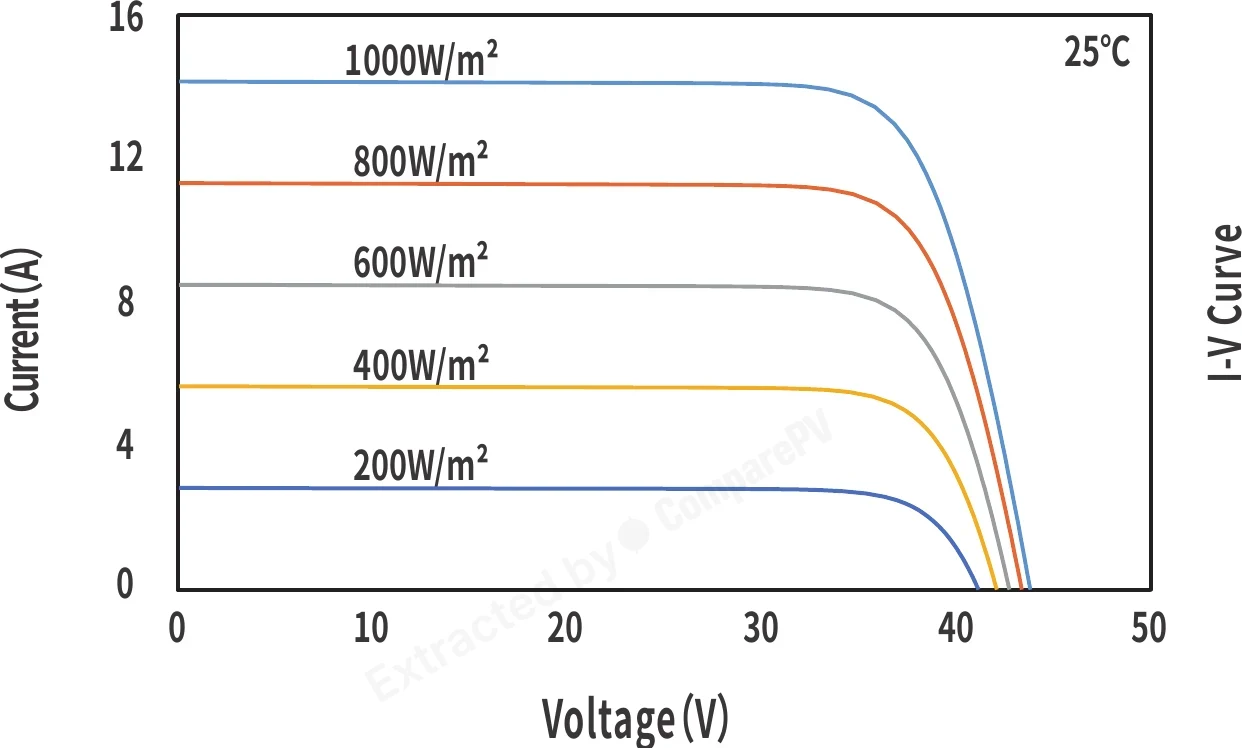
Nominal power (Pmax) 510 Wp Nameplate at 1000 W/m², 25 °C
Module efficiency 22.60 % Typical Segment median 22.73%
Vmpp · Impp 36.33 V · 14.04 A Operating point at max power
Voc · Isc 43.50 V · 14.78 A Sizes the string length
Max system voltage 1500 V Longer strings than 1000 V modules
Dimensions 1994×1134×30 mm · 2.26 m² of roof
Weight 27.5 kg Typical Typical · median 27.0 kg
Bifaciality 80 % Rear output as a share of front
Coefficient Pmax -0.280 %/°C Strong top 10% of its segment
Coefficient Voc · Isc -0.250 · 0.045 %/°C
NOCT 42 °C At 800 W/m², 20 °C ambient
Product warranty 15 years Hardware defects only
Performance warranty 30 years Typical median 30 yrs · median 30 yrs
End-of-warranty output 87.4 % Equals 446 W guaranteed
Degradation 1.00 → 0.40 % First year, then annual

Datasheet charts

Open datasheet PDF

Measured curves published by DAS Solar in this model's datasheet. A chart carrying a wattage was measured on that variant alone - only the ones that describe 510 Wp appear here. The rest cover the whole series.
Simulations

Live - change any input
Lifetime output & value
30 years at 1200 kWh/kWp/year and €0.50 per kWh
Power in year 30
-
Lifetime energy
-
Energy value
-
With bifacial gain
-

Degradation from this panel's own datasheet figures. No inverter, soiling or shading losses.

Heat losses
-0.280 %/°C against a segment median of -0.290
-
Bifacial gain
Rear gain over light concrete: -
-

Model: bifaciality × albedo × 0.6 view factor. A first-order estimate, not a yield simulation.

Filter these
Size
Panel Power Eff. Temp. Weight Difference
DAS Solar DAS-DH120ND-510W 510 W 22.60% -0.280 27.5 kg You are here
LR7-54HJD-510M 510 W 25.00% -0.240 23.5 kg Cooler, lighter, +2.4 pp
AIKO-A495-MCE54Mw 495 W 24.80% -0.260 21.0 kg Cooler, lighter, +2.2 pp
LR7-60HVH-560M 560 W 24.80% -0.260 25.0 kg +50 W, lighter, +2.2 pp
LR7-54HJD-505M 505 W 24.70% -0.240 23.5 kg Cooler, lighter, +2.1 pp
LR7-60HVH-555M 555 W 24.60% -0.260 25.0 kg +45 W, lighter, +2.0 pp
AIKO-A490-MCE54Mw 490 W 24.50% -0.260 21.0 kg Cooler, lighter, +1.9 pp
LR7-54HJD-500M 500 W 24.50% -0.240 23.5 kg Cooler, lighter, +1.9 pp
DAS-DH120ND-490W 490 W 21.70% -0.280 27.5 kg -20 W, -0.9 pp
DAS-DH120ND-495W 495 W 21.90% -0.280 27.5 kg -15 W, -0.7 pp
DAS-DH120ND-500W 500 W 22.10% -0.280 27.5 kg -10 W, -0.5 pp
DAS-DH120ND-505W 505 W 22.30% -0.280 27.5 kg -0.3 pp
DAS-DH120ND-515W 515 W 22.80% -0.280 27.5 kg Very close match
LR7-60HVHL-550M 550 W 24.40% -0.260 16.3 kg +40 W, lighter, +1.8 pp
JAT60S40-540/LR 540 W 24.40% -0.260 23.5 kg +30 W, lighter, +1.8 pp
GK-5-60HG-540M 540 W 24.40% -0.260 23.3 kg +30 W, lighter, +1.8 pp
JKM545-54QL6-DV-F1-EU 545 W 24.27% -0.260 27.5 kg +35 W, cooler, +1.7 pp

Found 81 panels of the same or similar size to this one, within ±10 mm. See them here Found 94 panels of the same or similar size to this one, within ±25 mm. See them here Found 588 panels of the same or similar size to this one, within ±50 mm. See them here Found 1900 panels of the same or similar size to this one, within ±100 mm. See them here

Common questions

6 answered
How does the HJT technology in DAS Solar DAS-DH120ND panels differ from standard monocrystalline PERC cells?
HJT (Heterojunction Technology) cells combine a crystalline silicon layer with thin-film amorphous silicon, achieving module efficiencies of up to 22.8% — well above the typical 20–21% of PERC panels. The N-type cells used in the DAS-DH120ND series also feature a lower temperature coefficient, which means reduced power losses on hot days, as well as inherent resistance to LID (Light Induced Degradation). The net result is higher annual energy yield from the same roof area compared to equivalent PERC technology.
How much additional energy does the DAS-DH120ND Black Pro panel generate thanks to its bifacial design?
The dual-glass bifacial construction allows the panel to capture albedo irradiance reflected from the surface beneath via its rear side. Under favorable conditions — a light-colored ground surface, ground-mounted installation, or a light-colored roof — this translates to up to 30% higher energy generation compared to a conventional monofacial panel of the same nominal power rating. In a typical rooftop installation over dark roofing tiles, the realistic bifacial gain is 5–15%.
Will DAS Solar DAS-DH120ND Black Pro panels withstand Polish winters and heavy snow loads?
Yes. The DAS-DH120ND series uses a dual-glass construction consisting of two layers of tempered glass (2.0 mm + 2.0 mm), providing resistance to snow loads of up to 5,400 Pa and wind pressure of up to 2,400 Pa. These values significantly exceed the structural requirements for the vast majority of locations in Poland. The dual-glass design also offers superior resistance to moisture ingress and mechanical damage compared to standard backsheet-based panels.
What warranty does DAS Solar offer for the DAS-DH120ND series, and what exactly does it cover?
The manufacturer provides a 15-year product warranty covering material and workmanship defects, along with a 30-year linear power output warranty. The power warranty guarantees that after 30 years the panel will retain at least the manufacturer-specified percentage of its nominal power output. DAS Solar is a Tier 1 manufacturer, a classification that reflects the company's financial stability and its credible capacity to honor long-term warranty commitments.
Are the DAS-DH120ND Black Pro panels compatible with 1500 V inverters and systems used by typical Polish installers?
Yes. The DAS-DH120ND series is certified for operation in 1500 V DC systems, which is the current standard in commercial installations and increasingly common in large prosumer systems. Compatibility with 1500 V allows longer strings to be configured, reducing cable runs and simplifying system design. The panels are compatible with inverters from leading manufacturers — including Fronius, SMA, Huawei, and SolarEdge — that support this voltage class.
How much does a DAS Solar DAS-DH120ND panel weigh, and will a typical roof structure support the installation?
A single DAS-DH120ND module weighs approximately 27.5 kg and has dimensions of 1,994 × 1,134 × 30 mm. This is somewhat heavier than lighter 60-cell panels, so a structural assessment of the roof's load-bearing capacity is recommended prior to installation, particularly for older buildings. Standard steel or aluminum mounting systems handle this weight without issue; the critical factor is the load capacity of the rafters and the underlying roof structure.
Add to compare