Solid all-round for its segment
The DAH Bifacial Double Glass Module series redefines performance standards by maximizing the use of reflected and scattered light. Thanks to the use of bifacial energy generation, these modules allow for a significantly higher power yield from the back side of the cells, which drastically shortens the return on investment time, especially on high-albedo surfaces such as light gravel or bright roof membranes. The construction based on a glass-glass structure provides unparalleled resistance to PID degradation and corrosive factors such as ammonia or salt mist, making them an ideal choice for the agro sector and coastal areas. The use of modern N-type TOPCon cells guarantees not only record efficiency but also minimal power degradation over time and excellent performance in low-light conditions. What sets this series apart from the competition is a set of innovative solutions that prevent dust and sediment buildup on the edges, which, combined with extreme mechanical strength, minimizes maintenance costs. These panels are dedicated to demanding photovoltaic farms, industrial installations, and modern carports, where the priority is maximum system longevity exceeding three decades. By choosing these modules, the investor opts for uncompromising technology that effectively handles the toughest environmental challenges.
Ranking
Signals from the data
Utility-scale, commercial and agrivoltaic.
DAH Solar has maintained continuous BNEF Tier 1 listing from Q2 2024 through Q1, Q3, and Q4 2025, directly supporting project bankability and acceptance by financing institutions. None of the peer comparables (Talesun, Horay Solar, AE Solar) appear on this list, making DAH a clearly superior choice for projects requiring external financing.
The measured temperature coefficient is -0.29%/°C, compared to the typical -0.35 to -0.40%/°C for PERC modules. At a cell temperature of 65°C (a summer day in Poland), this advantage over PERC translates to approximately 2.5–3% higher instantaneous yield — equivalent to a real gain of 2–3 MWh of additional annual energy generation for a 100 kWp system.
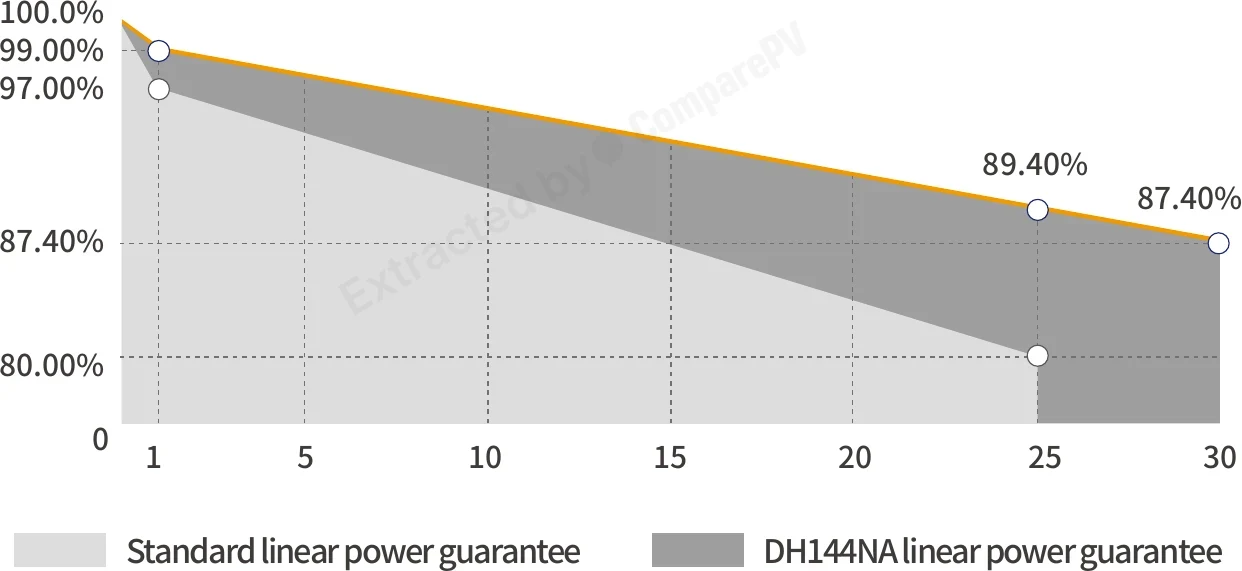
The manufacturer's guaranteed linear degradation schedule ensures at least 87.4% of nominal power output after 30 years. Few manufacturers in this segment offer a comparable warranty level, and with a glass-glass construction and N-type technology (minimal LID degradation), real-world yield over the full service life is statistically expected to exceed the guaranteed minimum.
The glass-glass construction (2 mm + 2 mm) has been tested to snow loads of 5,400 Pa and wind loads of 2,400 Pa, meeting IEC requirements for alpine zones and high-wind environments. By comparison, standard backsheet modules are typically certified to 2,400 Pa snow load and 1,600–2,400 Pa wind load.
The series has been ranked as a Top Performer in the independent PV Module Reliability Scorecard 2025 by KIWA PV Evolution Labs — third-party reliability validation that goes beyond standard TÜV/IEC certifications and carries significant weight during due diligence assessments for utility-scale projects.
Despite its BNEF Tier 1 status, DAH Solar holds a notably smaller share of the European market than Jinko Solar, JA Solar, LONGi, or Trina Solar (all founded between 2006 and 2007). In practice, this may result in longer warranty claim response times in Poland and potentially higher bank financing spreads for PV farm projects above 1 MWp, where lenders tend to prefer Big 4 modules backed by a documented local service presence.
- Efficiency of 22.5% matches the TOPCon 550-600W median
- At 224.5 W/m² power density, roof space requirements are typical for TOPCon 550-600W panels
- Temperature coefficient of -0.30%/°C matches the TOPCon 550-600W median
- Bifacial design (80% factor) captures reflected light - adds 4-12% yield on ground-mount or white roof
- #4222 for efficiency, #6093 for temperature performance out of 14005 panels
Specifications
Datasheet charts
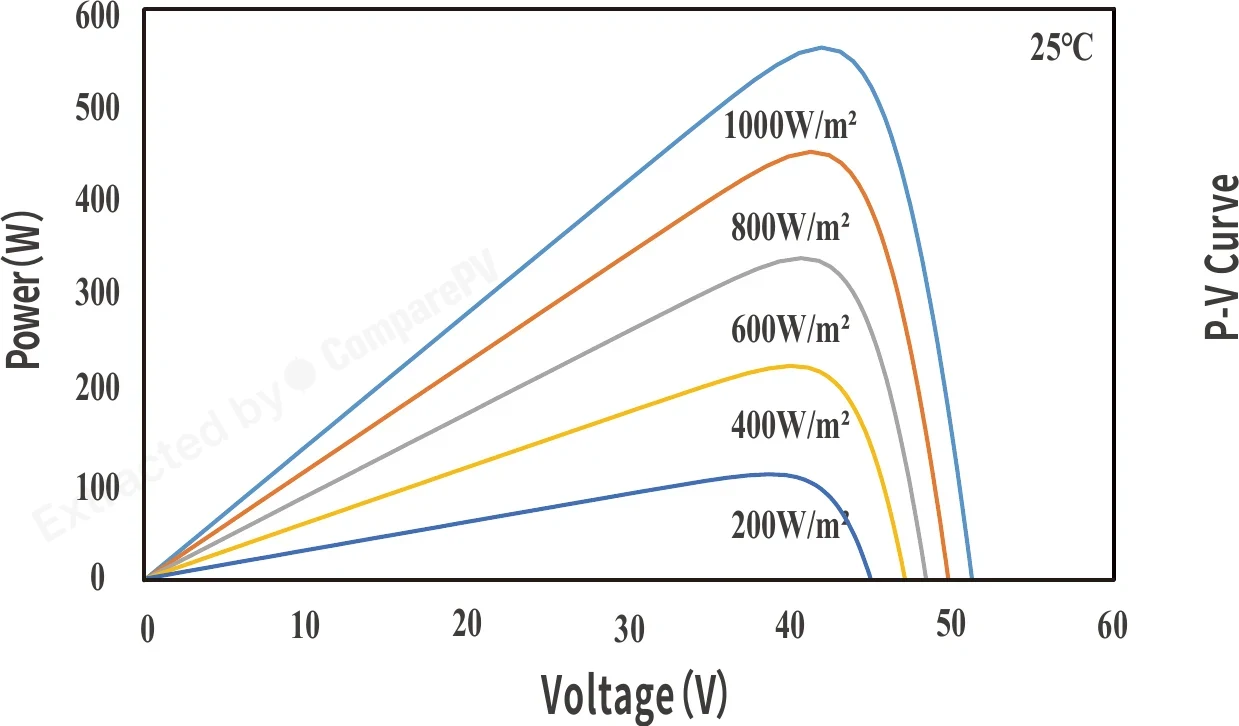
Measured curves published by DAH Solar in this model's datasheet. A chart carrying a wattage was measured on that variant alone - only the ones that describe 580 Wp appear here. The rest cover the whole series.
Simulations
Degradation from this panel's own datasheet figures. No inverter, soiling or shading losses.
Model: bifaciality × albedo × 0.6 view factor. A first-order estimate, not a yield simulation.




Found 2326 panels of the same or similar size to this one, within ±10 mm. See them here Found 2368 panels of the same or similar size to this one, within ±25 mm. See them here Found 2382 panels of the same or similar size to this one, within ±50 mm. See them here Found 2547 panels of the same or similar size to this one, within ±100 mm. See them here