Strong in heat, modest efficiency
The BISOL Lumina BDO series are bifacial photovoltaic modules with a transparent back sheet, which stand out from standard panels due to their unique combination of aesthetics and functionality. Thanks to the use of monocrystalline PERC cells in half-cut technology, as well as a specially designed cell matrix, the modules ensure uniform light penetration - which opens up completely new architectural possibilities. The Lumina series is the ideal solution wherever a panel needs to simultaneously function as a building barrier or roof covering: carports, greenhouses, roof-mounted skylights, pavilions, and agrivoltaic installations are its natural environment. The bifacial nature of the cells allows for energy generation from reflected light from the ground, which significantly increases yield compared to classic monofacial modules. An additional advantage is that the panels are designed and manufactured 100% in the European Union, which translates into consistent quality and a shortened supply chain. Lumina BDO is the choice for investors and architects looking for a solution in which photovoltaic installation becomes an integral, aesthetically pleasing element of the building or infrastructure, rather than just an addition mounted on the roof.
Ranking
Signals from the data
BIPV, agrivoltaic, shaded-installations and commercial.
Tight roof space and roofs where every square metre has to count.
Top 5% of the PERC 300-350 W segment, against a median of -0.360. Ranked 6,152nd in the whole database.
Bottom 22% of the PERC 300-350 W segment, against a median of 19.00%.
Bottom 23% of the PERC 300-350 W segment, against a median of 190.0.
The module combines the function of a building envelope element with energy generation - its transparent back sheet allows natural light transmission, making it one of the few panels on the market suitable for direct use in carports, skylights, winter gardens, and agrivoltaic installations without additional architectural modifications.
Bisol designs and manufactures its modules in Slovenia, ensuring a shortened supply chain, full compliance with European quality standards, and predictable after-sales serviceability - in contrast to the vast majority of competitors manufacturing in China.
The Pmax temperature coefficient of -0.30%/°C outperforms typical monofacial PERC modules (-0.35 to -0.37%/°C) and approaches HJT-class performance. This translates into measurably higher energy yields during summer months when rooftop operating temperatures are elevated.
According to the manufacturer's official documentation, the rear side of the module can generate up to 60% additional energy relative to the front side under favorable albedo conditions (light-colored surfaces, agrivoltaic setups), meaningfully increasing total annual energy yield above the rated 340 Wp STC.
Splitting cells into half-cut format reduces internal resistance and limits the impact of partial shading on the entire string - a particularly relevant advantage in vertical installations such as carports and facades, where the probability of partial shade is higher than on a conventional pitched roof.
Peer-comparable modules achieve 20.3-20.4% efficiency (Panasonic HIT+ N340, Bruk-Bet NIVO EXTREME) at the same rated power of 340 Wp - meaning the Lumina BDO requires approximately 15-17% more mounting area per kilowatt of installed capacity. In space-constrained installations, this difference is operationally significant.
The Lumina series is based on PERC cells introduced to the product lineup in 2014. Newer cell generations (TOPCon, HJT) offer lower LID/LeTID degradation rates and higher bifaciality factors. No information is available regarding a planned migration of the series to N-type cell technology.
The manufacturer offers a 15-year product warranty, while leading manufacturers (e.g., Panasonic, REC, Q CELLS Premium) have standardized on 25-year product warranties. For investments with a 20-30 year horizon, this gap may be material in financial risk assessments.
Bisol Group does not appear on the BloombergNEF Tier-1 list (confirmed as of Q1 2026), which may complicate non-recourse financing for commercial and utility-scale projects with lenders requiring products from bankable manufacturers - the manufacturer itself has published a statement distancing itself from this classification.
- At 17.4% efficiency, this panel is 2.1pp below the PERC 0-400W median of 19.4%
- Power density of 174.1 W/m² is 20.1 W/m² below PERC 0-400W median (194.2 W/m²) - needs more roof space
- Temperature coefficient of -0.30%/°C vs median -0.36%/°C means ~2% less power loss at 65°C
- Weight of 22.0 kg is 1.5 kg above PERC 0-400W median (20.5 kg) - verify structural support
- Bifacial design (70% factor) captures reflected light - adds 4-10% yield on ground-mount or white roof
Specifications
Datasheet charts
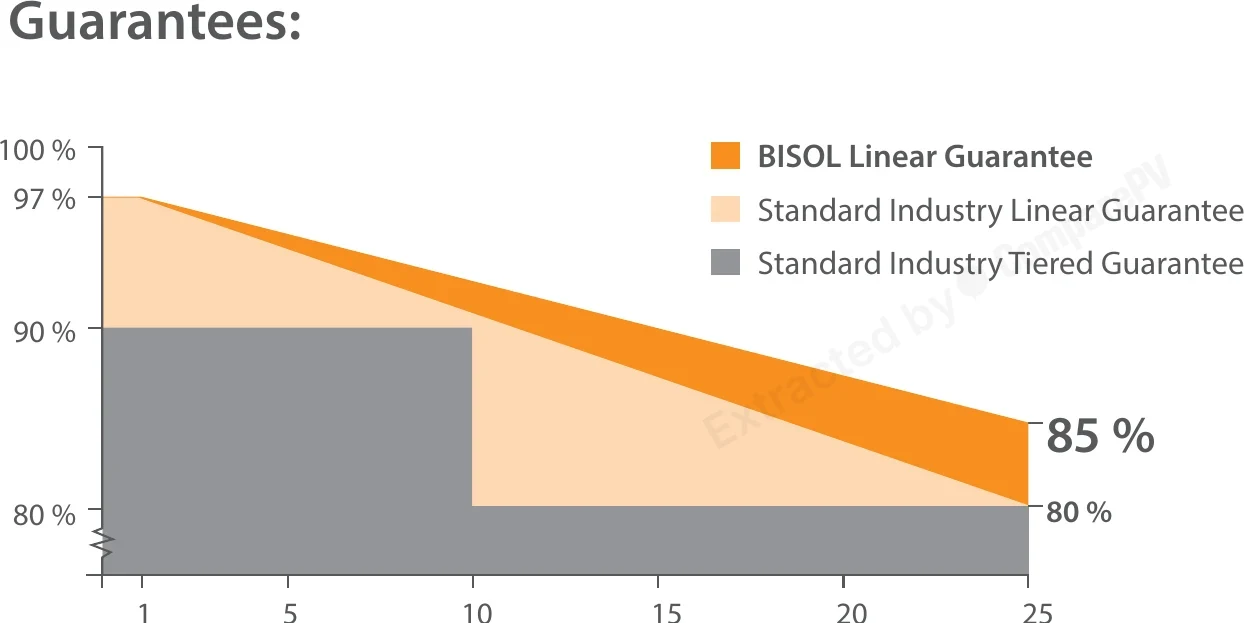
Measured curves published by Bisol in this model's datasheet. A chart carrying a wattage was measured on that variant alone - only the ones that describe 340 Wp appear here. The rest cover the whole series.
Simulations
Degradation from this panel's own datasheet figures. No inverter, soiling or shading losses.
Model: bifaciality × albedo × 0.6 view factor. A first-order estimate, not a yield simulation.






Found 1797 panels of the same or similar size to this one, within ±10 mm. See them here Found 1928 panels of the same or similar size to this one, within ±25 mm. See them here Found 3413 panels of the same or similar size to this one, within ±50 mm. See them here Found 4007 panels of the same or similar size to this one, within ±100 mm. See them here
About the Lumina series
These answers cover the whole series. Where a figure differs, the specification above is this module's own.