
Space saver, no clear weak spot
The Astronergy ASTRO N5s (Monofacial Series) was designed for maximum energy production from limited roof space, without compromising on aesthetics and durability. These modules feature a compact structure, often chosen where convenient installation and a cohesive system appearance matter - such as on single-family homes, segment roofs, small businesses, or premium projects.
A key advantage is the use of n-type TOPCon cells, which help maintain high efficiency over a long operational lifespan and reduce typical losses seen in standard technologies. In practice, this translates to a more reliable yield in real-world conditions, even at higher temperatures and varying sunlight exposure. Additionally, SMBB technology enhances current flow and improves resistance to micro-cracking, contributing to dependability.
The ASTRO N5s features an all-black design, making it an excellent fit for modern roofs, where appearance is key. This series is for investors seeking higher power density on the roof, easier logistics, and a sensible cost-yield balance for years to come.
Ranking
Signals from the data
Residential, commercial, shaded-installations and hot-climate.
Top 8% of the TOPCon 400-450 W segment, against a median of 220.2. Ranked 4,099th in the whole database.
Top 9% of the TOPCon 400-450 W segment, against a median of 22.00%. Ranked 4,222nd in the whole database.
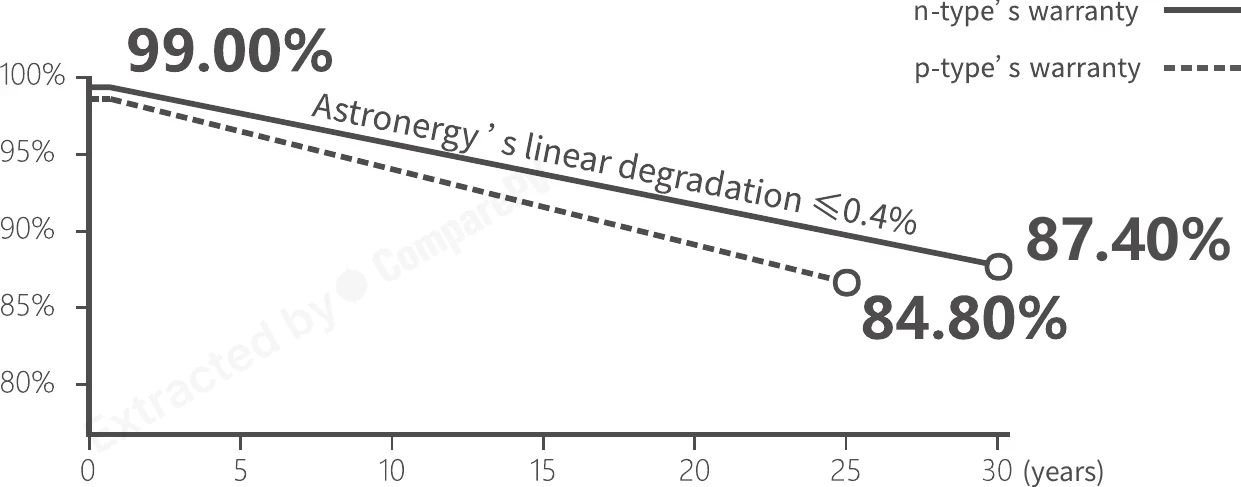
Independent tests by CPVT confirmed a first-year degradation rate of 0.66% for ASTRO N modules, compared to the industry average of approximately 1.0%. Subsequent years: 0.4% per year (linear degradation). This translates to approximately 150-200 kWh more per year for a 10 kWp installation, compared to typical PERC modules.
The efficiency of -0.29%/°C (data from the CHSM54N-HC datasheet) is significantly better than the standard PERC (-0.35%/°C). At a typical operating temperature of 60°C, this translates to approximately 7W more power per module compared to a comparable PERC module – which is particularly important in the Polish climate, where roofs can get very hot in the summer.
The manufacturer guarantees >87.4% power output after 30 years, and the warranty is protected by an external insurance company (Lloyd's of London / Astronergy reinsurance program), which means that claims can be pursued even in the event of the manufacturer's bankruptcy – a rare feature in the mid-range segment.
Astronergy is listed on the BNEF Tier 1 list (confirmed for Q2 2025) and ranked 6th in the Bloomberg Bankability ranking in 2023, with an annual production capacity of 56 GW. For projects requiring bank financing, it is one of the few Tier B manufacturers with full market acceptance.
The 54-cell format (1722×1134 mm) with efficiency up to 22.5% achieves a power density of approximately 227 W/m² – comparable to KDM Kingdom Solar (22.5%) and Lina Energy LEPV 132 (22.37%) in the same 440 Wp power range, while maintaining convenient installation logistics on rooftops.
The standard product warranty is 15 years, while some competitors in the TOPCon segment (including certain Astronergy and Luxor Solar variants on premium markets) offer 25 years. For prosumer installations with an expected lifespan of 25+ years, this difference is significant in the event of any mechanical issues.
The maximum efficiency of 22.5% is lower than Luxor ECO LINE N-TYPE NON-REFLECT (22.86%) with the same power rating of 440 Wp and similar TOPCon technology. The difference of 0.36% in efficiency per panel with an area of approximately 1.95 m² translates to roughly 7 W per module – which, with 20 panels, results in approximately 140 Wp less without compromising on price.
- Efficiency of 22.5% matches the TOPCon 400-450W median
- At 225.3 W/m² power density, this panel generates 5.1 W/m² more per unit area than TOPCon 400-450W median (220.2 W/m²)
- Temperature coefficient of -0.29%/°C matches the TOPCon 400-450W median
- #4222 for efficiency, #2165 for temperature performance out of 14005 panels
Specifications
Datasheet charts
Measured curves published by Astronergy in this model's datasheet. A chart carrying a wattage was measured on that variant alone - only the ones that describe 440 Wp appear here. The rest cover the whole series.
Simulations
Degradation from this panel's own datasheet figures. No inverter, soiling or shading losses.








Found 1783 panels of the same or similar size to this one, within ±10 mm. See them here Found 1914 panels of the same or similar size to this one, within ±25 mm. See them here Found 3392 panels of the same or similar size to this one, within ±50 mm. See them here Found 3970 panels of the same or similar size to this one, within ±100 mm. See them here