Warranty pick, heavy for its output
The AE Solar AURORA (ME-120BD) series is designed to maximize energy yield in locations where every square meter and long-term stability are crucial. These are bifacial modules that can utilize not only direct sunlight, but also light reflected from the ground - allowing the installation to produce more energy under the same conditions. The use of a double-glass construction enhances resistance to environmental factors and minor damage, which is important for roofs exposed to wind, hail, or significant temperature fluctuations. Mono-PERC cells with gallium doping, along with a half-cut design, help reduce losses and improve performance under partial shading, typical in homes with chimneys or commercial installations on roofs. The ME-120BD series is suitable for modern roof and ground-mounted projects, especially where durability, better performance in diffuse light, and predictable energy yield over the entire lifespan are important.
Ranking
Signals from the data
Commercial, utility-scale and shaded-installations.
Weight-limited structures.
Top 25% of the PERC 550-600 W segment, against a median of 27 yrs.
Bottom 17% of the PERC 550-600 W segment, against a median of 52.7.
AE Solar (headquartered in Germany, founded in 2003) has been listed on BNEF's Tier-1 ranking for over 16 quarters and is the only European manufacturer in BNEF's 2024 bankability ranking, where its indicator has increased from 26% (2023) to 50% (2024). This directly translates to easier financing of projects by banks and a higher residual value for the installations.
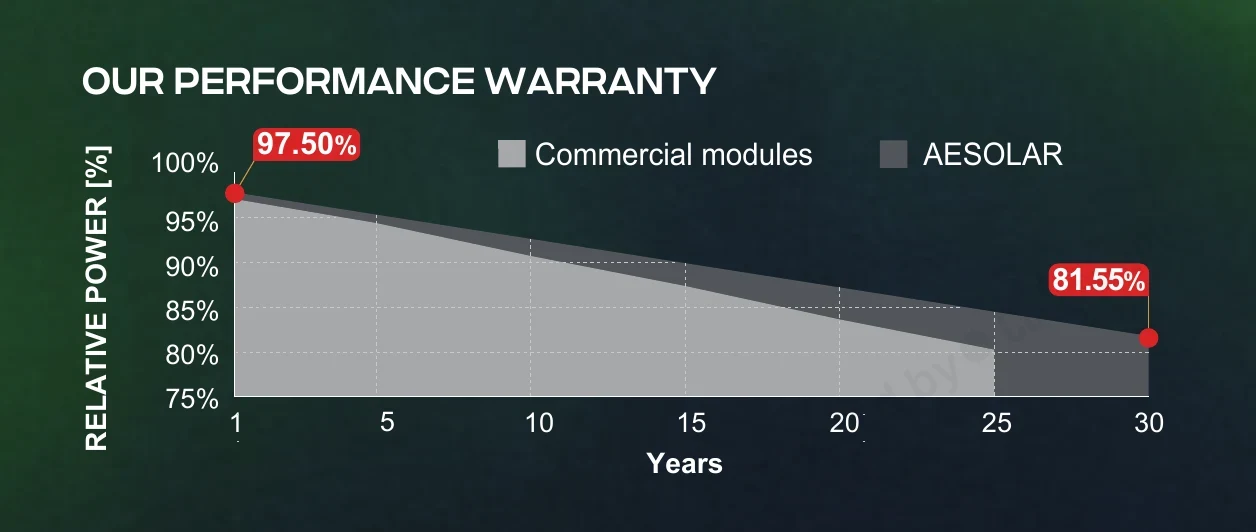
The manufacturer guarantees ≥87% of the rated power after 30 years of operation for both warranty components - product warranty and linear power warranty. Comparable models from the competition (e.g., Talesun BISTAR TP7F78M) typically offer a 25-year power warranty, making the ME-120BD more advantageous in long-term utility and commercial projects.
Bifacial modules with a back-facing glass achieve a bifaciality factor of approximately 70%, allowing for additional energy generation from reflected light (particularly on bright surfaces such as concrete, light membranes, or snow). The double-glass construction eliminates the risk of degradation from the back sheet and improves resistance to mechanical loads and corrosion.
The use of gallium doping in mono-PERC cells reduces the LID (Light-Induced Degradation) effect, which in traditional boron-doped PERC cells can range from 1-2% in the first year. The half-cut (120-cell) configuration reduces resistive losses and improves performance under partial shading compared to full-cell predecessors in the same power class.
The ME-120BD series has been discontinued, which means limited and declining market availability, no further production of the model, and a potential difficulty in replacing a faulty module under warranty after 10-15 years. This is a significant concern for projects that require expansion or long-term technical support.
Direct equivalents in the 580-600Wp segment - Tongwei TWMND N-type (23.2% efficiency) and Lexron 144 CELL TOPCon (23.23%) - achieve approximately 2% higher module efficiency, a higher bifaciality ratio (~85% vs ~70%), and a more favorable temperature coefficient (-0.30 vs -0.35%/°C for PERC). Field tests in 2025 are expected to show approximately 1.5-2.5% higher annual energy yield with TOPCon under the same mounting conditions.
- At 21.1% efficiency, this panel is on par with typical PERC 550-600W modules
- Power density of 210.5 W/m² matches the PERC 550-600W median
- At -0.34%/°C, hot weather performance is typical for PERC 550-600W panels
- At 35.0 kg (4.2 kg above PERC 550-600W median of 30.8 kg), requires checking roof load capacity
- 70% bifaciality enables rear-side power generation, boosting yield by 4-10% on reflective surfaces
Specifications
Datasheet charts
Measured curves published by AE Solar in this model's datasheet. A chart carrying a wattage was measured on that variant alone - only the ones that describe 595 Wp appear here. The rest cover the whole series.
Simulations
Degradation from this panel's own datasheet figures. No inverter, soiling or shading losses.
Model: bifaciality × albedo × 0.6 view factor. A first-order estimate, not a yield simulation.







Found 497 panels of the same or similar size to this one, within ±10 mm. See them here Found 502 panels of the same or similar size to this one, within ±25 mm. See them here Found 502 panels of the same or similar size to this one, within ±50 mm. See them here Found 502 panels of the same or similar size to this one, within ±100 mm. See them here
About the AURORA (ME-120BD) series
These answers cover the whole series. Where a figure differs, the specification above is this module's own.