
Light for its output, no clear weak spot
The AE Solar AE MD-144BS panel series focuses on maximizing energy yields through the use of advanced bifacial technology, which allows for the absorption of sunlight from both sides of the module. This is a key solution for ground-mounted installations and surfaces with high albedo, where reflected light significantly increases total electricity production. The design, based on 144 half-cut cells, effectively minimizes resistance losses and limits the negative impact of partial shading on the stability of the entire system. A distinguishing feature of this series is its high resistance to the LID effect, achieved through the gallium-doping process, which guarantees the maintenance of nominal power over the long term. These panels solve the problem of limited installation space by offering higher power density per square meter compared to standard monofacial modules. They are primarily intended for commercial investments and solar farms, where the lowest levelized cost of energy (LCOE) matters. A robust frame and tempered glass ensure exceptional mechanical strength against snow and wind loads, which distinguishes them from cheaper alternatives with lower rigidity. By choosing AE MD-144BS, investors receive a product that combines German engineering precision with an innovative approach to reducing the risk of hot-spot formation, which directly translates into fire safety and trouble-free operation for decades.
Ranking
Signals from the data
Commercial, utility-scale and shaded-installations.
Top 11% of the PERC 500-550 W segment, against a median of 53.0.
AE Solar is listed on the BNEF Tier 1 list for the 16th time (Q1 2025), and is the only European manufacturer with this status. The bankability has increased from 26% (2023) to 50% (2024), which directly reduces the cost of financing PV farm projects by commercial banks.
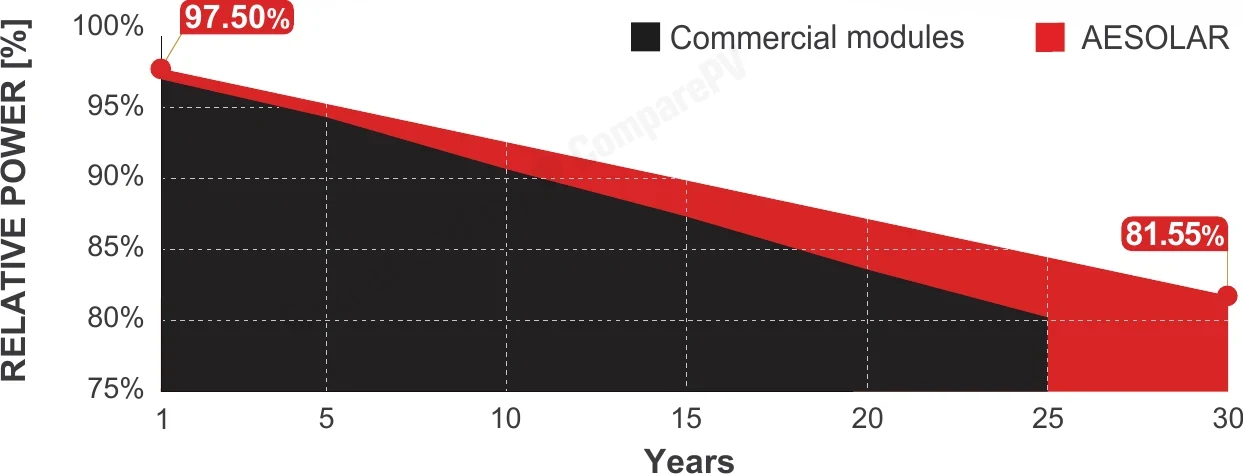
Both the product warranty and the power warranty cover a period of 30 years - 5 years longer than the standard 25-year warranties offered by most manufacturers in the segment (e.g., typical offerings from JA Solar, Trina Solar). The longer coverage reduces financial risks in LCOE models for commercial investments.
The series achieves a maximum efficiency of 21.31%, placing it on par with direct competitors such as Goldi Solar GS10-B144-TF (21.3%) and IBC Solar 182M (21.28%). The higher power density per square meter reduces the number of modules and BOS (balance of system) costs in ground-mounted installations.
The use of gallium-doped wafers instead of boron-doped wafers eliminates the classic LID (Light Induced Degradation) effect observed in standard p-type solar cells in the first year of operation. The manufacturer's datasheets also confirm resistance to PID (Potential Induced Degradation), saline mist, sand, and ammonia - which expands the range of applications to industrial and coastal environments.
Half-cut configuration reduces current in each half of the string, lowering resistive losses and limiting the impact of partial shading. When combined with bifacial technology, the module can achieve a real additional gain of 5-15% in ground-mounted installations with a high albedo surface (e.g., sand, concrete, snow).
PERC cells exhibit an annual degradation rate of 0.6-0.8%, while newer TOPCon cells achieve a rate of 0.4-0.5%, and the bifaciality coefficient for PERC is approximately 70% compared to approximately 83-85% for TOPCon. Market forecasts (2025-2026) indicate a decline in the share of PERC below 25% of global production capacity, which could make it more difficult to secure project financing in the future, as banks tend to favor newer technologies.
- At 20.7% efficiency, this panel is on par with typical PERC 500-550W modules
- At 207.3 W/m² power density, roof space requirements are typical for PERC 500-550W panels
- Temperature coefficient of -0.35%/°C matches the PERC 500-550W median
- 26.5 kg weight - 1.8 kg lighter than PERC 500-550W median (28.3 kg), reducing installation effort
- Bifaciality factor of 70% can add 4-10% extra yield with reflective mounting surface
Specifications
Datasheet charts
Measured curves published by AE Solar in this model's datasheet. A chart carrying a wattage was measured on that variant alone - only the ones that describe 535 Wp appear here. The rest cover the whole series.
Simulations
Degradation from this panel's own datasheet figures. No inverter, soiling or shading losses.
Model: bifaciality × albedo × 0.6 view factor. A first-order estimate, not a yield simulation.




Found 2327 panels of the same or similar size to this one, within ±10 mm. See them here Found 2369 panels of the same or similar size to this one, within ±25 mm. See them here Found 2383 panels of the same or similar size to this one, within ±50 mm. See them here Found 2548 panels of the same or similar size to this one, within ±100 mm. See them here
About the AE MD-144BS series
These answers cover the whole series. Where a figure differs, the specification above is this module's own.