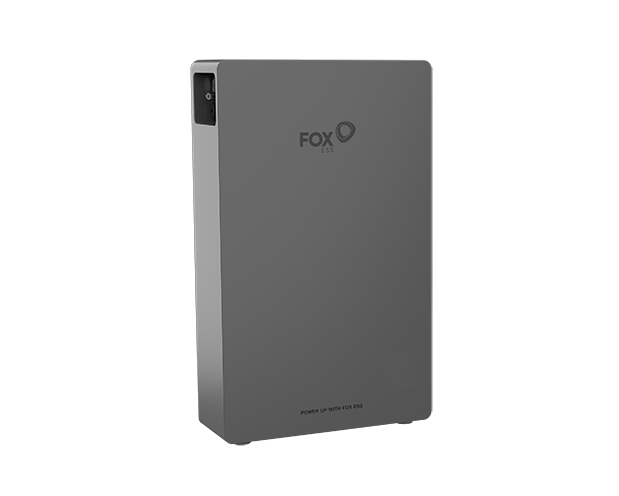

FoxESS EP5
The FoxESS EP (high-voltage system) energy storage series offers a practical solution designed for scalability and easy installation, prioritizing safety without compromise. Its key advantage lies in the LiFePO4 (LFP) battery chemistry, valued for its thermal stability, high resistance to overheating, and long lifespan compared to NMC, translating to a more reliable and predictable operation for years in real-world conditions.
High efficiency and operation in a high-voltage architecture are also crucial in daily use, enabling seamless integration with modern hybrid systems. The EP system allows for scalability through adding additional modules (including in parallel), making it adaptable to increasing energy consumption or larger PV installations.
The design benefits from an enclosure with an IP65 rating and flexible mounting options (wall or floor). The declared cycle life and long warranty provide real protection for the investment - whether for homes, businesses, or backup and off-grid applications.
Ranking
Specifications
Pros and cons
LFP chemistry offers a thermal runaway temperature of approximately 270°C, compared to ~150°C for NMC batteries, which significantly reduces the risk of fire. The declared cycle life for EP11 is >4,000, while newer versions (EP12) can reach up to 6,000 cycles, providing approximately 11-16 years of active use without the need for replacement under typical operating conditions.
The datasheet confirms a cyclic efficiency of ≥95% and a DoD (Depth of Discharge) of 90%, meaning that an EP11 module with a nominal capacity of 10.36 kWh actually provides 9.32 kWh - this performance is competitive with, for example, BYD Battery-Box HVM (DoD 90%) and Pylontech FORCE H2 (DoD 90%), placing FoxESS EP at the higher end of the HV segment.
The nominal voltage of 384V (ranging from 348-438V for EP11) reduces operating currents at the same power level, which translates to lower resistive losses in DC wiring and better compatibility with hybrid HV inverters (e.g., FoxESS H3 PRO, AIO H3). Compared to low-voltage systems (~48V, e.g., Pylontech US5000), it eliminates the need for thicker cable cross-sections in large installations.
The modular design allows for the connection of up to 4 units in parallel - the EP11 can scale to 41.6 kWh, and the EP12 to 46.08 kWh. It is also possible to add modules over time, without replacing the entire system. This provides the flexibility that is not available, for example, in the Huawei LUNA2000, where the maximum capacity for a single inverter is 30 kWh.
The IP65 degree of protection allows for installation in garages, boiler rooms, and technical rooms without an external enclosure, and the wall or floor mounting option makes it easy to adapt to different sizes. Some versions (EP11-H, EP12-H) include a heating element, which expands the operating range at low temperatures - a key feature for the climate in central Europe.
Founded in 2019, FoxESS offers a 10-year battery warranty, but the company itself has only existed for approximately 6 years. The financial continuity risk associated with the service is higher than that of manufacturers with a long track record (e.g., BYD, founded in 1995, and Panasonic/EnerSys). Institutional investors and installers pay close attention to this lack of a proven track record when assessing the service risk for installations with a lifespan of 15+ years.
Independent industry-specific services (such as SolarQuotes AU and the FoxESS Community Forum) document instances of delayed or ineffective responses from support departments - including delays in firmware updates, difficulty reaching support via phone or email. This contrasts with established leaders in after-sales support, such as SMA and Victron, and could be a significant constraint for commercial installations with strict service level agreements (SLAs).
Alternatives






About the EP (High Voltage Battery System) series
These answers cover the whole series. Where a figure differs, the specification above is this model's own.