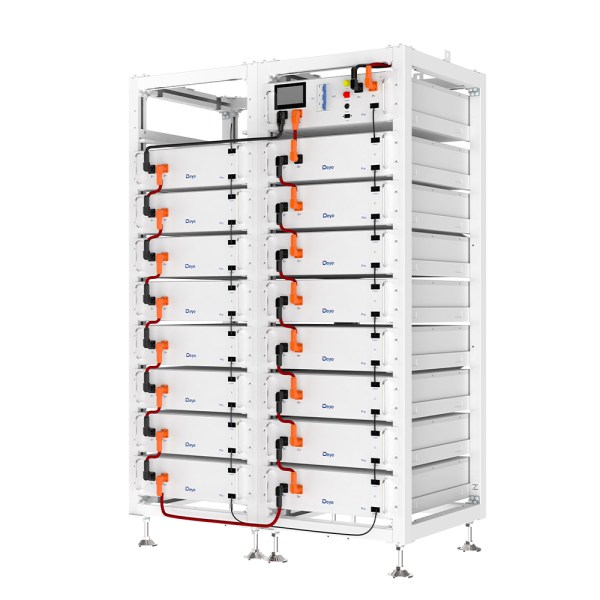

Deye BOS-G40 Pro
High-voltage energy storage solutions in the 19-inch rack standard, designed for quick and predictable installation and service. The key advantage lies in the LiFePO4 (LFP) chemistry - compared to NMC, it offers higher thermal stability, greater operational safety, and excellent durability in daily charging and discharging cycles. Parameter control is managed by an intelligent BMS, which balances the cells and protects the system from common operational risks, while additional fire safety solutions are also incorporated.
The BOS-G Pro features modular scalability - you can expand capacity as renewable energy consumption or backup power needs grow, without replacing the entire system. Its declared lifespan, measured in thousands of cycles, along with the long warranty, translates to lower energy costs over time and reduced investment risk. Communication via CAN and RS485 facilitates compatibility with hybrid inverters and the construction of off-grid, on-grid, and residential/commercial installations.
Ranking
Specifications
Pros and cons
LFP cells are reported to withstand over 6,000 cycles at 0.5 C and a 70% Depth of Discharge (DoD) at 25°C, which is significantly better than typical NMC-based storage systems (approximately 3,000-4,000 cycles). In practice, this translates to over 16 years of use with a single cycle per day, resulting in a lower Levelized Cost of Energy (LCOE).
Each module provides 5.12 kWh in a standard 19" rack format, allowing for precise matching of capacity to needs and expansion of the system without replacing the entire system. This is an advantage over compact all-in-one units, which do not offer this level of scalability.
Deye offered a 10-year warranty, and the product brochure was updated in January 2026 (v1.0), which confirms that the manufacturer actively supports this product line. This provides the investor with the assurance of ongoing service and technical support throughout the warranty period.
Support for both communication standards (CAN 2.0 and RS485) ensures native compatibility with a wide range of hybrid inverter ecosystems (including Deye, Growatt, Solis, SMA, and Victron). This eliminates the need for protocol converters, simplifying integration.
The certified operating range of -20°C to +55°C allows the system to be installed in unheated boiler rooms or cool garages without risking warranty loss - a significant advantage in a central European climate, where winter temperatures can drop several degrees below zero in technical areas.
The IP20 protection level only protects against objects larger than 12.5 mm and provides no protection against moisture. Competitive rack-HV systems, such as BYD HVM (IP55), allow for installation in outdoor or humid environments. This limits the flexibility of location - a dry, enclosed technical room is required.
Alternatives

About the BOS-G Pro series
These answers cover the whole series. Where a figure differs, the specification above is this model's own.