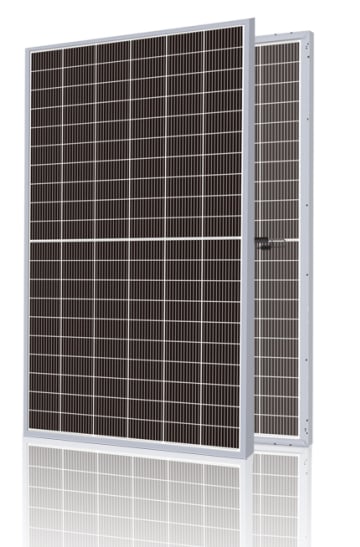
ZNShine ZXM8-TPLDD120-595

ZXM8-TPLDD120-595

595 Wp PERC Bifacial 70%
ComparePV verdict

Warranty pick, heavy for its output

Rank 5,659 of 14,005
Compare panels Datasheet PDF
Power (Wp)
595
Strong · top 6%
Efficiency (%)
21.02
Typical · median 21.29%
Density (Wp/m²)
210.2
Typical · median 212.9
Temp (%/°C)
-0.340
Typical · median -0.350
Weight (kg)
35.0
Weak · 4.2 kg above median
Warranty (yrs)
30
Strong · top 25%

The ZNShine ZXM8-TPLDD120 series is designed for maximum energy yield in real-world operating conditions-including when the installation does not have ideal exposure. These are bifacial modules in double glass construction, capable of harnessing reflected light from the ground surface, thereby enhancing annual production. The application of half-cut technology minimizes losses and supports stable operation under partial shading, while multi-string wiring facilitates a uniform energy flow and higher reliability.

In practice, this series addresses typical challenges faced by large-scale projects and industrial roofs: reduced yield during weaker light conditions, increased risk of micro-cracking, and faster aging in harsher environments. These modules are engineered for operation in areas with elevated humidity, dust exposure, or near agricultural installations-hence, they perform exceptionally well in PV farms, warehouses, industrial facilities, and commercial projects where external resistance and predictable operation are crucial.

Ranking

589 panels in the segment PERC 550-600 W
Metric This panel Median Position in segment Overall rank
Module efficiency 21.02% 21.29% Typical 9,696
Power density 210.2 212.9 Typical 9,670
Temperature coefficient -0.340 -0.350 Typical 8,778
Weight per kWp 58.8 52.7 Weak · bottom 17% 11,913
Performance warranty 30 yrs 27 yrs Strong · top 25% 21
Colour key Strong - top 25% Typical - middle 50% Weak - bottom 25%

Signals from the data

1 positive · 1 caution
Best for

Commercial, utility-scale and shaded-installations.

Not ideal for

Weight-limited structures.

Strengths
30 year performance warranty

Top 25% of the PERC 550-600 W segment, against a median of 27 yrs.

Watch-outs
58.8 kg per kWp

Bottom 17% of the PERC 550-600 W segment, against a median of 52.7.

Notes from the database
  • At 21.0% efficiency, this panel is on par with typical PERC 550-600W modules
  • At 210.2 W/m² power density, roof space requirements are typical for PERC 550-600W panels
  • Temperature coefficient of -0.34%/°C matches the PERC 550-600W median
  • At 35.0 kg, this panel is 4.2 kg heavier than the PERC 550-600W median (30.8 kg) - more demanding for installation crews
  • Bifaciality factor of 70% can add 4-10% extra yield with reflective mounting surface

Specifications

Open datasheet PDF
Nominal power (Pmax) 595 Wp Nameplate at 1000 W/m², 25 °C
Module efficiency 21.02 % Typical Segment median 21.29%
Vmpp · Impp 34.30 V · 17.35 A Operating point at max power
Voc · Isc 41.30 V · 18.29 A Sizes the string length
Max system voltage 1500 V Longer strings than 1000 V modules
Dimensions 2172×1303×35 mm · 2.83 m² of roof
Weight 35.0 kg Weak Weak · 4.2 kg above median
Cells 120 · PERC Monocrystalline
Bifaciality 70 % Rear output as a share of front
Coefficient Pmax -0.340 %/°C Typical median -0.350 of its segment
Coefficient Voc · Isc -0.290 · 0.050 %/°C
NOCT 43 °C At 800 W/m², 20 °C ambient
Product warranty 12 years Hardware defects only
Performance warranty 30 years Strong top 25% · median 27 yrs
End-of-warranty output 85.0 % Equals 505 W guaranteed
Degradation 2.00 → 0.45 % First year, then annual

Simulations

Live - change any input
Lifetime output & value
30 years at 1200 kWh/kWp/year and €0.50 per kWh
Power in year 30
-
Lifetime energy
-
Energy value
-
With bifacial gain
-

Degradation from this panel's own datasheet figures. No inverter, soiling or shading losses.

Heat losses
-0.340 %/°C against a segment median of -0.350
-
Bifacial gain
Rear gain over light concrete: -
-

Model: bifaciality × albedo × 0.6 view factor. A first-order estimate, not a yield simulation.

Filter these
Size
Panel Power Eff. Temp. Weight Difference
ZNShine ZXM8-TPLDD120-595 595 W 21.02% -0.340 35.0 kg You are here
AIKO-A645-MAE72Mw 645 W 25.00% -0.260 27.0 kg Cooler, lighter, +4.0 pp
LR7-60HVH-560M 560 W 24.80% -0.260 25.0 kg Cooler, lighter, +3.8 pp
AIKO-A640-MAE72Mw 640 W 24.80% -0.260 27.0 kg Cooler, lighter, +3.8 pp
LR7-60HVH-555M 555 W 24.60% -0.260 25.0 kg Cooler, lighter, +3.6 pp
AIKO-A635-MAE72Mw 635 W 24.60% -0.260 27.0 kg Cooler, lighter, +3.6 pp
ZXM8-TPLD120-585 585 W 20.67% -0.340 35.0 kg -10 W, -0.3 pp
ZXM8-TPLD120-590 590 W 20.85% -0.340 35.0 kg Very close match
ZXM8-TPLD120-600 600 W 21.20% -0.340 35.0 kg Very close match
ZXM8-TPLD120-605 605 W 21.38% -0.340 35.0 kg +10 W, +0.4 pp
GKA210N120 680 W 24.03% -0.340 28.0 kg +85 W, lighter, +3.0 pp
GKA210N120-675 675 W 23.85% -0.340 28.0 kg +80 W, lighter, +2.8 pp
QN-670HJT-01 670 W 23.70% -0.240 35.5 kg +75 W, cooler, +2.7 pp
GKA210N120-670 670 W 23.67% -0.340 28.0 kg +75 W, lighter, +2.7 pp
QN-665HJT-01 665 W 23.50% -0.240 35.5 kg +70 W, cooler, +2.5 pp
GKA210N120-665 665 W 23.50% -0.340 28.0 kg +70 W, lighter, +2.5 pp
SPDG660-N120M12 660 W 23.32% -0.300 34.2 kg +65 W, cooler, +2.3 pp

Found 497 panels of the same or similar size to this one, within ±10 mm. See them here Found 502 panels of the same or similar size to this one, within ±25 mm. See them here Found 502 panels of the same or similar size to this one, within ±50 mm. See them here Found 506 panels of the same or similar size to this one, within ±100 mm. See them here

Common questions

6 answered
How much extra energy do the bifacial ZNShine ZXM8-TPLDD120 panels actually generate?
Thanks to the double glass construction and bifacial technology, ZXM8-TPLDD120 modules capture additional light reflected from the ground surface beneath the array. With a bright surface such as gravel or a white roof membrane, annual energy yield can increase by several to over ten percent compared to a monofacial module of the same 610 Wp rating. The actual gain depends on mounting height and ground albedo.
Are ZXM8-TPLDD120 panels suitable for large industrial roofs and solar farms?
Yes, this series is primarily designed for commercial and utility-scale installations. Dimensions of 2172x1303 mm and a weight of about 35 kg require a sturdy mounting structure, typical of industrial roofs and ground-mounted solar farms. Resistance to humidity and dust makes these modules well suited for use near agricultural and production facilities as well.
What warranty does ZNShine offer on power output and product quality for the ZXM8-TPLDD120 series?
The manufacturer provides a 12-year product warranty and a 30-year linear power warranty, guaranteeing at least 84.95 percent of initial output after 30 years of operation. This is a standard typical of Tier 1 manufacturers, confirming the maturity of the technology and the financial stability of ZNShine as a supplier.
How does half-cut cell technology in the ZXM8-TPLDD120 differ from full-cell modules?
Half-cut cells are split in half, reducing electrical resistance and power losses under partial shading, for example from a chimney or antenna. If one half of the panel is shaded, the other half continues operating efficiently, and the multi-busbar (12BB) design further improves current flow and reduces the risk of performance loss from microcracks.
What is the efficiency and maximum power output of the ZNShine ZXM8-TPLDD120 series?
This series delivers up to 610 Wp with module efficiency reaching around 21.5 percent, placing it among the top-performing monocrystalline PERC panels on the market. Combining PERC cells with bifacial technology and a double glass build allows for high power density per unit area, which matters when roof or ground space is limited.
Do ZXM8-TPLDD120 panels perform well in cold climates and low temperatures?
Yes, the temperature coefficient of power is -0.34 percent per degree Celsius, meaning smaller power losses as panel temperature rises compared to many lower-cost modules. In cooler climates, where cell temperatures less often exceed reference test conditions, these modules achieve relatively higher production efficiency than during hot summer days.
Add to compare