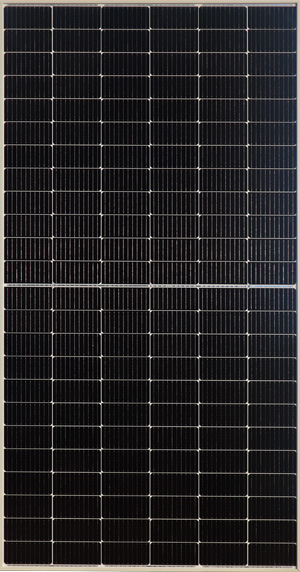
Suntech STP415S-C54/Nshb

Suntech STP415S-C54/Nshb

415 Wp TOPCon
ComparePV verdict

Middle of its segment, needs the roof space

Rank 9,011 of 14,129
Compare panels Datasheet PDF
Power (Wp)
415
Weak · bottom 9%
Efficiency (%)
21.30
Weak · bottom 13%
Density (Wp/m²)
212.5
Weak · bottom 10%
Temp (%/°C)
-0.290
Typical · median -0.290
Weight (kg)
21.0
Typical · median 22.0 kg
Warranty (yrs)
30
Typical · median 30 yrs

Suntech Ultra V Pro mini series (STPXXXS - C54/Nshb) are compact modules in the 108 half-cell format, designed for high power density on rooftops and aesthetic installations. The use of N-type TOPCon cells translates to more stable long-term performance and reduced degradation losses at the start of operation, helping maintain predictable energy production. The half-cut construction improves performance under partial shading - a real advantage in residential roofing, where shading from chimneys or trees is often unavoidable. The ALL-Black variant (Nshb designation) allows creating elegant, visually cohesive installations on modern roofs, without compromising technology. The series also stands out for its improved resistance to phenomena such as PID, thanks to carefully selected lamination materials, increasing reliability in demanding conditions. This is a good choice for homes, small businesses, and premium projects, where performance, durability, and appearance matter.

Ranking

1,220 panels in the segment TOPCon 400-450 W
Metric This panel Median Position in segment Overall rank
Module efficiency 21.30% 22.00% Weak · bottom 13% 8,585
Power density 212.5 220.2 Weak · bottom 10% 8,858
Temperature coefficient -0.290 -0.290 Typical 2,220
Weight per kWp 50.6 51.5 Typical 4,042
Performance warranty 30 yrs 30 yrs Typical 21
Colour key Strong - top 25% Typical - middle 50% Weak - bottom 25%

Signals from the data

0 positive · 2 caution
Best for

Residential, commercial and shaded-installations.

Not ideal for

Roofs where every square metre has to count and tight roof space.

Watch-outs
212.5 watts per square metre

Bottom 10% of the TOPCon 400-450 W segment, against a median of 220.2.

21.30% module efficiency

Bottom 13% of the TOPCon 400-450 W segment, against a median of 22.00%.

Notes from the database
  • Module efficiency of 21.3% is 0.7pp below average for TOPCon 400-450W panels (median: 22.0%)
  • 212.5 W/m² power density is 7.7 W/m² below TOPCon 400-450W median (220.2 W/m²) - requires larger installation area
  • Temperature coefficient of -0.29%/°C matches the TOPCon 400-450W median
  • Weight of 21.0 kg is typical for TOPCon 400-450W panels
  • #8585 for efficiency, #2220 for temperature performance out of 14129 panels

Specifications

Open datasheet PDF
Nominal power (Pmax) 415 Wp Nameplate at 1000 W/m², 25 °C
Module efficiency 21.30 % Weak Segment median 22.00%
Vmpp · Impp 31.78 V · 13.14 A Operating point at max power
Voc · Isc 38.46 V · 14.09 A Sizes the string length
Max system voltage 1500 V Longer strings than 1000 V modules
Dimensions 1722×1134×30 mm · 1.95 m² of roof
Weight 21.0 kg Typical Typical · median 22.0 kg
Cells 108 · TOPCon Monocrystalline
Coefficient Pmax -0.290 %/°C Typical median -0.290 of its segment
Coefficient Voc · Isc -0.250 · 0.046 %/°C
NOCT 42 °C At 800 W/m², 20 °C ambient
Product warranty 25 years Hardware defects only
Performance warranty 30 years Typical median 30 yrs · median 30 yrs
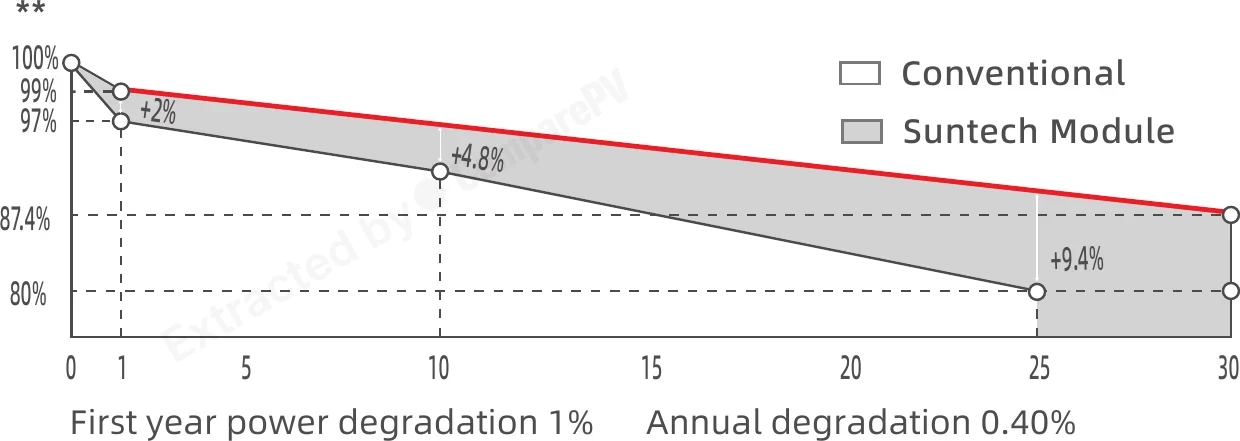
End-of-warranty output 87.4 % Equals 363 W guaranteed
Degradation 1.00 → 0.40 % First year, then annual

Datasheet charts

Open datasheet PDF

Measured curves published by Suntech in this model's datasheet. A chart carrying a wattage was measured on that variant alone - only the ones that describe 415 Wp appear here. The rest cover the whole series.
Simulations

Live - change any input
Lifetime output & value
30 years at 1200 kWh/kWp/year and €0.50 per kWh
Power in year 30
-
Lifetime energy
-
Energy value
-

Degradation from this panel's own datasheet figures. No inverter, soiling or shading losses.

Heat losses
-0.290 %/°C against a segment median of -0.290
-
Filter these
Size
Panel Power Eff. Temp. Weight Difference
Suntech STP415S-C54/Nshb 415 W 21.30% -0.290 21.0 kg You are here
JST-EDMH-(445-465)W-TD (465W class) 465 W 23.81% -0.300 20.5 kg +50 W, hotter, +2.5 pp
LX-465M/182R-96+ GG 465 W 23.80% -0.260 23.5 kg +50 W, cooler, +2.5 pp
AIKO-A460-MAH54Mb 460 W 23.60% -0.290 20.5 kg +45 W, +2.3 pp
LX-465M/182R188-108+ GG 465 W 23.60% -0.290 24.5 kg +50 W, heavier, +2.3 pp
JST-EDMH-(445-465)W-TD (460W class) 460 W 23.56% -0.300 20.5 kg +45 W, hotter, +2.3 pp
LX-460M/182R-96+ GG 460 W 23.55% -0.260 23.5 kg +45 W, cooler, +2.2 pp
PS-MNB108(HCBF)-460W 460 W 23.53% -0.290 20.5 kg +45 W, +2.2 pp
JAT54S40-460/LR 460 W 23.50% -0.260 19.3 kg +45 W, cooler, +2.2 pp
STP390S-C54/Umh 390 W 19.90% -0.360 22.1 kg Hotter, -1.4 pp, -5 yr warranty
STP395S-C54/Umhm 395 W 20.20% -0.340 21.0 kg Hotter, -1.1 pp, -5 yr warranty
STP395S-C54/Umh 395 W 20.20% -0.360 22.1 kg Hotter, -1.1 pp, -5 yr warranty
STP400S-C54/Umhm 400 W 20.50% -0.340 21.0 kg Hotter, -0.8 pp, -5 yr warranty
STP400S-C54/Umh 400 W 20.50% -0.360 22.1 kg Hotter, -0.8 pp, -5 yr warranty
STP405S-C54/Umhm 405 W 20.70% -0.340 21.0 kg Hotter, -0.6 pp, -5 yr warranty
STP405S-C54/Umh 405 W 20.70% -0.360 22.1 kg Hotter, -0.6 pp, -5 yr warranty
LR7-54HJD-510M 510 W 25.00% -0.240 23.5 kg +95 W, cooler, +3.7 pp

Found 1797 panels of the same or similar size to this one, within ±10 mm. See them here Found 1928 panels of the same or similar size to this one, within ±25 mm. See them here Found 3413 panels of the same or similar size to this one, within ±50 mm. See them here Found 4007 panels of the same or similar size to this one, within ±100 mm. See them here

About the Ultra V Pro mini (STPXXXS - C54/Nshb) series

6 answered

These answers cover the whole series. Where a figure differs, the specification above is this module's own.

What is the maximum power output of the Suntech Ultra V Pro mini (STPXXXS - C54/Nshb) panel?
Modules in the Ultra V Pro mini series reach a maximum power output of up to 420 Wp with a 108 half-cell format. This is a strong result for such a compact size, thanks to the use of N-type TOPCon cells with high efficiency. Exact power varies by model within the series, so check the label on the specific panel.
How does the TOPCon technology in Suntech panels differ from older PERC cells?
The N-type TOPCon cells used in the Ultra V Pro mini series show lower initial degradation and more stable long-term performance compared to P-type PERC cells. This results in higher and more predictable energy yield throughout the system's lifetime, an advantage that becomes especially noticeable after several years of operation.
What is the warranty on Suntech Ultra V Pro mini solar panels?
The manufacturer provides a 25-year product warranty and a 30-year power output warranty. Suntech is a Tier 1 manufacturer headquartered in China, which means a stable financial position and realistic prospects for service support throughout such a long warranty period - important for a long-term investment like a solar installation.
Does the ALL-Black (Nshb) variant differ in specifications from the standard version of the panel?
The ALL-Black variant, marked Nshb, differs mainly in appearance - a black frame and black backsheet create a uniform, aesthetic surface ideal for modern roofs. Electrical parameters, including up to 420 Wp power and TOPCon technology, remain the same as the standard version, so there is no need to trade performance for aesthetics.
Do Ultra V Pro mini panels perform well under partial shading, e.g., from a chimney?
Yes, the half-cut cell construction used in this series splits cells in half, reducing the power drop of the entire panel when part of it is shaded, for example by a chimney, antenna, or tree. This is a practical advantage for single-family homes, where the roof is rarely fully exposed to sunlight all day.
Are Suntech Ultra V Pro mini panels resistant to potential induced degradation (PID)?
Yes, the series features enhanced PID resistance thanks to carefully selected lamination materials. This reduces the risk of power loss caused by voltage potential differences between cells and the frame, which is important in installations with higher system voltage and contributes to greater reliability under demanding operating conditions.
Add to compare