VSUN420N-108BMH-BB

420 Wp TOPCon Bifacial 80%
ComparePV verdict

Middle of its segment, needs the roof space

Rank 10,547 of 14,005
Compare panels Datasheet PDF
Power (Wp)
420
Weak · bottom 16%
Efficiency (%)
21.51
Weak · bottom 20%
Density (Wp/m²)
215.1
Weak · bottom 19%
Temp (%/°C)
-0.300
Typical · median -0.290
Weight (kg)
21.4
Typical · median 22.0 kg
Warranty (yrs)
30
Typical · median 30 yrs

The VSUN N-108BMH-BB series consists of advanced modules based on N-type TOPCon technology, which currently represents the peak of efficiency in the photovoltaic industry. The use of N-type cells effectively eliminates the problem of light-induced degradation (LID), which translates into a significantly longer lifespan and stable energy production for decades. Thanks to the Half-Cut design, these panels perform excellently in partial shading conditions, minimizing power losses and protecting the system against the formation of hot-spots. A unique feature of this series is its aesthetics combined with high performance - the black frame and compact design make it an ideal choice for demanding users who care about the appearance of their roof. A low temperature coefficient guarantees that the installation maintains maximum efficiency even on hot summer days, which clearly distinguishes it from older P-type solutions. This product solves the problem of limited mounting space, offering high power density from every square meter of surface area. It is a solution dedicated to modern prosumer installations and commercial projects, where a fast return on investment and the reliability of Tier-1 class components are key. Investing in this series ensures the use of the latest achievements in materials engineering, providing excellent module performance in low sunlight conditions.

Ranking

1,218 panels in the segment TOPCon 400-450 W
Metric This panel Median Position in segment Overall rank
Module efficiency 21.51% 22.00% Weak · bottom 20% 7,894
Power density 215.1 220.2 Weak · bottom 19% 7,882
Temperature coefficient -0.300 -0.290 Typical 6,093
Weight per kWp 51.0 51.4 Typical 4,321
Performance warranty 30 yrs 30 yrs Typical 21
Colour key Strong - top 25% Typical - middle 50% Weak - bottom 25%

Signals from the data

0 positive · 2 caution
Best for

Residential, commercial, shaded-installations and hot-climate.

Not ideal for

Roofs where every square metre has to count and tight roof space.

Watch-outs
215.1 watts per square metre

Bottom 19% of the TOPCon 400-450 W segment, against a median of 220.2.

21.51% module efficiency

Bottom 20% of the TOPCon 400-450 W segment, against a median of 22.00%.

Notes from the database
  • Efficiency of 21.5% matches the TOPCon 400-450W median
  • Power density of 215.1 W/m² is 5.1 W/m² below TOPCon 400-450W median (220.2 W/m²) - needs more roof space
  • Temperature coefficient of -0.30%/°C matches the TOPCon 400-450W median
  • 80% bifaciality enables rear-side power generation, boosting yield by 4-12% on reflective surfaces
  • In the top 56% for efficiency among all TOPCon panels

Specifications

Open datasheet PDF
Nominal power (Pmax) 420 Wp Nameplate at 1000 W/m², 25 °C
Module efficiency 21.51 % Weak Segment median 22.00%
Vmpp · Impp 31.52 V · 13.32 A Operating point at max power
Voc · Isc 38.11 V · 14.07 A Sizes the string length
Max system voltage 1500 V Longer strings than 1000 V modules
Dimensions 1722×1134×30 mm · 1.95 m² of roof
Weight 21.4 kg Typical Typical · median 22.0 kg
Cells 108 · TOPCon Monocrystalline
Bifaciality 80 % Rear output as a share of front
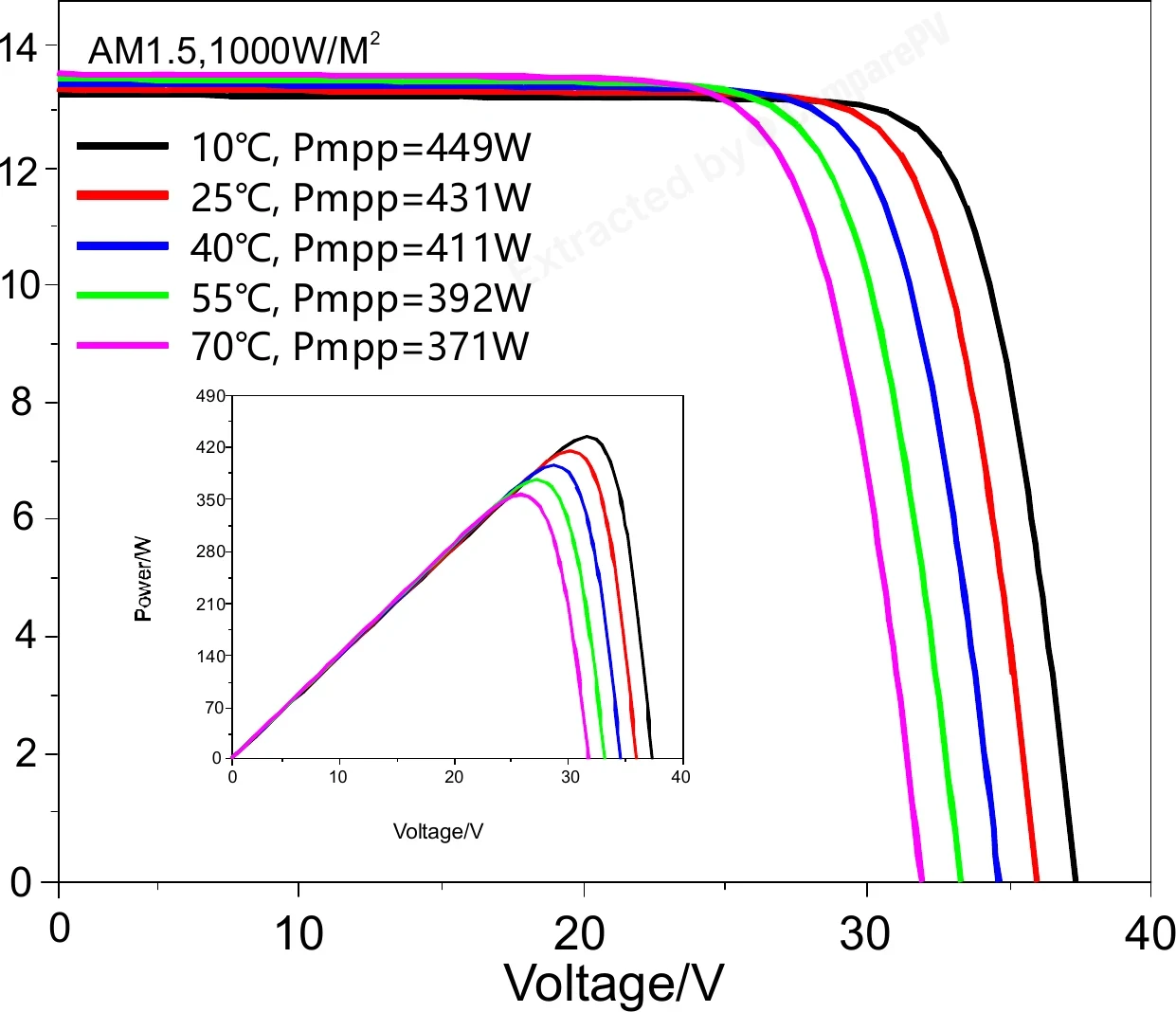
Coefficient Pmax -0.300 %/°C Typical median -0.290 of its segment
Coefficient Voc · Isc -0.260 · 0.046 %/°C
NOCT 45 °C At 800 W/m², 20 °C ambient
Product warranty 12 years Hardware defects only
Performance warranty 30 years Typical median 30 yrs · median 30 yrs
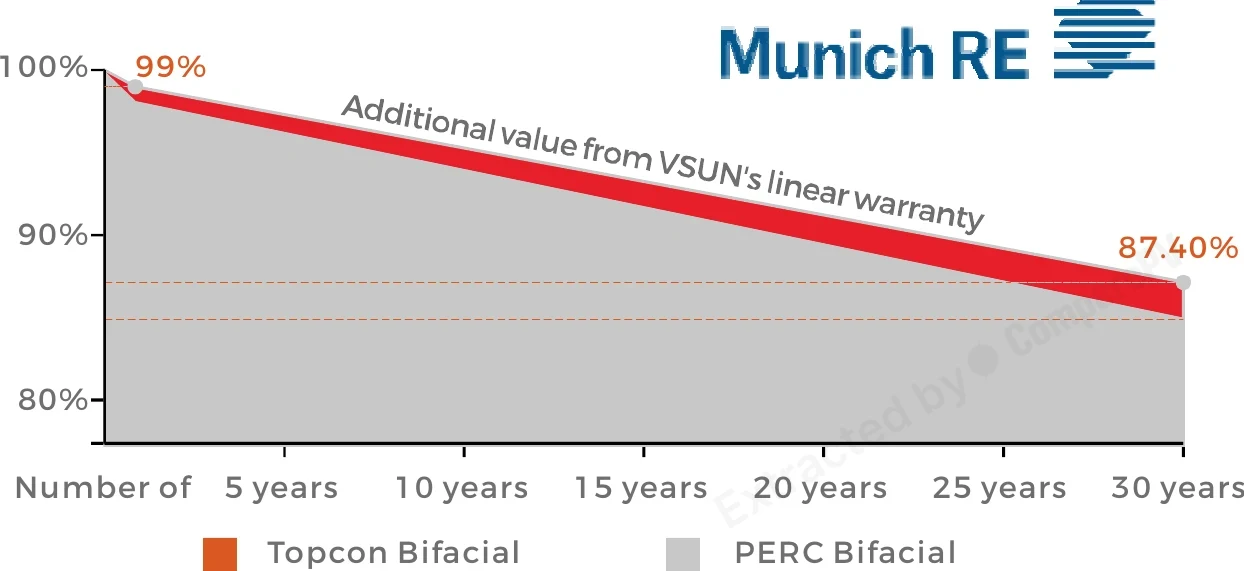
End-of-warranty output 87.4 % Equals 367 W guaranteed
Degradation 1.00 → 0.40 % First year, then annual

Datasheet charts

Open datasheet PDF

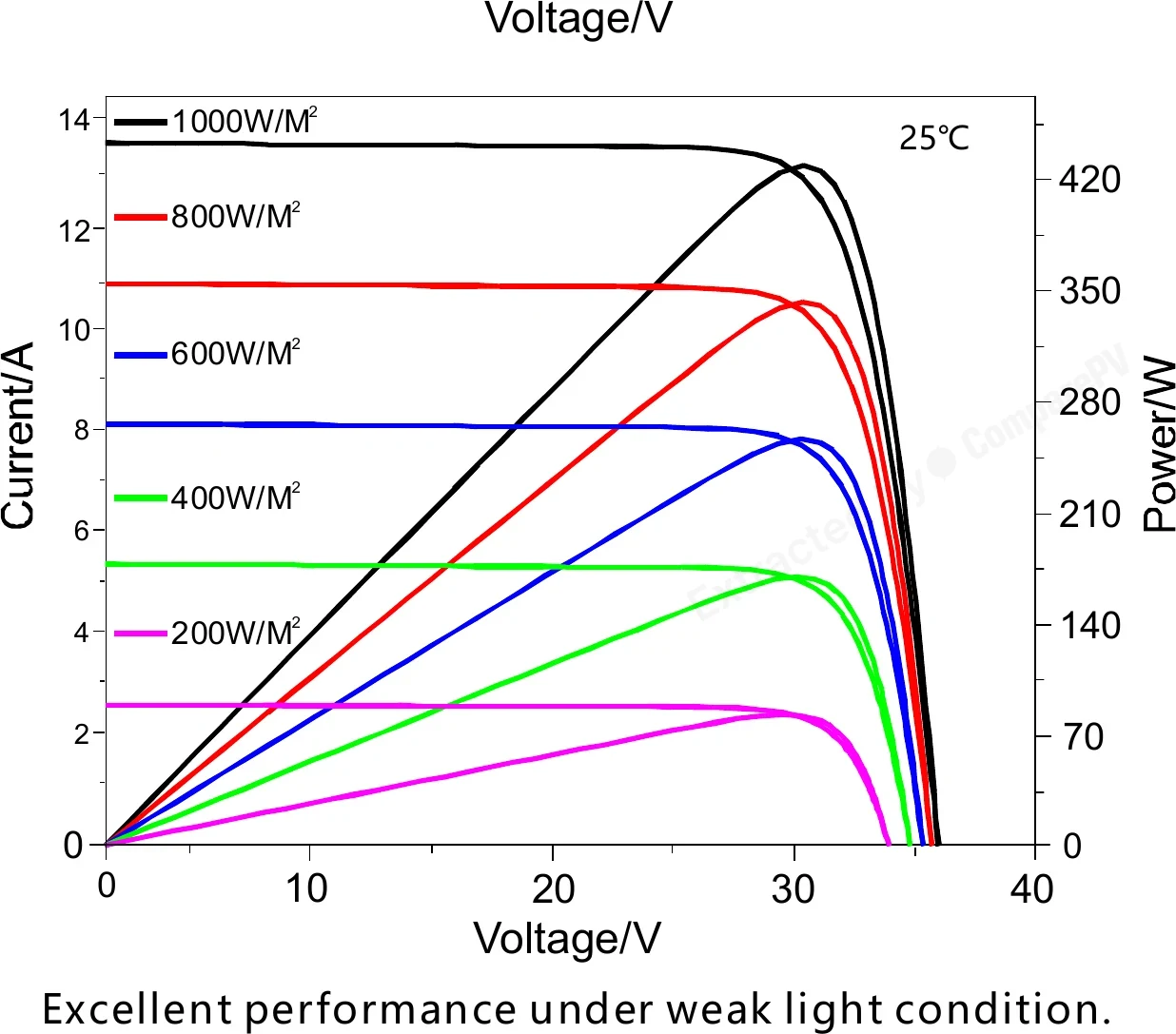
Measured curves published by VSUN in this model's datasheet. A chart carrying a wattage was measured on that variant alone - only the ones that describe 420 Wp appear here. The rest cover the whole series.
Simulations

Live - change any input
Lifetime output & value
30 years at 1200 kWh/kWp/year and €0.50 per kWh
Power in year 30
-
Lifetime energy
-
Energy value
-
With bifacial gain
-

Degradation from this panel's own datasheet figures. No inverter, soiling or shading losses.

Heat losses
-0.300 %/°C against a segment median of -0.290
-
Bifacial gain
Rear gain over light concrete: -
-

Model: bifaciality × albedo × 0.6 view factor. A first-order estimate, not a yield simulation.

Filter these
Size
Panel Power Eff. Temp. Weight Difference
VSUN VSUN420N-108BMH-BB 420 W 21.51% -0.300 21.4 kg You are here
JST-EDMH-(445-465)W-TD (465W class) 465 W 23.81% -0.300 20.5 kg +45 W, +2.3 pp
LX-465M/182R-96+ GG 465 W 23.80% -0.260 23.5 kg +45 W, cooler, +2.3 pp
SPR-MAX7-470 470 W 23.70% -0.270 21.1 kg +50 W, +2.2 pp, +10 yr warranty
AIKO-A470-MAH54Mb 470 W 23.60% -0.260 21.5 kg +50 W, cooler, +2.1 pp
AIKO-A460-MAH54Mb 460 W 23.60% -0.290 20.5 kg +40 W, cooler, +2.1 pp
HSM-BD54-LA470 470 W 23.60% -0.260 21.5 kg +50 W, cooler, +2.1 pp
VSUN390-108BMH-DG 390 W 19.97% -0.320 24.7 kg -30 W, heavier, -1.5 pp
VSUN395-108BMH-DG 395 W 20.23% -0.320 24.7 kg -25 W, heavier, -1.3 pp
VSUN400-108BMH-DG 400 W 20.48% -0.320 24.7 kg Hotter, heavier, -1.0 pp
VSUN405-108BMH-DG 405 W 20.74% -0.320 24.7 kg Hotter, heavier, -0.8 pp
VSUN410-108BMH 410 W 21.00% -0.320 21.4 kg -10 W, hotter, -0.5 pp
VSUN415N-108MH 415 W 21.25% -0.300 21.4 kg -0.3 pp
LR7-54HJD-510M 510 W 25.00% -0.240 23.5 kg +90 W, cooler, +3.5 pp
AIKO-A495-MCE54Mw 495 W 24.80% -0.260 21.0 kg +75 W, cooler, +3.3 pp
LR7-54HJD-505M 505 W 24.70% -0.240 23.5 kg +85 W, cooler, +3.2 pp
AIKO-A490-MCE54Mw 490 W 24.50% -0.260 21.0 kg +70 W, cooler, +3.0 pp

Found 1783 panels of the same or similar size to this one, within ±10 mm. See them here Found 1914 panels of the same or similar size to this one, within ±25 mm. See them here Found 3392 panels of the same or similar size to this one, within ±50 mm. See them here Found 3970 panels of the same or similar size to this one, within ±100 mm. See them here

Common questions

6 answered
What is the difference between N-type TOPCon technology in the VSUN N-108BMH-BB and older P-type panels?
N-type TOPCon cells used in the N-108BMH-BB series virtually eliminate light-induced degradation (LID), which causes P-type panels to lose power output in their first years of operation. As a result, the module maintains higher efficiency over its entire lifespan, with a much more linear and predictable power degradation curve than older P-type technologies.
Are VSUN N-108BMH-BB panels bifacial, and how much extra energy does that produce?
Yes, the N-108BMH-BB series uses bifacial construction, generating power from both the front and rear side of the module. The rear side captures light reflected from the ground, roof, or a bright surface, and under favorable mounting conditions (e.g., light-colored roof, elevated racking) can increase annual energy yield by up to several percent compared to a monofacial panel of the same rated power.
What warranty does the VSUN N-108BMH-BB series come with?
The manufacturer provides a 12-year product warranty covering material and workmanship defects, along with a 30-year linear power output warranty guaranteeing sustained high performance throughout the system's operational life. This warranty structure is typical for modern N-type modules and supports long-term investment planning compared to older PV technologies.
Is the VSUN N-108BMH-BB suitable for small pitched roofs with limited space?
Yes, with power output up to 430 Wp and a compact half-cut cell layout, the series delivers high power density per square meter, which matters on pitched roofs with limited surface area. The half-cut design also reduces losses from partial shading, such as from chimneys or antennas, a common issue on residential roofs with complex geometry.
How does the VSUN N-108BMH-BB perform in high summer temperatures?
Thanks to N-type TOPCon technology, the series has a low power temperature coefficient, meaning less efficiency loss as the module heats up on hot days compared to conventional P-type panels. In practice, this results in more stable energy production during summer, when panel surface temperatures can exceed 60°C and older technologies lose proportionally more power.
Is VSUN a Tier-1 manufacturer, and is it reliable for a large investment?
VSUN is not currently on the BloombergNEF Tier-1 list, but the company operates a European hub in Germany, and its modules go through standard quality certifications and industry-standard reliability testing. Tier-1 status mainly reflects a manufacturer's financial bankability rather than technical module quality, so purchasing decisions should be based on warranty terms and technical specifications rather than this classification alone.
Add to compare