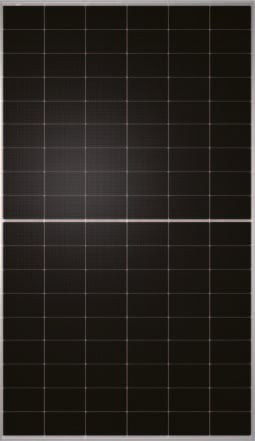
Tongwei TWMNH-54HD515

Tongwei TWMNH-54HD515

515 Wp N-type Bifacial 80%
ComparePV verdict

Efficiency leader, no clear weak spot

Rank 5,266 of 14,129
Compare panels Datasheet PDF
Power (Wp)
515
Typical for its class
Efficiency (%)
23.20
Strong · top 18%
Density (Wp/m²)
231.6
Strong · top 19%
Temp (%/°C)
-0.280
Strong · top 23%
Weight (kg)
26.5
Typical · median 26.2 kg
Warranty (yrs)
30
Typical · median 30 yrs

The Tongwei TWMNH-54HD series is designed for maximum energy yield on limited surfaces-ideal where high efficiency and stable operation in challenging conditions are essential. The use of N-type TOPCon cells ensures excellent performance at high temperatures and lower operational losses, genuinely supporting production predictability in the coming years. The bifacial construction harnesses reflected light from the ground, enabling higher energy output without increasing the number of modules. Additionally, dual glass enhances resistance to moisture and material aging, crucial for rooftop and ground installations. Half-cut technology minimizes shading impacts and reduces module losses, facilitating wiring designs in demanding locations. This solution excels in modern premium residential systems, commercial rooftops, and utility-scale PV farms, where yield, longevity, and reliable performance are paramount.

Ranking

142 panels in the segment N-type 500-550 W
Metric This panel Median Position in segment Overall rank
Module efficiency 23.20% 22.55% Strong · top 18% 1,349
Power density 231.6 225.3 Strong · top 19% 1,518
Temperature coefficient -0.280 -0.290 Strong · top 23% 1,347
Weight per kWp 51.5 50.0 Typical 4,858
Performance warranty 30 yrs 30 yrs Typical 21
Colour key Strong - top 25% Typical - middle 50% Weak - bottom 25%

Signals from the data

3 positive · 0 caution
Best for

Residential, commercial, shaded-installations and hot-climate.

Strengths
23.20% module efficiency

Top 18% of the N-type 500-550 W segment, against a median of 22.55%.

231.6 watts per square metre

Top 19% of the N-type 500-550 W segment, against a median of 225.3.

-0.280 %/°C temperature coefficient

Top 23% of the N-type 500-550 W segment, against a median of -0.290.

Notes from the database
  • Efficiency of 23.2% is 0.6pp above the N-type 500-550W median (22.6%)
  • Power density of 231.6 W/m² packs 6.3 W/m² more into the same footprint vs N-type 500-550W median (225.3 W/m²)
  • Temperature coefficient of -0.28%/°C matches the N-type 500-550W median
  • Bifacial design (80% factor) captures reflected light - adds 4-12% yield on ground-mount or white roof
  • Ranked #1349 out of 14129 panels for efficiency in the database

Specifications

Open datasheet PDF
Nominal power (Pmax) 515 Wp Nameplate at 1000 W/m², 25 °C
Module efficiency 23.20 % Strong Segment median 22.55%
Vmpp · Impp 34.43 V · 14.96 A Operating point at max power
Voc · Isc 40.60 V · 15.98 A Sizes the string length
Max system voltage 1500 V Longer strings than 1000 V modules
Dimensions 1961×1134×30 mm · 2.22 m² of roof
Weight 26.5 kg Typical Typical · median 26.2 kg
Cells 108 · N-type Monocrystalline
Bifaciality 80 % Rear output as a share of front
Coefficient Pmax -0.280 %/°C Strong top 23% of its segment
Coefficient Voc · Isc -0.240 · 0.046 %/°C
Product warranty 15 years Hardware defects only
Performance warranty 30 years Typical median 30 yrs · median 30 yrs
End-of-warranty output 87.4 % Equals 450 W guaranteed
Degradation 1.00 → 0.40 % First year, then annual

Datasheet charts

Open datasheet PDF

Measured curves published by Tongwei in this model's datasheet. A chart carrying a wattage was measured on that variant alone - only the ones that describe 515 Wp appear here. The rest cover the whole series.

Simulations

Live - change any input
Lifetime output & value
30 years at 1200 kWh/kWp/year and €0.50 per kWh
Power in year 30
-
Lifetime energy
-
Energy value
-
With bifacial gain
-

Degradation from this panel's own datasheet figures. No inverter, soiling or shading losses.

Heat losses
-0.280 %/°C against a segment median of -0.290
-
Bifacial gain
Rear gain over light concrete: -
-

Model: bifaciality × albedo × 0.6 view factor. A first-order estimate, not a yield simulation.

Filter these
Size
Panel Power Eff. Temp. Weight Difference
Tongwei TWMNH-54HD515 515 W 23.20% -0.280 26.5 kg You are here
LR7-54HJD-510M 510 W 25.00% -0.240 23.5 kg Cooler, lighter, +1.8 pp
AIKO-A495-MCE54Mw 495 W 24.80% -0.260 21.0 kg Cooler, lighter, +1.6 pp
LR7-60HVH-560M 560 W 24.80% -0.260 25.0 kg +45 W, cooler, +1.6 pp
LR7-54HJD-505M 505 W 24.70% -0.240 23.5 kg Cooler, lighter, +1.5 pp
WST-505BKX54-A2 505 W 24.70% -0.260 25.0 kg Cooler, lighter, +1.5 pp
LR7-60HVH-555M 555 W 24.60% -0.260 25.0 kg +40 W, cooler, +1.4 pp
AIKO-A490-MCE54Mw 490 W 24.50% -0.260 21.0 kg -25 W, lighter, +1.3 pp
TWMNH-54HD495 495 W 22.30% -0.280 26.5 kg -20 W, -0.9 pp
TWMNH-54HD500 500 W 22.50% -0.280 26.5 kg -15 W, -0.7 pp
TWMNH-54HD505 505 W 22.70% -0.280 26.5 kg -10 W, -0.5 pp
TWMNH-54HD510 510 W 22.90% -0.280 26.5 kg -0.3 pp
LR7-60HVHL-550M 550 W 24.40% -0.260 16.3 kg +35 W, lighter, +1.2 pp
JAT60S40-540/LR 540 W 24.40% -0.260 23.5 kg +25 W, lighter, +1.2 pp
GK-5-60HG-540M 540 W 24.40% -0.260 23.3 kg +25 W, lighter, +1.2 pp
JKM545-54QL6-DV-F1-EU 545 W 24.27% -0.260 27.5 kg +30 W, cooler, +1.1 pp
LR7-60HVH-545M 545 W 24.20% -0.260 25.0 kg +30 W, cooler, +1.0 pp

Found 471 panels of the same or similar size to this one, within ±10 mm. See them here Found 508 panels of the same or similar size to this one, within ±25 mm. See them here Found 662 panels of the same or similar size to this one, within ±50 mm. See them here Found 1476 panels of the same or similar size to this one, within ±100 mm. See them here

About the TWMNH-54HD series

6 answered

These answers cover the whole series. Where a figure differs, the specification above is this module's own.

What is the maximum power and efficiency of the Tongwei TWMNH-54HD panel?
The TWMNH-54HD series reaches a maximum power output of up to 515 Wp with module efficiency reaching 23.2%. This is achieved through 108 N-type TOPCon half-cut cells, which reduce resistive losses and make better use of the available surface area. Higher efficiency means fewer modules are needed to reach a target system capacity, which lowers mounting structure and cabling costs.
Are TWMNH-54HD panels suitable for mounting on a sloped residential roof?
Yes, though the panel's dimensions should be considered - 1961x1134x30 mm and a weight of 26.5 kg are typical for dual-glass modules, somewhat heavier than standard single-glass panels. The frame withstands wind loads up to 2400 Pa and snow loads up to 5400 Pa, meeting requirements for most sloped roofs in temperate climates. Before installation, check the existing roof structure's load capacity and choose suitable mounting hardware.
What is N-type TOPCon technology and how does it differ from popular PERC?
TOPCon (Tunnel Oxide Passivated Contact) is an N-type cell technology with an additional passivation layer that reduces electron recombination and increases efficiency compared to P-type PERC cells. In practice this means higher energy yield, a smaller power drop at high temperatures, and slower degradation over time. TWMNH-54HD panels use this technology, resulting in more predictable energy production throughout the 30-year power warranty period.
Do Tongwei TWMNH-54HD panels perform well in high summer temperatures?
Yes, thanks to N-type TOPCon technology the temperature coefficient of power is -0.28%/°C, better than typical PERC panels (usually around -0.35%/°C). This means a smaller power drop on hot summer days when module temperature can exceed 60°C. For installations in temperate climates, this results in a more stable energy yield during summer months when solar irradiance is highest.
What warranty does Tongwei offer on the TWMNH-54HD series?
The manufacturer provides a 15-year product warranty and a 30-year linear power warranty, guaranteeing at least 87.4% of initial power output after 30 years. Tongwei is a Tier 1 manufacturer based in China, meaning stable financial standing and realistic ability to honor warranty claims over the long term. This is an important factor when choosing panels for a system expected to operate for decades.
How much extra energy does bifacial construction provide compared to standard panels?
Bifacial panels in the TWMNH-54HD series capture light reflected off the ground and can generate up to 25% more energy than standard monofacial modules, depending on the ground albedo beneath the array (light gravel, snow, or a white roof surface increase the effect). The added dual-glass layer also improves resistance to moisture and material aging, relevant both for ground-mount installations and flat roofs with proper tilt angle.
Add to compare