TS-BBT54(410)

410 Wp TOPCon Bifacial 80%
ComparePV verdict

Middle of its segment, modest efficiency

Rank 10,754 of 14,005
Compare panels Datasheet PDF
Power (Wp)
410
Weak · bottom 4%
Efficiency (%)
21.00
Weak · bottom 5%
Density (Wp/m²)
210.0
Weak · bottom 5%
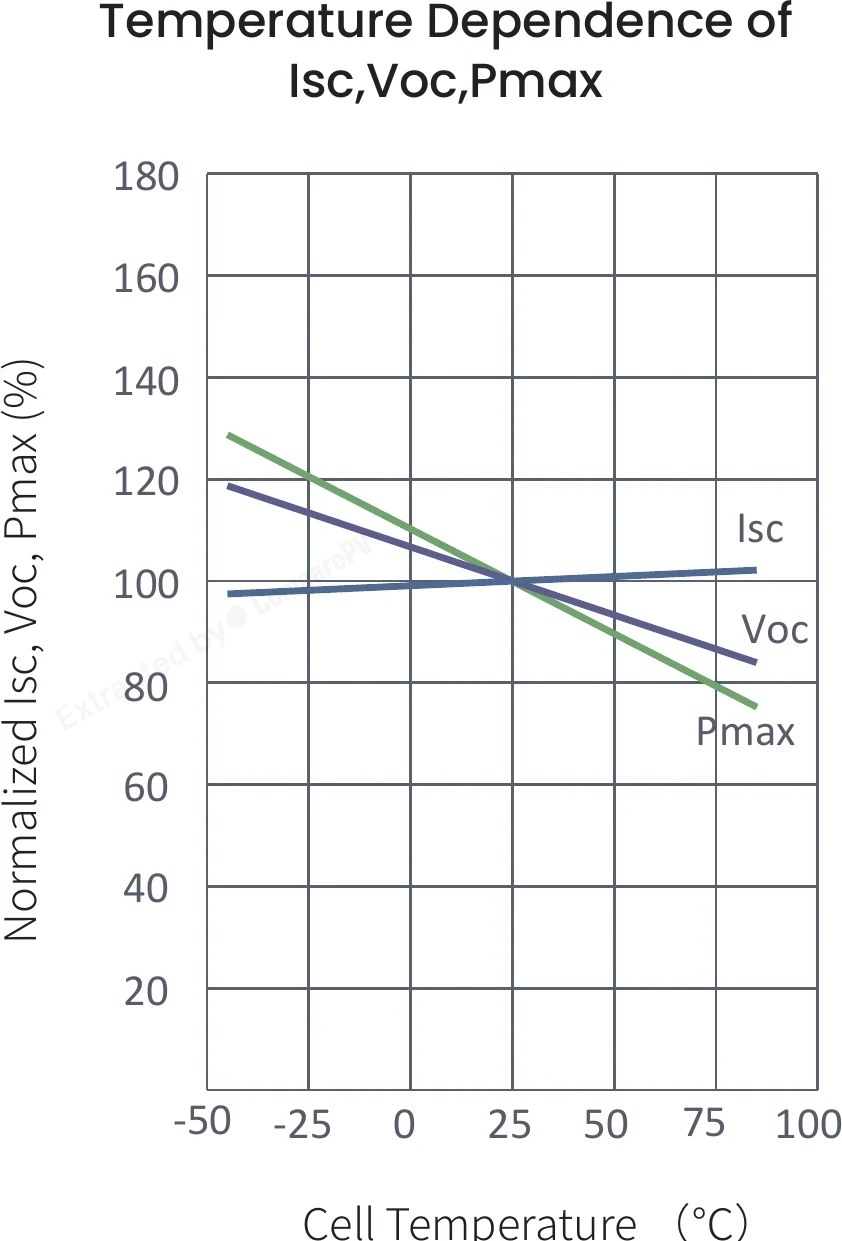
Temp (%/°C)
-0.300
Typical · median -0.290
Weight (kg)
21.5
Typical · median 22.0 kg
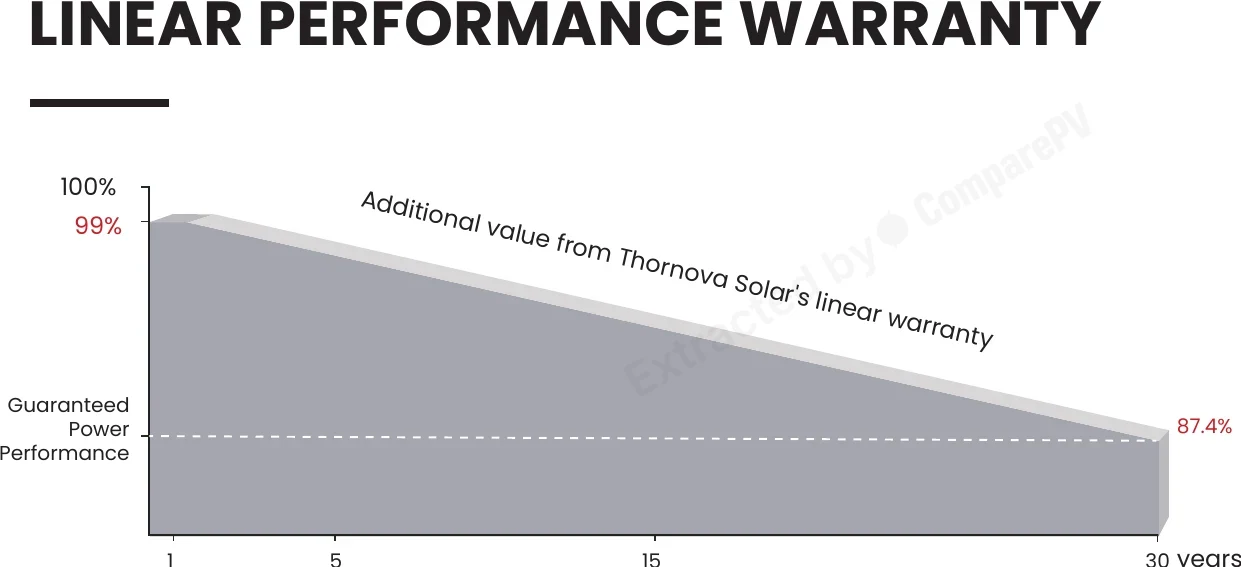
Warranty (yrs)
30
Typical · median 30 yrs

The Sunova TS-BBT54 All Black series is designed for roofs, where both aesthetics and real energy production are important. These are black-colored modules with a refined finish that complement modern architecture and make it easier to meet the requirements of investors who value a consistent design. The use of N-type (TOPCon) cells helps to minimize degradation over time and improves stability in challenging conditions, such as high temperatures or variable sunlight. The bifacial design also allows for the use of light from the back side, which is particularly beneficial on bright roofs and in installations with appropriate reflection. Thanks to the positive power tolerance, it is easier to predict and optimize the profitability. This is a good choice for single-family homes and small commercial buildings when you need a compact format that makes it easier to design strings and install on a limited area.

Ranking

1,218 panels in the segment TOPCon 400-450 W
Metric This panel Median Position in segment Overall rank
Module efficiency 21.00% 22.00% Weak · bottom 5% 9,758
Power density 210.0 220.2 Weak · bottom 5% 9,772
Temperature coefficient -0.300 -0.290 Typical 6,093
Weight per kWp 52.4 51.4 Typical 5,941
Performance warranty 30 yrs 30 yrs Typical 21
Colour key Strong - top 25% Typical - middle 50% Weak - bottom 25%

Signals from the data

0 positive · 2 caution
Best for

Residential, commercial and BIPV.

Not ideal for

Tight roof space and roofs where every square metre has to count.

Watch-outs
21.00% module efficiency

Bottom 5% of the TOPCon 400-450 W segment, against a median of 22.00%. Ranked 9,758th in the whole database.

210.0 watts per square metre

Bottom 5% of the TOPCon 400-450 W segment, against a median of 220.2. Ranked 9,772nd in the whole database.

Notes from the database
  • At 21.0% efficiency, this panel is 1.0pp below the TOPCon 400-450W median of 22.0%
  • At 210.0 W/m², this panel generates 10.2 W/m² less per unit area than TOPCon 400-450W median (220.2 W/m²)
  • Temperature coefficient of -0.30%/°C matches the TOPCon 400-450W median
  • Bifaciality factor of 80% can add 4-12% extra yield with reflective mounting surface
  • Ranked #9758 out of 14005 panels for efficiency in the database

Specifications

Open datasheet PDF
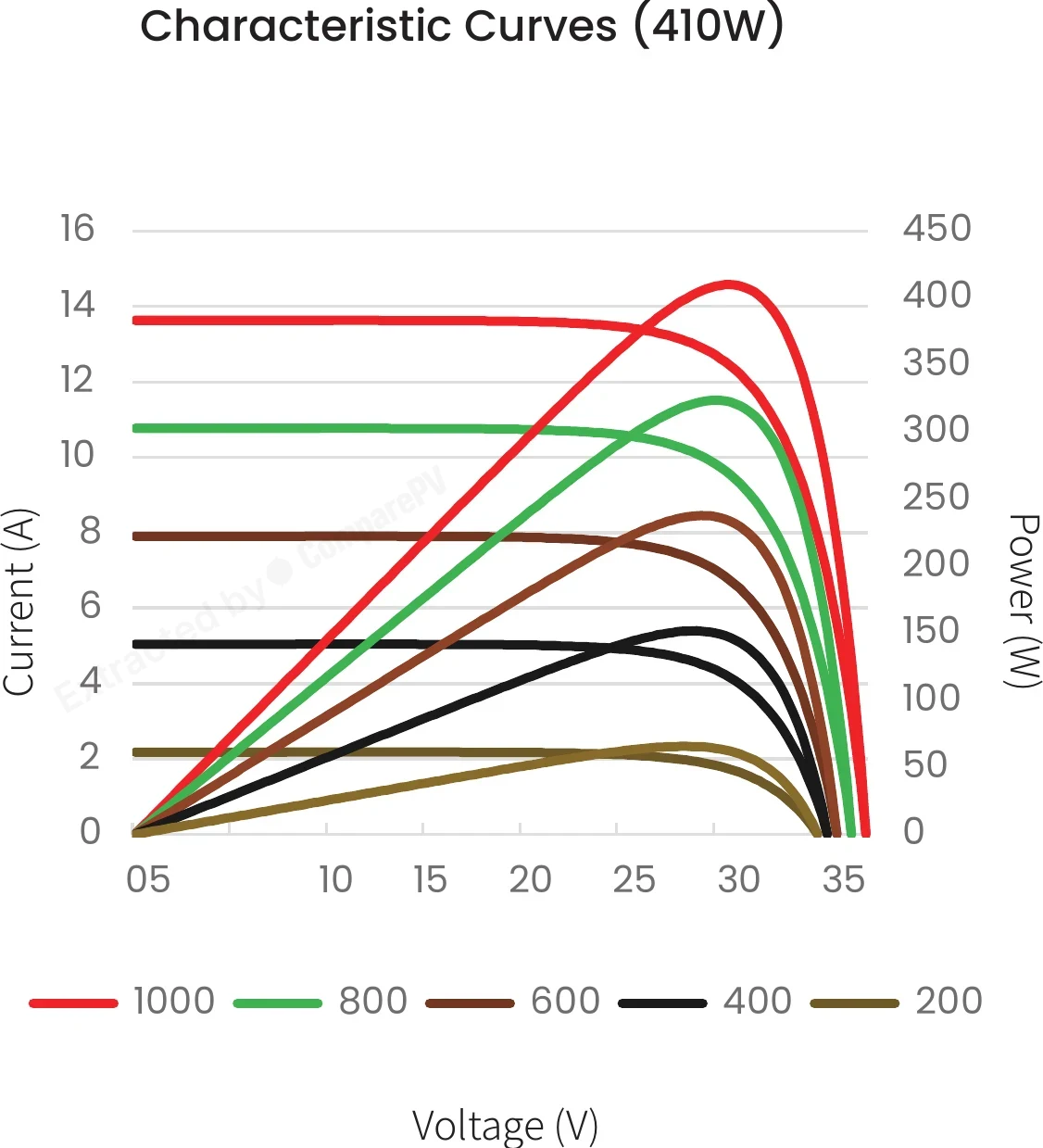
Nominal power (Pmax) 410 Wp Nameplate at 1000 W/m², 25 °C
Module efficiency 21.00 % Weak Segment median 22.00%
Vmpp · Impp 32.64 V · 12.56 A Operating point at max power
Voc · Isc 38.25 V · 13.23 A Sizes the string length
Max system voltage 1500 V Longer strings than 1000 V modules
Dimensions 1722×1134×35 mm · 1.95 m² of roof
Weight 21.5 kg Typical Typical · median 22.0 kg
Cells 108 · TOPCon Monocrystalline
Bifaciality 80 % Rear output as a share of front
Coefficient Pmax -0.300 %/°C Typical median -0.290 of its segment
Coefficient Voc · Isc -0.280 · 0.040 %/°C
NOCT 45 °C At 800 W/m², 20 °C ambient
Product warranty 15 years Hardware defects only
Performance warranty 30 years Typical median 30 yrs · median 30 yrs
End-of-warranty output 87.4 % Equals 358 W guaranteed
Degradation 1.00 → 0.40 % First year, then annual

Datasheet charts

Open datasheet PDF

Measured curves published by Sunova in this model's datasheet. A chart carrying a wattage was measured on that variant alone - only the ones that describe 410 Wp appear here. The rest cover the whole series.
Simulations

Live - change any input
Lifetime output & value
30 years at 1200 kWh/kWp/year and €0.50 per kWh
Power in year 30
-
Lifetime energy
-
Energy value
-
With bifacial gain
-

Degradation from this panel's own datasheet figures. No inverter, soiling or shading losses.

Heat losses
-0.300 %/°C against a segment median of -0.290
-
Bifacial gain
Rear gain over light concrete: -
-

Model: bifaciality × albedo × 0.6 view factor. A first-order estimate, not a yield simulation.

Alternatives

All Sunova panels
Filter these
Size
Panel Power Eff. Temp. Weight Difference
Sunova TS-BBT54(410) 410 W 21.00% -0.300 21.5 kg You are here
AIKO-A460-MAH54Mb 460 W 23.60% -0.290 20.5 kg +50 W, cooler, +2.6 pp
JST-EDMH-(445-465)W-TD (460W class) 460 W 23.56% -0.300 20.5 kg +50 W, lighter, +2.6 pp
LX-460M/182R-96+ GG 460 W 23.55% -0.260 23.5 kg +50 W, cooler, +2.6 pp
PS-MNB108(HCBF)-460W 460 W 23.53% -0.290 20.5 kg +50 W, cooler, +2.5 pp
JAT54S40-460/LR 460 W 23.50% -0.260 19.3 kg +50 W, cooler, +2.5 pp
LX-460M/182R188-108+ GG 460 W 23.35% -0.290 24.5 kg +50 W, heavier, +2.4 pp
AIKO-455-MAH54Db 455 W 23.30% -0.260 24.0 kg +45 W, cooler, +2.3 pp
LR5-54HTH-455M 455 W 23.30% -0.290 20.8 kg +45 W, +2.3 pp, -5 yr warranty
TS-BW54(400) 400 W 20.48% -0.330 21.5 kg Hotter, -0.5 pp, -5 yr warranty
TS-BG54(405)-X 405 W 20.74% -0.330 24.2 kg Hotter, heavier, -0.3 pp
LR7-54HJD-510M 510 W 25.00% -0.240 23.5 kg +100 W, cooler, +4.0 pp
AIKO-A495-MCE54Mw 495 W 24.80% -0.260 21.0 kg +85 W, cooler, +3.8 pp
LR7-54HJD-505M 505 W 24.70% -0.240 23.5 kg +95 W, cooler, +3.7 pp
AIKO-A490-MCE54Mw 490 W 24.50% -0.260 21.0 kg +80 W, cooler, +3.5 pp
LR7-54HJD-500M 500 W 24.50% -0.240 23.5 kg +90 W, cooler, +3.5 pp
CIPRO-TN9C54M-500W 500 W 24.50% -0.260 21.4 kg +90 W, cooler, +3.5 pp

Found 1783 panels of the same or similar size to this one, within ±10 mm. See them here Found 1914 panels of the same or similar size to this one, within ±25 mm. See them here Found 3392 panels of the same or similar size to this one, within ±50 mm. See them here Found 3970 panels of the same or similar size to this one, within ±100 mm. See them here

Common questions

6 answered
How does the bifacial technology in Sunova TS-BBT54 All Black panels differ from standard mono-facial modules?
TS-BBT54 bifacial modules have active cells on both sides, so besides direct sunlight they also capture light reflected off the roof or ground surface. On bright, reflective surfaces this can add several percent or more of extra energy compared to a mono-facial panel with the same nominal power rating. The biggest gain shows up on white roofing or light-colored gravel installations.
Do TOPCon cells in the TS-BBT54 series perform well on roofs that heat up in summer?
Yes, N-type TOPCon cells have a better power temperature coefficient than older P-type technology, meaning less output loss as the panel gets hot. TOPCon also virtually eliminates light-induced degradation (LID), so the module keeps stable energy production even after years of operation in hot climates or poorly ventilated roof sections.
What warranty comes with Sunova TS-BBT54 All Black panels?
The manufacturer offers a 15-year product warranty along with a 30-year power output warranty, which is standard for modern N-type modules. In practice this means the panel should still deliver a significant share of its initial power after 30 years, making it easier to plan long-term return on investment, especially for installations financed with a loan or subsidy.
Are TS-BBT54 All Black panels suitable for a small single-family house roof?
Yes, the series was designed with a compact format in mind, making string layout easier on limited pitched-roof surfaces. With up to 430 Wp of power and a full-black aesthetic, the module blends well with modern architecture while fitting more panels on a smaller roof section than larger-format modules would allow.
Is Sunova a Tier 1 manufacturer, and where are TS-BBT54 panels made?
Sunova is not on the Tier 1 list according to BloombergNEF classification, which doesn't mean lower quality but rather a shorter track record of financing large-scale projects. The panels are manufactured in China, where the company runs its own N-type TOPCon production lines. This is worth checking if your project financing requires panels from a Tier 1 list.
What does positive power tolerance mean on TS-BBT54 panels, and why does it matter?
Positive power tolerance means the actual panel output never falls below the rated label value and often slightly exceeds it. This lets installers and investors more accurately predict real energy yield during system design, avoiding the risk of underestimating string output, which makes it easier to close the profitability balance and size the inverter correctly.
Add to compare