SS8-72HD-595N

595 Wp TOPCon Bifacial 80%
ComparePV verdict

Efficiency leader, no clear weak spot

Rank 2,702 of 14,005
Compare panels Datasheet PDF
Power (Wp)
595
Strong · top 5%
Efficiency (%)
23.03
Strong · top 5%
Density (Wp/m²)
230.3
Strong · top 7%
Temp (%/°C)
-0.290
Typical · median -0.290
Weight (kg)
31.2
Typical · median 31.2 kg
Warranty (yrs)
30
Typical · median 30 yrs

The Solarspace Lumina II series consists of modules based on n-type TOPCon cells, designed to significantly increase energy yield under typical Polish conditions - even with cloud cover and in cooler months. The use of a glass-glass construction increases resistance to microcracks and long-term environmental stress, leading to more stable operation of the installation over many years. The bifacial variants can utilize reflected light from the ground, allowing the installation to produce more energy without increasing the roof or ground area.

A key feature of the Lumina II is its low LID and LeTID degradation, which is important for investors considering long-term profitability. In addition, the module features refined solutions that improve current flow, such as MBB technology and a half-cell arrangement, which support reliability even with partial shading.

This is a good choice for homes, businesses, and ground-mounted installations - anywhere where durability, the aesthetics of the full-black versions, and predictable energy production are important.

Ranking

1,018 panels in the segment TOPCon 550-600 W
Metric This panel Median Position in segment Overall rank
Module efficiency 23.03% 22.44% Strong · top 5% 1,744
Power density 230.3 224.4 Strong · top 7% 1,758
Temperature coefficient -0.290 -0.290 Typical 2,165
Weight per kWp 52.4 53.8 Typical 5,937
Performance warranty 30 yrs 30 yrs Typical 21
Colour key Strong - top 25% Typical - middle 50% Weak - bottom 25%

Signals from the data

2 positive · 0 caution
Best for

Residential, commercial, utility-scale and shaded-installations.

Strengths
23.03% module efficiency

Top 5% of the TOPCon 550-600 W segment, against a median of 22.44%. Ranked 1,744th in the whole database.

230.3 watts per square metre

Top 7% of the TOPCon 550-600 W segment, against a median of 224.4. Ranked 1,758th in the whole database.

Notes from the database
  • At 23.0% efficiency, this panel is 0.6pp above typical TOPCon 550-600W modules (median: 22.4%)
  • 230.3 W/m² power density - 5.9 W/m² more than TOPCon 550-600W median (224.4 W/m²), more power per roof area
  • At -0.29%/°C, hot weather performance is typical for TOPCon 550-600W panels
  • Bifacial design (80% factor) captures reflected light - adds 4-12% yield on ground-mount or white roof
  • #1744 for efficiency, #2165 for temperature performance out of 14005 panels

Specifications

Open datasheet PDF
Nominal power (Pmax) 595 Wp Nameplate at 1000 W/m², 25 °C
Module efficiency 23.03 % Strong Segment median 22.44%
Vmpp · Impp 43.06 V · 13.82 A Operating point at max power
Voc · Isc 52.08 V · 14.54 A Sizes the string length
Max system voltage 1500 V Longer strings than 1000 V modules
Dimensions 2278×1134×30 mm · 2.58 m² of roof
Weight 31.2 kg Typical Typical · median 31.2 kg
Cells 144 · TOPCon Monocrystalline
Bifaciality 80 % Rear output as a share of front
Coefficient Pmax -0.290 %/°C Typical median -0.290 of its segment
Coefficient Voc · Isc -0.260 · 0.045 %/°C
NOCT 45 °C At 800 W/m², 20 °C ambient
Product warranty 15 years Hardware defects only
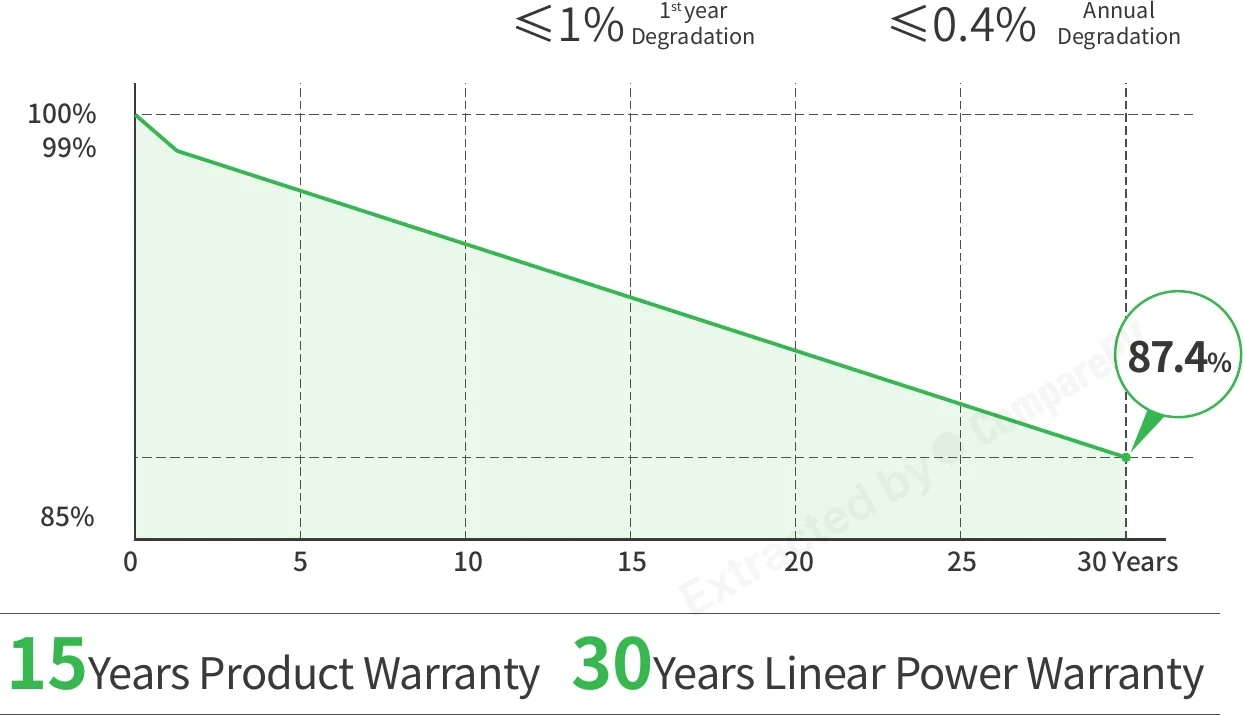
Performance warranty 30 years Typical median 30 yrs · median 30 yrs
End-of-warranty output 87.4 % Equals 520 W guaranteed
Degradation 1.00 → 0.40 % First year, then annual

Datasheet charts

Open datasheet PDF

Measured curves published by Solarspace in this model's datasheet. A chart carrying a wattage was measured on that variant alone - only the ones that describe 595 Wp appear here. The rest cover the whole series.
Simulations

Live - change any input
Lifetime output & value
30 years at 1200 kWh/kWp/year and €0.50 per kWh
Power in year 30
-
Lifetime energy
-
Energy value
-
With bifacial gain
-

Degradation from this panel's own datasheet figures. No inverter, soiling or shading losses.

Heat losses
-0.290 %/°C against a segment median of -0.290
-
Bifacial gain
Rear gain over light concrete: -
-

Model: bifaciality × albedo × 0.6 view factor. A first-order estimate, not a yield simulation.

Filter these
Size
Panel Power Eff. Temp. Weight Difference
Solarspace SS8-72HD-595N 595 W 23.03% -0.290 31.2 kg You are here
AIKO-A645-MAE72Mw 645 W 25.00% -0.260 27.0 kg +50 W, lighter, +2.0 pp
LR7-60HVH-560M 560 W 24.80% -0.260 25.0 kg -35 W, lighter, +1.8 pp
AIKO-A640-MAE72Mw 640 W 24.80% -0.260 27.0 kg +45 W, lighter, +1.8 pp
LR7-60HVH-555M 555 W 24.60% -0.260 25.0 kg -40 W, lighter, +1.6 pp
AIKO-A635-MAE72Mw 635 W 24.60% -0.260 27.0 kg +40 W, lighter, +1.6 pp
SS8-72HD-535M 535 W 20.71% -0.334 31.2 kg -60 W, hotter, -2.3 pp
SS8-72HD-540M 540 W 20.90% -0.334 31.2 kg -55 W, hotter, -2.1 pp
SS8-72HD-545M 545 W 21.10% -0.334 31.2 kg -50 W, hotter, -1.9 pp
SS8-72HD-550M 550 W 21.29% -0.334 31.2 kg -45 W, hotter, -1.7 pp
SS8-72HD-555M 555 W 21.48% -0.334 31.2 kg -40 W, hotter, -1.6 pp
SS8-72HD-560M 560 W 21.68% -0.334 31.2 kg -35 W, hotter, -1.4 pp
SS8-72HD-565N 565 W 21.87% -0.290 31.2 kg -30 W, -1.2 pp
SS8-72HD-570N 570 W 22.07% -0.290 31.2 kg -25 W, -1.0 pp
SS8-72HD-575N 575 W 22.26% -0.290 31.2 kg -20 W, -0.8 pp
SS8-72HD-580N 580 W 22.45% -0.290 31.2 kg -15 W, -0.6 pp
AIKO-A650-MAE72Mw 650 W 25.20% -0.260 27.0 kg +55 W, lighter, +2.2 pp

Found 2326 panels of the same or similar size to this one, within ±10 mm. See them here Found 2368 panels of the same or similar size to this one, within ±25 mm. See them here Found 2382 panels of the same or similar size to this one, within ±50 mm. See them here Found 2547 panels of the same or similar size to this one, within ±100 mm. See them here

Common questions

6 answered
What warranty does the Solarspace Lumina II series come with?
Solarspace provides a 15-year product warranty and a 30-year linear power output warranty on the Lumina II series. This means the manufacturer guarantees a defined minimum power retention after 30 years of operation. Thanks to the low LID and LeTID degradation inherent to n-type TOPCon cells, real-world power loss over that period is expected to be significantly lower than with older PERC technology.
Do Lumina II bifacial panels actually produce more electricity?
Yes, though the gain depends on the surface beneath the modules. Lumina II bifacial panels capture reflected light from the rear side — from light-colored roofing membranes, concrete, or snow. On ground-mounted systems with a reflective surface, the bifacial gain can reach 5–15% over an equivalent monofacial module. On a dark pitched roof the effect is minimal, but bifacial configuration introduces no output penalty compared to a standard single-sided panel.
How do Solarspace Lumina II panels perform in overcast conditions and during Polish winters?
The n-type TOPCon cells used in Lumina II deliver high efficiency under diffuse irradiance, which is common in Central Europe during autumn and winter. A low temperature coefficient of power means the modules perform better on cold sunny days than in summer heat. The series was designed with the Central European climate in mind, making it suitable for installations across Poland, including regions with higher cloud cover.
What does the glass-glass construction in Lumina II actually offer, and does it matter?
The glass-glass design replaces the traditional plastic backsheet with a rear glass panel. In practical terms this delivers significantly higher resistance to micro-cracks, moisture ingress, and UV degradation. For the system owner it translates to more stable output throughout the warranty period and a lower risk of costly field failures. It is especially valuable in installations exposed to variable weather, heavy snow loads, or high wind stress.
Is a Solarspace Lumina II panel rated up to 595 Wp the right choice for a residential rooftop?
Modules at 595 Wp are large-format panels typically suited to utility-scale ground-mounted systems or large flat commercial rooftops. For an average single-family home, smaller variants within the Lumina II lineup may be more practical if the manufacturer offers them. That said, if the roof has sufficient area and structural capacity, using higher-wattage panels reduces the total module count and shortens installation time while achieving the target system output.
What are MBB and half-cut cells in Lumina II, and do they help with shading?
MBB (multi-busbar) replaces a few thick busbars with many thin ones, shortening the current path inside each cell and reducing resistive losses. Half-cut cells split the module into two independent electrical circuits, so shading on one half does not cut production from the other. As a result, Lumina II handles partial shade from chimneys, skylights, or nearby trees better than conventional full-cell modules, improving annual energy yield in typical residential installation conditions.
Add to compare