NS-430MH-144

430 Wp Monocrystalline
ComparePV verdict

Middle of its segment, modest efficiency

Rank 11,784 of 14,005
Compare panels Datasheet PDF
Power (Wp)
430
Typical for its class
Efficiency (%)
19.72
Weak · bottom 11%
Density (Wp/m²)
197.3
Weak · bottom 11%
Temp (%/°C)
-0.290
Typical · median -0.300
Weight (kg)
24.0
Typical · median 23.3 kg
Warranty (yrs)
25
Weak · bottom 17%

PolyCrown Solar Tech Monocrystalline 144 panels utilize an advanced 144-cell architecture that reduces resistive losses, which directly translates into higher efficiency for the entire module. The use of Half-Cut technology allows the upper and lower parts of the panel to operate independently, which drastically reduces power drops in partial shading conditions. This design is an ideal solution for commercial installations and large rooftop projects where maximizing the use of available space while maintaining high mechanical resistance is key. Thanks to PERC technology, the cells capture light of different wavelengths more effectively, guaranteeing stable energy yields even on cloudy days, characteristic of the Polish climate. This series stands out from the competition with its low temperature coefficient, which means lower performance losses during hot summers. Investors appreciate these modules for their optimized current flow, which minimizes the risk of so-called hot-spots, thereby extending the lifespan of the entire system. By choosing this solution, the user receives a product that combines industrial durability with precision craftsmanship, making it one of the most cost-effective choices in the high-power module segment. This is equipment designed to work in demanding conditions, where every watt of generated energy and the long-term reliability of the investment count.

Ranking

6,963 panels in the 330-530 W band, all technologies
Metric This panel Median Position in segment Overall rank
Module efficiency 19.72% 21.51% Weak · bottom 11% 12,501
Power density 197.3 215.1 Weak · bottom 11% 12,486
Temperature coefficient -0.290 -0.300 Typical 2,165
Weight per kWp 55.8 52.9 Typical 10,195
Performance warranty 25 yrs 30 yrs Weak · bottom 17% 9,798
Colour key Strong - top 25% Typical - middle 50% Weak - bottom 25%

Signals from the data

4 positive · 6 caution
Not ideal for

Tight roof space, roofs where every square metre has to count and owners who want a long output guarantee.

Watch-outs
19.72% module efficiency

Bottom 11% of the 330-530 W band, against a median of 21.51%.

197.3 watts per square metre

Bottom 11% of the 330-530 W band, against a median of 215.1.

25 year performance warranty

Bottom 17% of the 330-530 W band, against a median of 30 yrs.

What owners get
Minimal LID degradation via N-type

N-type cells show near-negligible LID (about 0.26% per independent ABPV360 testing from April 2026) compared to roughly 1.92% for classic P-type PERC cells, translating into higher energy yield right from the first year of operation.

Efficiency on par with segment leaders

Peak efficiency of 22.63% is essentially in line with top-tier comparable N-type series at the same 585 Wp power class: Hanersun Hitouch 5N (22.65%), Q-SUN Qrystal N8 (22.65%), and Risen RSM144-9 (22.6%).

Wide power range of 430-585 Wp

9 variants within one series allow matching the module to both smaller rooftop installations and large commercial projects without mixing different product lines.

Lower annual power degradation

N-type technology shows an annual degradation rate of about 0.4% versus roughly 0.5% for P-type PERC, resulting in higher nameplate power retention over the module's lifetime compared to older constructions.

Trade-offs
No BNEF Tier 1 manufacturer status

Per the BloombergNEF Tier 1 ranking for Q2 2026, PolyCrown Solar Tech does not appear among the roughly 40-42 recognized Tier 1 manufacturers (e.g., JinkoSolar, Trina, JA Solar, DMEGC), which may complicate bank financing for larger projects.

Warranty below 2026 N-type standard

A 15-year product warranty and 25-year power warranty fall short of the current standard for premium N-type TOPCon modules, where segment leaders (Canadian Solar, Jinko, Trina, JA Solar) offer 25-year product coverage and 30-year linear performance warranties with a minimum 87.4% output floor at year 30.

No bifacial variant in the series

The series is monofacial only (is_bifacial: false), while some comparable models - e.g., Risen RSM144-9-560-585BNDG (the BNDG designation suggesting a dual-glass/bifacial construction) - may deliver additional albedo-driven energy gain in the range of several to over ten percent.

Notes from the database
  • Module efficiency of 19.7% is 2.1pp below average for database panels (median: 21.8%)
  • At 197.3 W/m², this panel generates 20.8 W/m² less per unit area than database median (218.1 W/m²)
  • At -0.29%/°C, hot weather performance is typical for database panels
  • At 24.0 kg, this panel is 2.5 kg lighter than database median (26.5 kg) - easier handling during installation
  • In the top 89% for efficiency among all N-type panels

Specifications

Open datasheet PDF
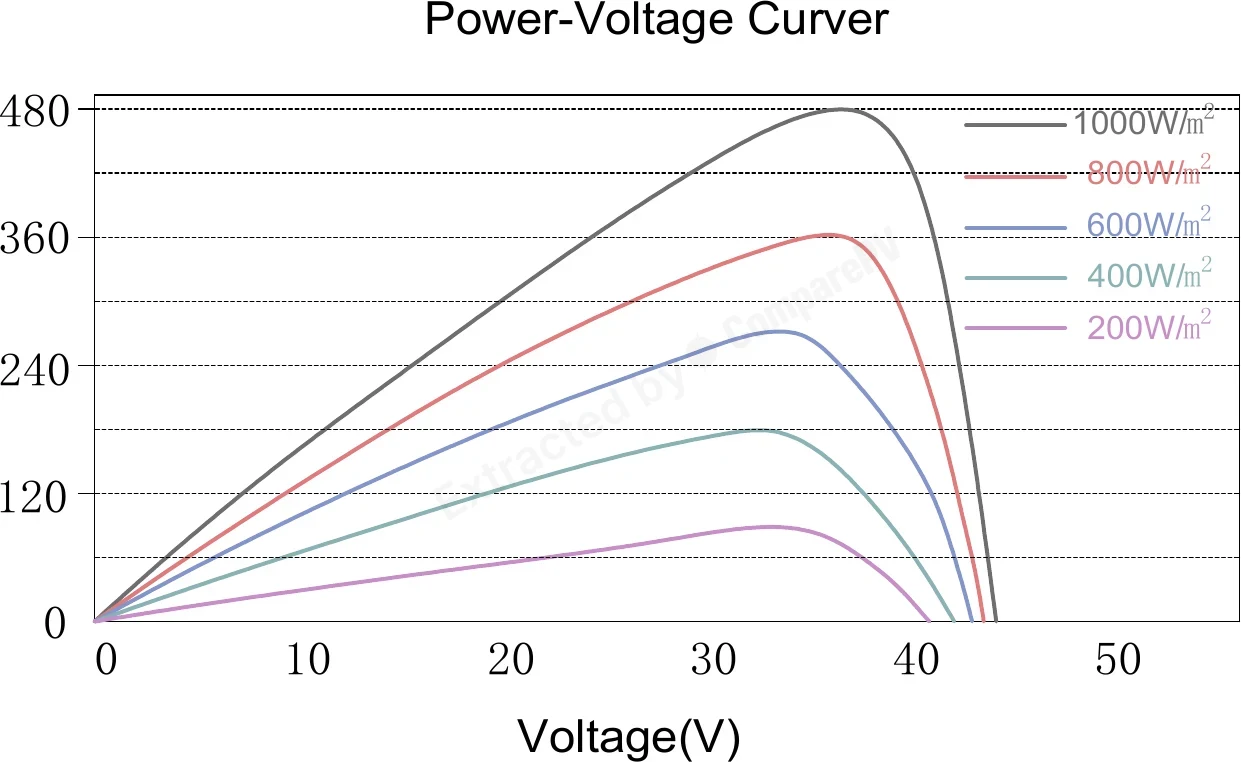
Nominal power (Pmax) 430 Wp Nameplate at 1000 W/m², 25 °C
Module efficiency 19.72 % Weak Segment median 21.51%
Vmpp · Impp 41.11 V · 10.46 A Operating point at max power
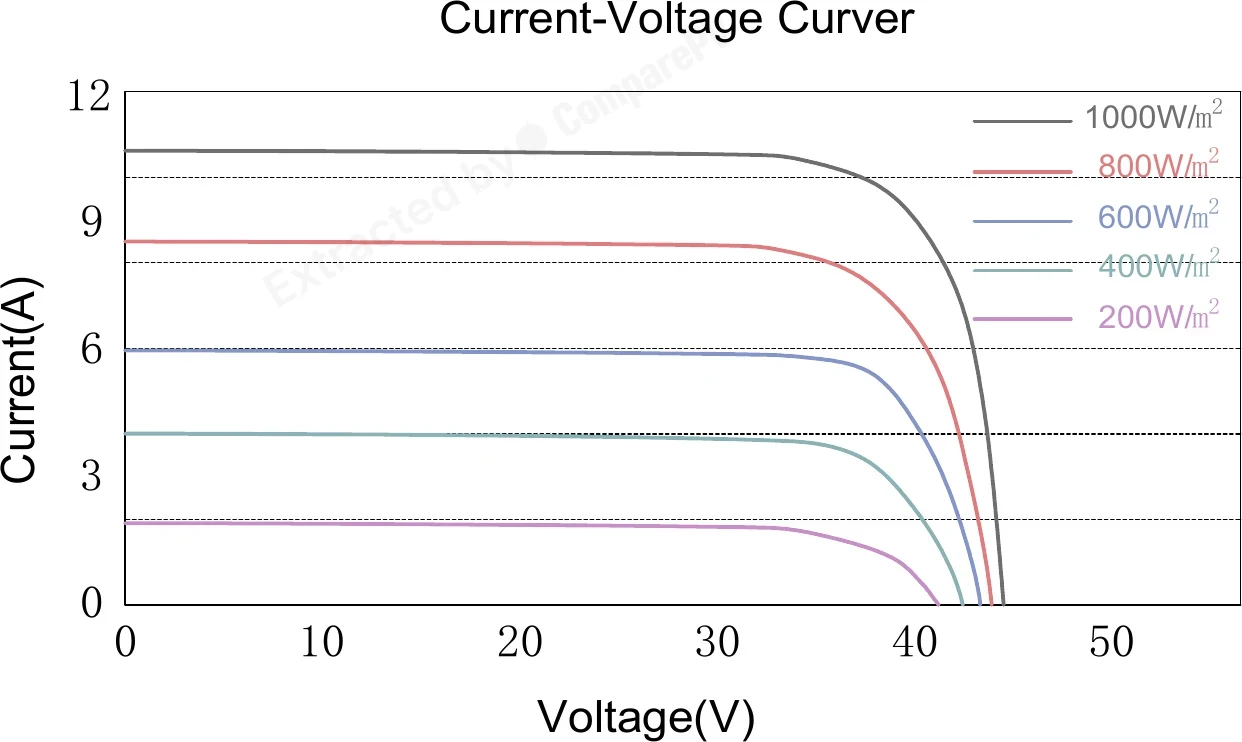
Voc · Isc 48.78 V · 11.30 A Sizes the string length
Max system voltage 1500 V Longer strings than 1000 V modules
Dimensions 2096×1040×30 mm · 2.18 m² of roof
Weight 24.0 kg Typical Typical · median 23.3 kg
Cells 144 Monocrystalline
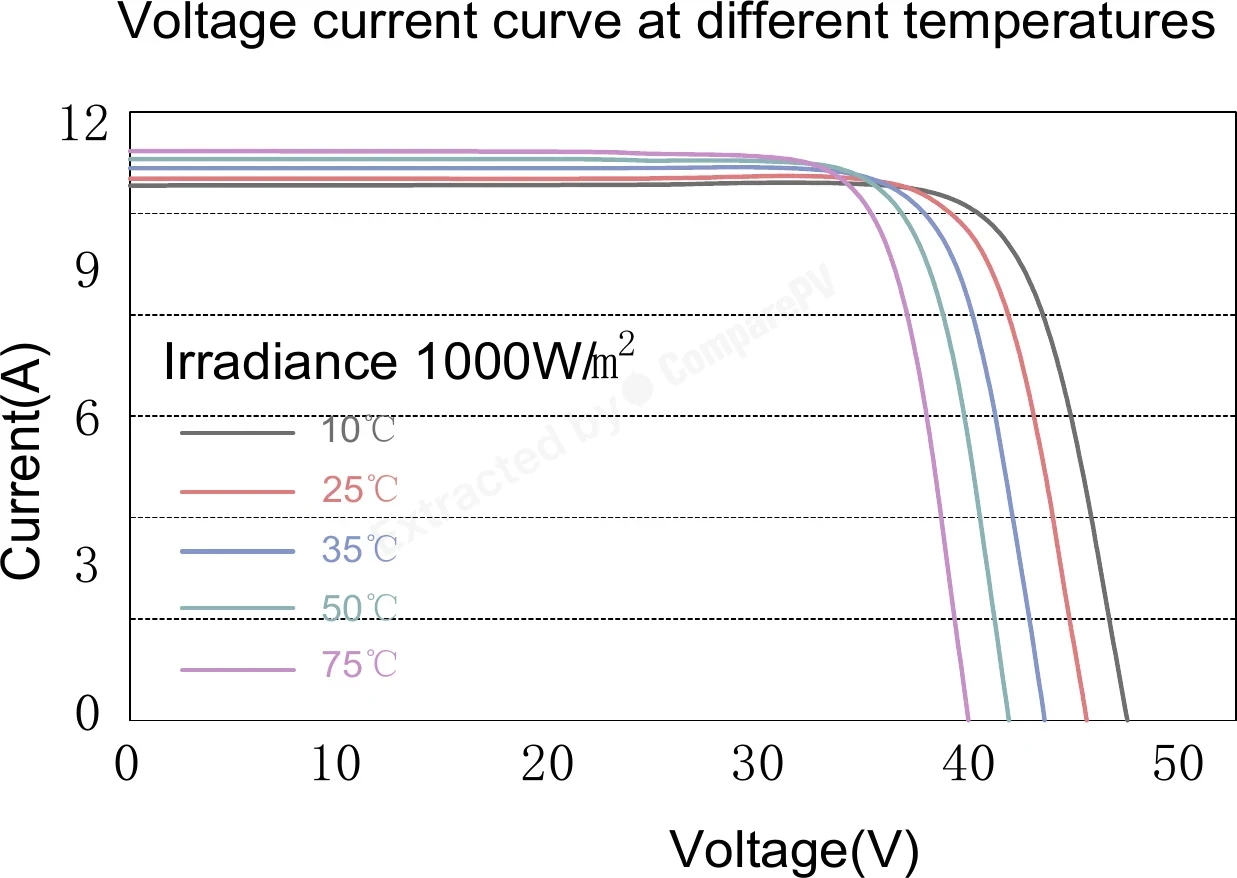
Coefficient Pmax -0.290 %/°C Typical median -0.300 of its segment
Coefficient Voc · Isc -0.250 · 0.045 %/°C
NOCT 45 °C At 800 W/m², 20 °C ambient
Product warranty 15 years Hardware defects only
Performance warranty 25 years Weak bottom 17% · median 30 yrs
End-of-warranty output 89.0 % Equals 373 W guaranteed
Degradation 1.00 → 0.42 % First year, then annual

Datasheet charts

Open datasheet PDF

Measured curves published by PolyCrown Solar Tech in this model's datasheet. A chart carrying a wattage was measured on that variant alone - only the ones that describe 430 Wp appear here. The rest cover the whole series.
Simulations

Live - change any input
Lifetime output & value
30 years at 1200 kWh/kWp/year and €0.50 per kWh
Power in year 30
-
Lifetime energy
-
Energy value
-

Degradation from this panel's own datasheet figures. No inverter, soiling or shading losses.

Heat losses
-0.290 %/°C against a segment median of -0.300
-
Filter these
Size
Panel Power Eff. Temp. Weight Difference
PolyCrown Solar Tech NS-430MH-144 430 W 19.72% -0.290 24.0 kg You are here
AIKO-A480-MAH54Mw 480 W 24.10% -0.260 21.5 kg +50 W, +4.4 pp, +5 yr warranty
GK-5-54HG-480M 480 W 24.10% -0.260 21.0 kg +50 W, +4.4 pp, +5 yr warranty
JKM480N-48QL6-DB-F2-EU 480 W 24.02% -0.260 24.4 kg +50 W, +4.3 pp, +5 yr warranty
GKA96N-PRO-480W 480 W 24.02% -0.300 21.0 kg +50 W, +4.3 pp, +5 yr warranty
NS-440MH-144 440 W 20.18% -0.290 24.0 kg +10 W, +0.5 pp
NS-450MH-144 450 W 20.64% -0.290 24.0 kg +20 W, +0.9 pp
NS-460MH-144 460 W 21.10% -0.290 24.0 kg +30 W, +1.4 pp
GKA120N-PRO-590W 590 W 23.82% -0.300 26.7 kg +160 W, +4.1 pp, +5 yr warranty
GKA120N-PRO-585W 585 W 23.62% -0.300 26.7 kg +155 W, +3.9 pp, +5 yr warranty
BGO 580 580 W 23.50% -0.290 26.0 kg +150 W, +3.8 pp, +5 yr warranty
GKA120N-PRO-580W 580 W 23.42% -0.300 26.7 kg +150 W, +3.7 pp, +5 yr warranty

Found 234 panels of the same or similar size to this one, within ±10 mm. See them here Found 325 panels of the same or similar size to this one, within ±25 mm. See them here Found 352 panels of the same or similar size to this one, within ±50 mm. See them here Found 1068 panels of the same or similar size to this one, within ±100 mm. See them here

Common questions

6 answered
What warranty does the PolyCrown Solar Tech Monocrystalline144 series carry?
The Monocrystalline144 series comes with a 15-year product warranty covering material and workmanship defects, plus a 25-year linear power output warranty. This means the manufacturer guarantees a minimum power yield — typically above 80% of rated output — through the end of the warranty period. That is among the longer standard terms in the high-wattage module segment.
Does the N-type cell technology in the Monocrystalline144 series actually improve energy yield on overcast days?
Yes. N-type cells are more responsive to diffuse irradiance than standard P-type cells. Under the overcast conditions typical of Central European climates, this translates to a realistically few percentage points of additional annual energy output. The absence of light-induced degradation (LID) further stabilizes the module's long-term performance parameters.
How does the 144-cell half-cut design affect panel performance under partial shading?
The half-cut architecture splits the panel into two independent halves — top and bottom. When a chimney, antenna, or adjacent module shades only one section, the other continues operating at full power. In a conventional full-cell panel, the entire cell string loses efficiency. With 144 half-cut cells instead of 72, each cell also has lower internal resistance, reducing resistive losses and minimizing the risk of hot-spots.
Is the 585 Wp PolyCrown Monocrystalline144 panel suitable for a residential pitched roof?
Modules in this 585 Wp class are primarily designed for commercial installations and large rooftop projects, given the dimensions typical of the 144-cell format. Installation on a residential pitched roof is technically feasible, but the roof's load-bearing capacity and available surface area should be verified with a certified installer beforehand — modules in this power class typically weigh approximately 28–32 kg.
Do the Monocrystalline144 panels suffer significant power loss during hot summer temperatures?
The Monocrystalline144 series features a low temperature coefficient, meaning reduced power losses on hot days. N-type cells typically achieve a temperature coefficient of around -0.30%/°C, outperforming standard P-type modules at -0.35%/°C or higher. In practice, at a module surface temperature of 40°C, power losses are noticeably lower than those of lower-cost competing products.
Are PolyCrown Solar Tech Monocrystalline144 panels compatible with popular inverters available in Poland?
Yes, the modules in this series are compatible with standard string inverters and microinverters widely available in Poland (including SMA, Fronius, Huawei, SolarEdge, and Deye). The key parameters to match are Voc, the inverter's MPPT voltage range, and maximum input current — confirm these against the specific model's datasheet and consult a system designer before purchase.
Add to compare