Leapton LP182*210-M-48-NB-435W

Leapton LP182*210-M-48-NB-435W

435 Wp TOPCon Bifacial 80%
ComparePV verdict

Middle of its segment, heavy for its output

Rank 7,839 of 14,129
Compare panels Datasheet PDF
Power (Wp)
435
Typical for its class
Efficiency (%)
21.77
Typical · median 22.00%
Density (Wp/m²)
217.7
Typical · median 220.2
Temp (%/°C)
-0.300
Typical · median -0.290
Weight (kg)
25.0
Weak · 3.0 kg above median
Warranty (yrs)
30
Typical · median 30 yrs

The Leapton LP182*210-M-48-NB series consists of modules based on N-type TOPCon solar cells in a 210R format, designed for high efficiency and stable operation under real-world conditions. The use of dual glass construction (glass-to-glass) enhances resistance to stress and material aging, resulting in greater predictability of performance over the long term. This solution is particularly appealing to investors who want to minimize the risk of performance degradation and prioritize durability over compromises.

A key feature of the series is bidirectional energy harvesting, which allows for better utilization of reflected light - important on bright roofs, when mounted on the ground, and in installations with elevated structures. The modules are attractive for residential and commercial installations, where power density per unit area and aesthetics are important - the full black finish variants are particularly well-suited for modern architecture. An additional advantage is extended product and linear warranty, which supports the overall profitability of the investment.

Ranking

1,220 panels in the segment TOPCon 400-450 W
Metric This panel Median Position in segment Overall rank
Module efficiency 21.77% 22.00% Typical 7,297
Power density 217.7 220.2 Typical 7,129
Temperature coefficient -0.300 -0.290 Typical 6,152
Weight per kWp 57.5 51.5 Weak · bottom 11% 11,316
Performance warranty 30 yrs 30 yrs Typical 21
Colour key Strong - top 25% Typical - middle 50% Weak - bottom 25%

Signals from the data

5 positive · 2 caution
Best for

Residential, commercial and BIPV.

Not ideal for

Weight-limited structures.

Watch-outs
57.5 kg per kWp

Bottom 11% of the TOPCon 400-450 W segment, against a median of 51.5.

What owners get
N-type TOPCon cells over PERC

N-type TOPCon technology (efficiency up to 22.77%) delivers lower LID/LeTID degradation and better high-temperature performance than older PERC cells, translating into higher real-world annual yield, especially in summer.

30-year linear power warranty

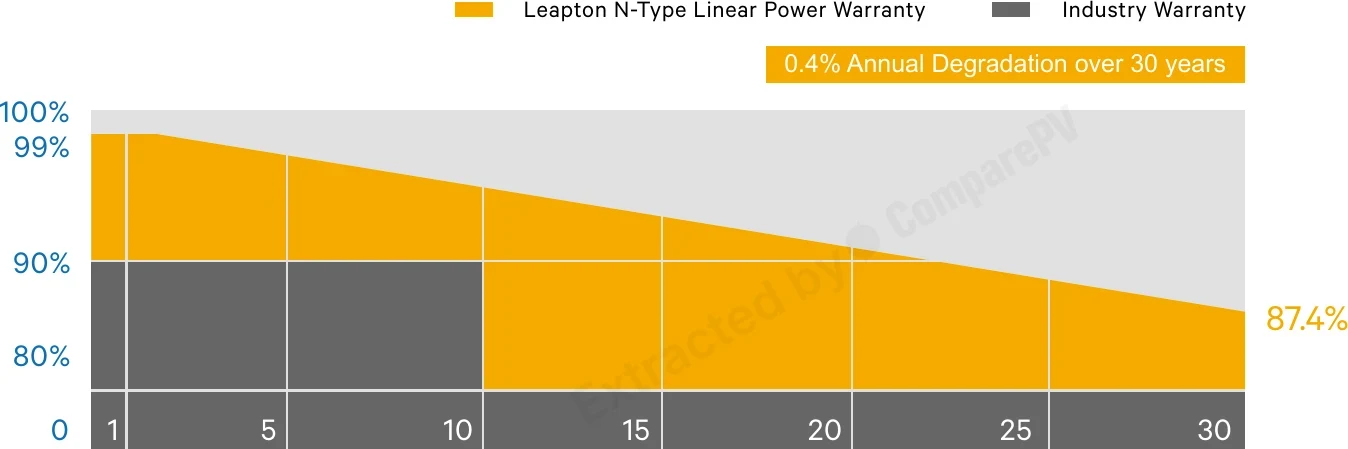
Leapton guarantees power retention for 30 years (annual degradation ~0.4%) with a 25-year product warranty - this is top-segment standard for N-type modules and matches LEDVANCE and Solitek offerings from the same peer set.

Dual glass construction boosts durability

Glass-glass design increases mechanical resistance (TÜV Nord tested: 2400 Pa wind load, 5400 Pa snow load) and reduces moisture ingress, meaningfully lowering the risk of premature degradation compared to glass-backsheet construction.

Bifacial design increases energy yield

The bifacial module enables an additional energy gain of roughly 5-25% depending on ground albedo - a significant advantage for ground-mount installations or bright roof surfaces where monofacial modules miss reflected-light potential.

Tier-1 status from a Japanese manufacturer

Leapton Energy (Japan, founded 2012) is listed as a BNEF Tier-1 manufacturer, confirming financial stability and eligibility for bank-financed projects - a key argument for commercial investment financing.

Trade-offs
Heavier dual-glass construction

Double glass increases module weight compared to glass-backsheet designs, which can raise transport and installation costs and require a stronger mounting structure, particularly on weaker roof surfaces.

Notes from the database
  • Efficiency of 21.8% matches the TOPCon 400-450W median
  • Power density of 217.7 W/m² matches the TOPCon 400-450W median
  • At -0.30%/°C, hot weather performance is typical for TOPCon 400-450W panels
  • At 25.0 kg, this panel is 3.0 kg heavier than the TOPCon 400-450W median (22.0 kg) - more demanding for installation crews
  • Bifaciality factor of 80% can add 4-12% extra yield with reflective mounting surface

Specifications

Open datasheet PDF
Nominal power (Pmax) 435 Wp Nameplate at 1000 W/m², 25 °C
Module efficiency 21.77 % Typical Segment median 22.00%
Vmpp · Impp 29.18 V · 14.91 A Operating point at max power
Voc · Isc 35.13 V · 15.77 A Sizes the string length
Max system voltage 1500 V Longer strings than 1000 V modules
Dimensions 1762×1134×30 mm · 2.00 m² of roof
Weight 25.0 kg Weak Weak · 3.0 kg above median
Cells 96 · TOPCon Monocrystalline
Bifaciality 80 % Rear output as a share of front
Coefficient Pmax -0.300 %/°C Typical median -0.290 of its segment
Coefficient Voc · Isc -0.250 · 0.046 %/°C
NOCT 41 °C At 800 W/m², 20 °C ambient
Product warranty 25 years Hardware defects only
Performance warranty 30 years Typical median 30 yrs · median 30 yrs
End-of-warranty output 87.4 % Equals 380 W guaranteed
Degradation 0.40 % Per year after the first

Datasheet charts

Open datasheet PDF

Measured curves published by Leapton in this model's datasheet. A chart carrying a wattage was measured on that variant alone - only the ones that describe 435 Wp appear here. The rest cover the whole series.
Simulations

Live - change any input
Lifetime output & value
30 years at 1200 kWh/kWp/year and €0.50 per kWh
Power in year 30
-
Lifetime energy
-
Energy value
-
With bifacial gain
-

Degradation from this panel's own datasheet figures. No inverter, soiling or shading losses.

Heat losses
-0.300 %/°C against a segment median of -0.290
-
Bifacial gain
Rear gain over light concrete: -
-

Model: bifaciality × albedo × 0.6 view factor. A first-order estimate, not a yield simulation.

Filter these
Size
Panel Power Eff. Temp. Weight Difference
Leapton LP182*210-M-48-NB-435W 435 W 21.77% -0.300 25.0 kg You are here
JAT54S40-485/LR 485 W 24.30% -0.260 19.3 kg +50 W, lighter, +2.5 pp
AIKO-A485-MCE54Mw 485 W 24.30% -0.260 21.0 kg +50 W, lighter, +2.5 pp
AIKO-A485-MAH54Mw 485 W 24.30% -0.260 21.5 kg +50 W, cooler, +2.5 pp
GK-5-54HG-485M 485 W 24.30% -0.260 21.0 kg +50 W, lighter, +2.5 pp
ZEUS 3.0+ 108 485WP 485 W 24.30% -0.260 24.2 kg +50 W, cooler, +2.5 pp
LP182*182-M-54-NH-430W 430 W 21.52% -0.300 22.0 kg Lighter, -0.2 pp
LP182*210-M-48-NB-440W 440 W 22.02% -0.300 24.0 kg Lighter, +0.2 pp
LR7-54HJD-510M 510 W 25.00% -0.240 23.5 kg +75 W, cooler, +3.2 pp
AIKO-A495-MCE54Mw 495 W 24.80% -0.260 21.0 kg +60 W, lighter, +3.0 pp
LR7-54HJD-505M 505 W 24.70% -0.240 23.5 kg +70 W, cooler, +2.9 pp
WST-505BKX54-A2 505 W 24.70% -0.260 25.0 kg +70 W, cooler, +2.9 pp
AIKO-A490-MCE54Mw 490 W 24.50% -0.260 21.0 kg +55 W, lighter, +2.7 pp
LR7-54HJD-500M 500 W 24.50% -0.240 23.5 kg +65 W, cooler, +2.7 pp
CIPRO-TN9C54M-500W 500 W 24.50% -0.260 21.4 kg +65 W, cooler, +2.7 pp

Found 1402 panels of the same or similar size to this one, within ±10 mm. See them here Found 1432 panels of the same or similar size to this one, within ±25 mm. See them here Found 3651 panels of the same or similar size to this one, within ±50 mm. See them here Found 3999 panels of the same or similar size to this one, within ±100 mm. See them here

About the LP182*210-M-48-NB (N-type TOPCon dual glass) series

6 answered

These answers cover the whole series. Where a figure differs, the specification above is this module's own.

What warranty comes with the Leapton LP182*210-M-48-NB panels?
The LP182*210-M-48-NB series includes a 25-year product warranty covering material and workmanship defects, plus a 30-year linear power output warranty. The N-type TOPCon technology keeps annual degradation at or below 0.4%, meaning the module retains most of its rated power after three decades. This is one of the longest combined warranties currently available on the residential and commercial PV market.
How does TOPCon compare to PERC cells and is the difference noticeable in real-world output?
N-type TOPCon cells deliver higher baseline efficiency (up to roughly 22.5% for this series) and lower long-term degradation than P-type PERC. The practical advantage is better performance at elevated cell temperatures and under diffuse irradiance - both common conditions in Central European climates. This translates into higher annual energy yield per square meter compared to previous-generation PERC modules of equal wattage.
Does the bifacial design of the LP182*210-M-48-NB make a real difference on a typical pitched roof?
The rear-side gain from bifacial modules depends heavily on surface albedo and mounting clearance. On a dark tile roof the effect is minimal, but on light-colored metal roofing, white gravel, or ground-mount racking with adequate clearance, Leapton specifies a 5-25% additional output from the rear side. For a standard pitched roof a realistic bonus is 5-10%, which meaningfully improves the installation's LCOE over its lifetime.
Can these panels handle heavy snow loads and high wind pressure?
Yes. The dual glass construction of this series is TÜV Nord-certified for snow loads up to 5400 Pa and wind loads up to 2400 Pa. The 5400 Pa snow rating exceeds the structural requirements of most Central European climate zones. The glass-glass design also eliminates the rear backsheet, which over time is more susceptible to moisture ingress and delamination than tempered glass.
What is the peak power of the Leapton LP182*210-M-48-NB and how many panels are needed for a 10 kW system?
The highest-power variant in this series is rated at 455 Wp under STC. A 10 kW peak system requires approximately 22 modules (22 × 455 W = 10,010 W). The 210R cell format and compact footprint (1762 × 1134 mm) mean that a 22-panel array occupies less roof area than equivalent systems built with lower-wattage legacy modules, which matters when usable roof space is limited.
Is Leapton a bankable manufacturer and can these modules be used in financed commercial projects?
Leapton Energy was founded in 2012 in Kobe, Japan and operates manufacturing facilities in China. The company holds Tier 1 status from independent financial research institutions, meaning its modules are accepted as collateral by banks and leasing funds for commercial and utility-scale PV project financing. This bankability is a key requirement for EPC contractors and investors seeking external financing for larger installations.
Add to compare