JW-HD108N-R3-430W

430 Wp TOPCon Bifacial 80%
ComparePV verdict

Middle of its segment, heavy for its output

Rank 10,440 of 14,005
Compare panels Datasheet PDF
Power (Wp)
430
Typical for its class
Efficiency (%)
21.52
Weak · bottom 23%
Density (Wp/m²)
215.2
Weak · bottom 23%
Temp (%/°C)
-0.300
Typical · median -0.290
Weight (kg)
24.6
Weak · 2.6 kg above median
Warranty (yrs)
30
Typical · median 30 yrs

Jolywood JW-HD108N Series panels are an advanced solution based on innovative N-type TOPCon cell technology, which redefines efficiency standards in challenging lighting conditions. This series stands out with its bifacial (double-sided) glass-glass construction, which ensures not only additional energy yield from reflected light, but also exceptional resistance to light-induced degradation (LID) and external factors such as moisture or ammonia. The use of a smaller number of cells in the 108 format makes the modules compact and perfectly suited for residential roofs while maintaining high power output. For investors, a key benefit is the minimal annual efficiency decline, which translates into stable and predictable profits over decades. Unlike standard P-type modules, the JW-HD108N series offers a better temperature coefficient, allowing the system to operate more efficiently on hot days. It is the ideal choice for those looking for maximum durability and fire safety resulting from the hermetic double-glass construction. This solution combines aesthetics with uncompromising technology, outperforming the competition in terms of service life and operational stability in the variable Polish climate.

Ranking

1,218 panels in the segment TOPCon 400-450 W
Metric This panel Median Position in segment Overall rank
Module efficiency 21.52% 22.00% Weak · bottom 23% 7,853
Power density 215.2 220.2 Weak · bottom 23% 7,816
Temperature coefficient -0.300 -0.290 Typical 6,093
Weight per kWp 57.2 51.4 Weak · bottom 12% 11,127
Performance warranty 30 yrs 30 yrs Typical 21
Colour key Strong - top 25% Typical - middle 50% Weak - bottom 25%

Signals from the data

5 positive · 5 caution
Best for

Residential, shaded-installations and hot-climate.

Not ideal for

Weight-limited structures, tight roof space and roofs where every square metre has to count.

Watch-outs
57.2 kg per kWp

Bottom 12% of the TOPCon 400-450 W segment, against a median of 51.4.

21.52% module efficiency

Bottom 23% of the TOPCon 400-450 W segment, against a median of 22.00%.

215.2 watts per square metre

Bottom 23% of the TOPCon 400-450 W segment, against a median of 220.2.

What owners get
N-type TOPCon: superior temperature coefficient

The JW-HD108N's N-type TOPCon cells deliver a power temperature coefficient of -0.28%/°C, compared to -0.35% to -0.40%/°C typical of P-type PERC modules. Under real-world conditions where module temperatures routinely exceed 60°C in summer, this advantage translates to a 2–4% higher annual energy yield versus PERC technology.

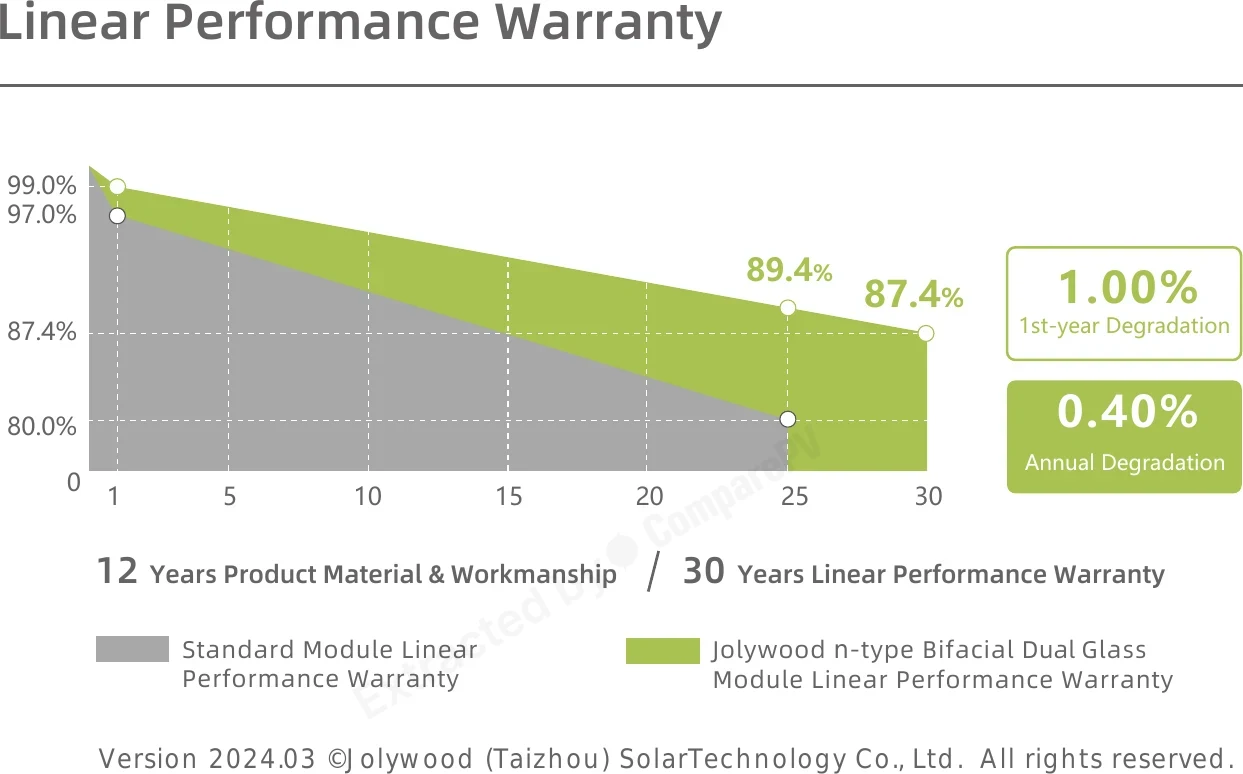
30-year linear power warranty (≥87.4% output)

Jolywood guarantees at least 87.4% of rated power after 30 full years of operation — five years longer than the standard 25-year warranties offered by comparable series from Risen (RSM96-11-440-460BNDG) and SunKean (SKT440~460M12-96D4). The extended warranty horizon lowers the project LCOE and reduces investor risk when structuring project finance.

Bifacial double-glass construction with up to +25% bifacial gain

The hermetic glass-glass encapsulation, combined with bifacial cell architecture, enables an additional energy yield of up to +25% over a monofacial module at albedo values ≥20%. The dual-glass build also eliminates moisture-induced degradation (DH), ammonia corrosion, LID, and PID — a critical advantage for installations exposed to high humidity and frequent precipitation.

BNEF Tier-1 Q2 2026 — bankability confirmed

Jolywood appears on BloombergNEF's Q2 2026 Tier-1 PV Module Manufacturer list, confirming its ability to participate in projects financed by international banking institutions. Tier-1 status reduces credit risk for lenders and simplifies insurance underwriting for both residential and commercial PV portfolios.

Compact 108 half-cut cell format for residential rooftops

The 108 half-cut cell count results in a physically smaller and lighter module footprint compared to the more common 120–132 cell formats, simplifying installation on pitched residential rooftops with limited usable area. The smaller format also reduces per-cell mechanical stress, lowering susceptibility to micro-cracks (MIC) during handling and transport.

Trade-offs
Higher module weight (~27 kg) due to double-glass build

The glass-glass construction results in a module weight of approximately 27.3 kg (per R2 variant datasheets), compared to 20–22 kg for equivalent glass-backsheet modules. On older residential roof structures, a structural assessment or rafter reinforcement may be required, adding to BoS costs.

Entry-level variant efficiency below top peer comparables

The lowest-efficiency variant in the series reaches 21.52%, while direct competitors SunKean SKT460 (23.02%) and Risen RSM96-460 (23.00%) start from a higher baseline. The ~1.5 percentage point gap means that 1–2 additional modules per 10 kWp may be required on space-constrained rooftops when compared to the most efficient alternatives in the same segment.

Notes from the database
  • At 21.5% efficiency, this panel is on par with typical TOPCon 400-450W modules
  • Power density of 215.2 W/m² is 5.0 W/m² below TOPCon 400-450W median (220.2 W/m²) - needs more roof space
  • At -0.30%/°C, hot weather performance is typical for TOPCon 400-450W panels
  • At 24.6 kg (2.6 kg above TOPCon 400-450W median of 22.0 kg), requires checking roof load capacity
  • Bifacial design (80% factor) captures reflected light - adds 4-12% yield on ground-mount or white roof

Specifications

Open datasheet PDF
Nominal power (Pmax) 430 Wp Nameplate at 1000 W/m², 25 °C
Module efficiency 21.52 % Weak Segment median 22.00%
Vmpp · Impp 32.97 V · 13.04 A Operating point at max power
Voc · Isc 38.37 V · 13.86 A Sizes the string length
Max system voltage 1500 V Longer strings than 1000 V modules
Dimensions 1762×1134×30 mm · 2.00 m² of roof
Weight 24.6 kg Weak Weak · 2.6 kg above median
Cells 108 · TOPCon Monocrystalline
Bifaciality 80 % Rear output as a share of front
Coefficient Pmax -0.300 %/°C Typical median -0.290 of its segment
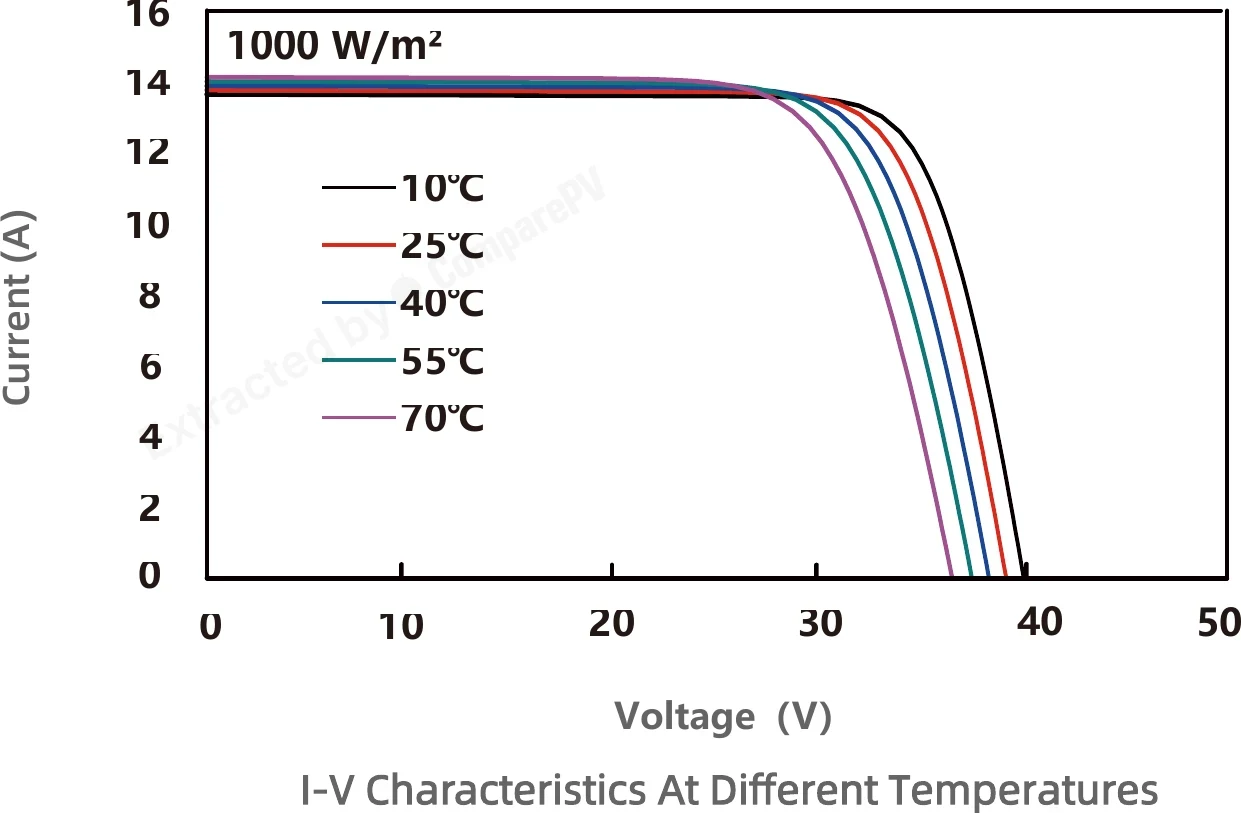
Coefficient Voc · Isc -0.250 · 0.045 %/°C
NOCT 42 °C At 800 W/m², 20 °C ambient
Product warranty 12 years Hardware defects only
Performance warranty 30 years Typical median 30 yrs · median 30 yrs
End-of-warranty output 87.4 % Equals 376 W guaranteed
Degradation 1.00 → 0.40 % First year, then annual

Datasheet charts

Open datasheet PDF

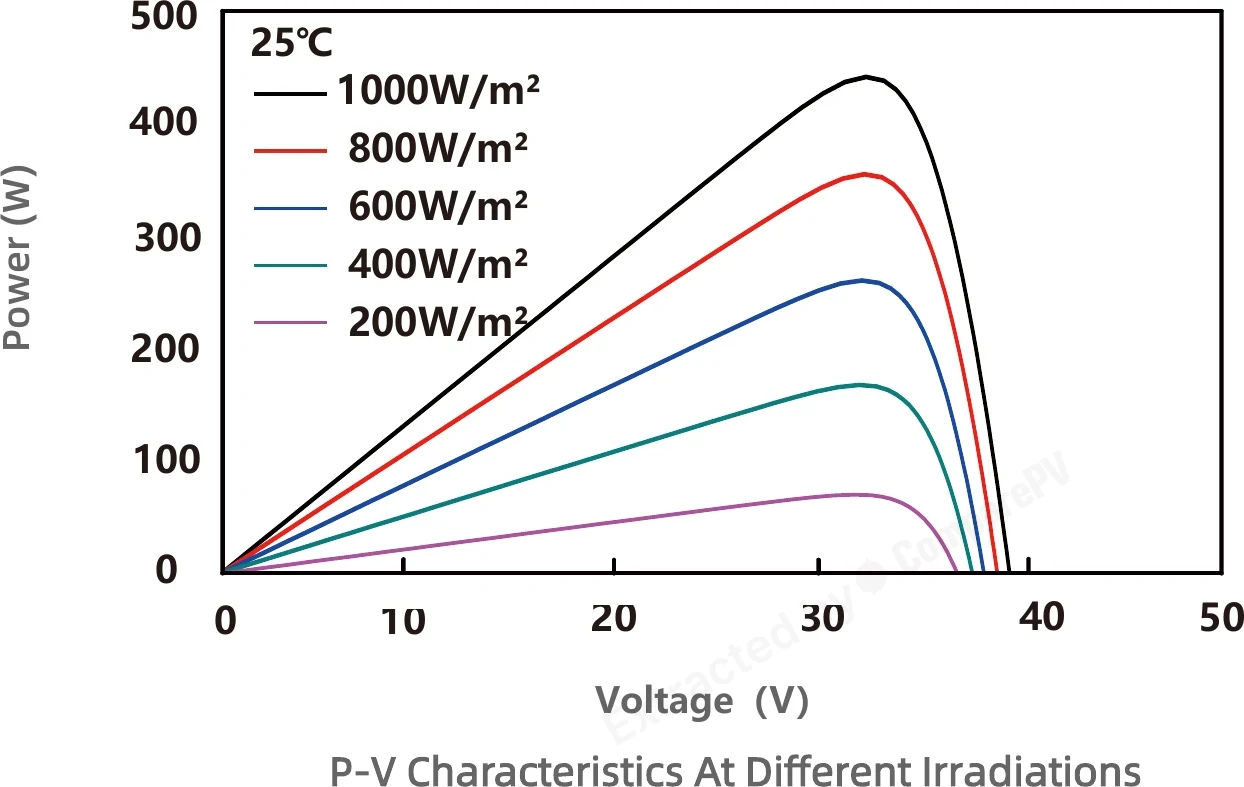
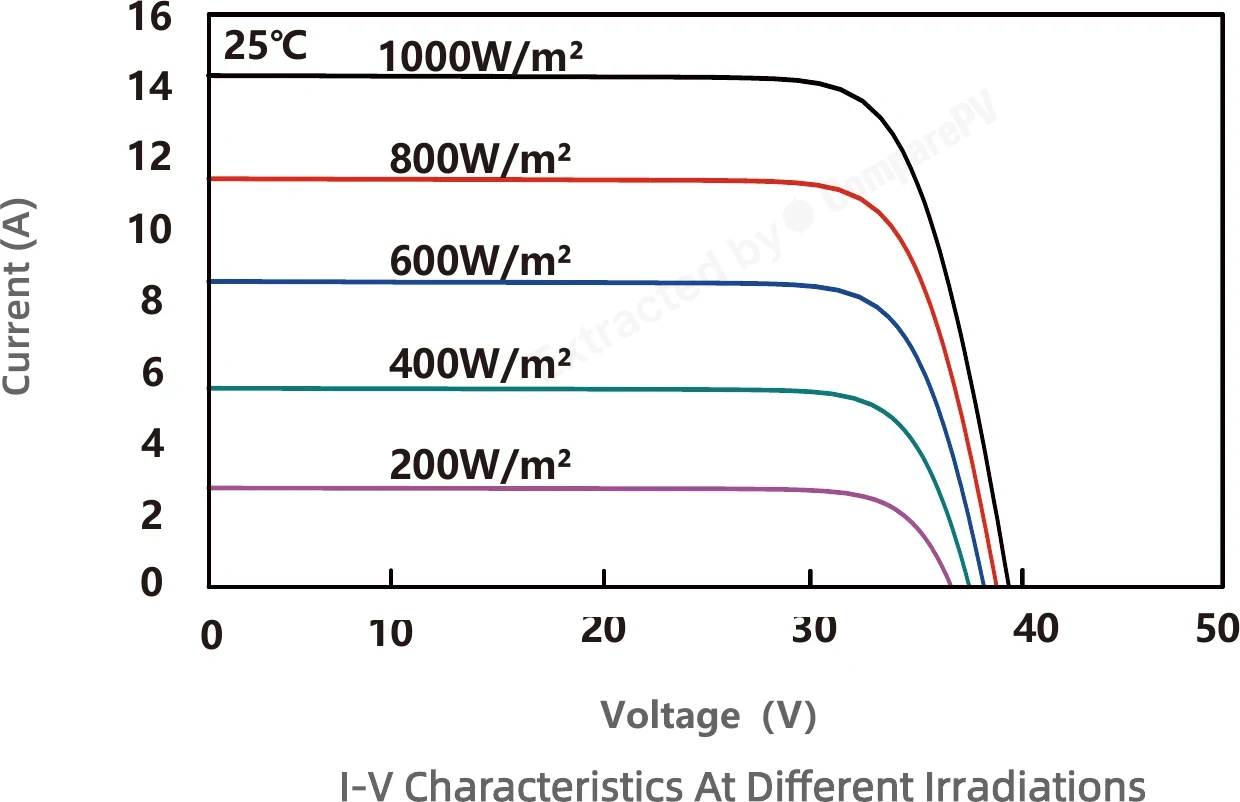
Measured curves published by Jolywood in this model's datasheet. A chart carrying a wattage was measured on that variant alone - only the ones that describe 430 Wp appear here. The rest cover the whole series.
Simulations

Live - change any input
Lifetime output & value
30 years at 1200 kWh/kWp/year and €0.50 per kWh
Power in year 30
-
Lifetime energy
-
Energy value
-
With bifacial gain
-

Degradation from this panel's own datasheet figures. No inverter, soiling or shading losses.

Heat losses
-0.300 %/°C against a segment median of -0.290
-
Bifacial gain
Rear gain over light concrete: -
-

Model: bifaciality × albedo × 0.6 view factor. A first-order estimate, not a yield simulation.

Filter these
Size
Panel Power Eff. Temp. Weight Difference
Jolywood JW-HD108N-R3-430W 430 W 21.52% -0.300 24.6 kg You are here
AIKO-A480-MAH54Mw 480 W 24.10% -0.260 21.5 kg +50 W, cooler, +2.6 pp
GK-5-54HG-480M 480 W 24.10% -0.260 21.0 kg +50 W, cooler, +2.6 pp
JKM480N-48QL6-DB-F2-EU 480 W 24.02% -0.260 24.4 kg +50 W, cooler, +2.5 pp
GKA96N-PRO-480W 480 W 24.02% -0.300 21.0 kg +50 W, lighter, +2.5 pp
JW-HT108N-R3 435W 435 W 21.80% -0.280 21.7 kg Cooler, lighter, +0.3 pp
JW-HT108N-R3 440W 440 W 22.00% -0.280 21.7 kg Cooler, lighter, +0.5 pp
LR7-54HJD-510M 510 W 25.00% -0.240 23.5 kg +80 W, cooler, +3.5 pp
AIKO-A495-MCE54Mw 495 W 24.80% -0.260 21.0 kg +65 W, cooler, +3.3 pp
LR7-54HJD-505M 505 W 24.70% -0.240 23.5 kg +75 W, cooler, +3.2 pp
AIKO-A490-MCE54Mw 490 W 24.50% -0.260 21.0 kg +60 W, cooler, +3.0 pp
LR7-54HJD-500M 500 W 24.50% -0.240 23.5 kg +70 W, cooler, +3.0 pp
CIPRO-TN9C54M-500W 500 W 24.50% -0.260 21.4 kg +70 W, cooler, +3.0 pp

Found 1395 panels of the same or similar size to this one, within ±10 mm. See them here Found 1425 panels of the same or similar size to this one, within ±25 mm. See them here Found 3614 panels of the same or similar size to this one, within ±50 mm. See them here Found 3962 panels of the same or similar size to this one, within ±100 mm. See them here

Common questions

6 answered
How does the JW-HD108N Series handle high temperatures — does power drop significantly on hot days?
Thanks to N-type TOPCon technology, the power temperature coefficient is approximately -0.28%/°C, which is among the best in its class. On hot, sunny days JW-HD108N modules lose less energy than typical P-type PERC panels, which commonly reach -0.35%/°C. For a 10 kWp system, this difference can translate into several hundred kilowatt-hours of additional annual yield.
How much extra energy does the bifacial design of the Jolywood JW-HD108N Series actually provide?
The bifacial glass-glass construction allows the module's rear side to capture light reflected from the ground or rooftop surface. In ground-mounted installations over a bright surface, rear-side energy gain can reach 10–30% relative to the front side, depending on the albedo of the surroundings. On pitched roofs the effect is smaller but still measurable — especially with light-colored or reflective roofing materials.
What warranties does the Jolywood JW-HD108N Series carry — product and power output?
Jolywood provides a 25-year product warranty covering material and workmanship defects, and a 30-year linear power warranty. Over three decades, modules must maintain a defined output level — typically at or above 87.5% of rated power after 30 years. This is one of the longest power warranties on the market, reflecting Jolywood's confidence in the long-term durability of TOPCon cell technology.
Does the glass-glass construction of the JW-HD108N improve fire safety for residential rooftop installations?
Yes — the hermetically sealed double glass enclosure eliminates the backsheet, which is the primary fire risk in standard modules. The glass construction is non-combustible, resistant to moisture and ammonia, and significantly reduces light-induced degradation (LID). For residential rooftops, this means a higher fire safety classification, reduced long-term degradation, and longer service life in variable climates.
Which inverters are compatible with the JW-HD108N Series, and do the modules support 1500 V DC systems?
The JW-HD108N Series supports a maximum system voltage of 1500 V DC, making it compatible with modern string and central inverters from all major brands including SMA, Fronius, Huawei, and Sungrow. For residential prosumer installations up to 10 kW, a 1000 V DC inverter is sufficient — MPPT string configuration should be verified with a certified installer before commissioning.
How do the JW-HD108N panels compare to standard P-type PERC modules, and is the price premium justified?
The N-type TOPCon cells in the JW-HD108N Series exhibit lower LID and LeTID degradation, a better temperature coefficient, and higher cell efficiency compared to mainstream P-type PERC modules. This translates into more energy harvested from the same roof area and greater output stability over a 30-year operational lifespan. At current installation costs, the panel price premium typically pays back within the first few years of operation.
Add to compare