Jinko Solar JSHC166M120-375W

375 Wp Monocrystalline
ComparePV verdict

Middle of its segment, heavy for its output

Rank 12,963 of 14,129
Compare panels Datasheet PDF
Power (Wp)
375
Weak · bottom 18%
Efficiency (%)
21.30
Typical · median 21.10%
Density (Wp/m²)
206.0
Typical · median 211.0
Temp (%/°C)
-0.340
Typical · median -0.310
Weight (kg)
34.0
Weak · 12.0 kg above median
Warranty (yrs)
25
Weak · bottom 20%

The Jinko Solar JSHC166M120 series is designed for high power output without increasing the risk of failures during daily operation. The use of half-cut technology reduces energy losses in the module and improves performance under partial shading, which, in Polish conditions (chimneys, trees, skylights), translates into more stable yields. The design based on multi-busbar technology supports better current collection and performance in low-light conditions, while the dense interconnection grid enhances efficiency without the need to "inflate" parameters on paper.

Compared to many competing panels, this series stands out due to its focus on durability: the manufacturer emphasizes minimizing microcracks through precise cutting, as well as PID resistance, which refers to power drops caused by potential differences in the installation. This is a good choice for single-family homes, commercial rooftops, and micro-installations, where reliability, predictable yields, and a quick return on investment are important.

Ranking

5,861 panels in the 275-475 W band, all technologies
Metric This panel Median Position in segment Overall rank
Module efficiency 21.30% 21.10% Typical 8,585
Power density 206.0 211.0 Typical 11,187
Temperature coefficient -0.340 -0.310 Typical 8,846
Weight per kWp 90.7 53.6 Weak · bottom 1% 13,991
Performance warranty 25 yrs 30 yrs Weak · bottom 20% 9,912
Colour key Strong - top 25% Typical - middle 50% Weak - bottom 25%

Signals from the data

5 positive · 6 caution
Best for

Residential, commercial and shaded-installations.

Not ideal for

Weight-limited structures and owners who want a long output guarantee.

Watch-outs
90.7 kg per kWp

Bottom 1% of the 275-475 W band, against a median of 53.6. Ranked 13,991st in the whole database.

25 year performance warranty

Bottom 20% of the 275-475 W band, against a median of 30 yrs.

What owners get
Up to 21.3% efficiency - segment leader

The top-tier variant reaches 21.3% conversion efficiency, outperforming direct peer comparables: Boviet Solar VEGA (max 20.0%) and ENCOR EC (max 20.59%). On roof areas with limited space, this translates to a measurably higher annual energy yield without increasing the module count.

Half-cut cells + multi-busbar (MBB)

Half-cut cell design reduces resistive losses to ¼ of those in full-cell modules, while the dense MBB layout shortens current conduction paths by over 50%. In practice, this improves performance under partial shading (chimneys, dormers) - a significant factor in typical Central European residential rooftop conditions.

Certified PID resistance

The series meets IEC 61215 and IEC 61730 requirements for potential-induced degradation resistance. PID is a key risk factor in systems with ungrounded DC strings or long cable runs - a common configuration in Polish prosumer microinstallations.

Jinko Solar - BNEF #1 bankability

The manufacturer holds the top position in the Bloomberg NEF bankability ranking (2025 report: sole manufacturer rated bankable by 100% of surveyed respondents) and leads global module shipments at 86.8 GW in 2025. Tier-1 status materially reduces investment risk and facilitates project financing.

25-year linear power warranty

Jinko Solar guarantees linear power degradation over 25 years, in line with the segment standard. Combined with Jinko's Tier-1 financial standing, the risk of warranty non-enforcement is significantly lower than with Tier-2 or Tier-3 manufacturers.

Trade-offs
P-type PERC, not N-type technology

P-type PERC cells exhibit higher light-induced degradation (LID) and a worse temperature coefficient than modern TOPCon or HJT architectures. As of 2026, the premium segment is dominated by N-type modules - choosing this series means accepting a higher annual degradation rate (approx. 0.55% vs. approx. 0.40% for TOPCon).

2020 design - M6 (166 mm) wafer format

The series is built on M6 (166 mm) wafers, while the industry shifted to M10 (182 mm) and G12 (210 mm) between 2022 and 2026, delivering lower cost-per-Wp and better BoS economics (fewer modules for the same system power). The absence of an updated SMBB architecture may limit pricing competitiveness and availability in new tender processes.

No bifacial variant available

The series is monofacial only (is_bifacial: false). On commercial flat rooftops or ground-mount systems, bifacial PERC or TOPCon modules typically generate 5-15% additional yield from reflected albedo. Selecting this series forecloses that yield improvement without switching products.

Wide intra-series efficiency spread (18.9-21.3%)

Across 6 variants, the efficiency spread reaches 2.4 percentage points. Lower-power variants (350 Wp, approx. 18.9%) fall well short of same-segment competitors - ENCOR EC achieves 20.59% at its 375 Wp maximum. Buyers should verify which specific variant is actually delivered, as the stated series range can obscure significant performance differences.

Notes from the database
  • Efficiency of 21.3% is 0.5pp below the database median (21.8%)
  • At 206.0 W/m², this panel generates 12.1 W/m² less per unit area than database median (218.1 W/m²)
  • At -0.34%/°C, loses 0.04pp more power per degree than database median (-0.30%/°C)
  • Weight of 34.0 kg is 7.5 kg above database median (26.5 kg) - verify structural support
  • Ranked #8585 out of 14129 panels for efficiency in the database

Specifications

Open datasheet PDF
Nominal power (Pmax) 375 Wp Nameplate at 1000 W/m², 25 °C
Module efficiency 21.30 % Typical Segment median 21.10%
Vmpp · Impp 31.15 V · 13.32 A Operating point at max power
Voc · Isc 37.64 V · 13.81 A Sizes the string length
Max system voltage 1500 V Longer strings than 1000 V modules
Dimensions 1754×1038×35 mm · 1.82 m² of roof
Weight 34.0 kg Weak Weak · 12.0 kg above median
Cells 120 Monocrystalline
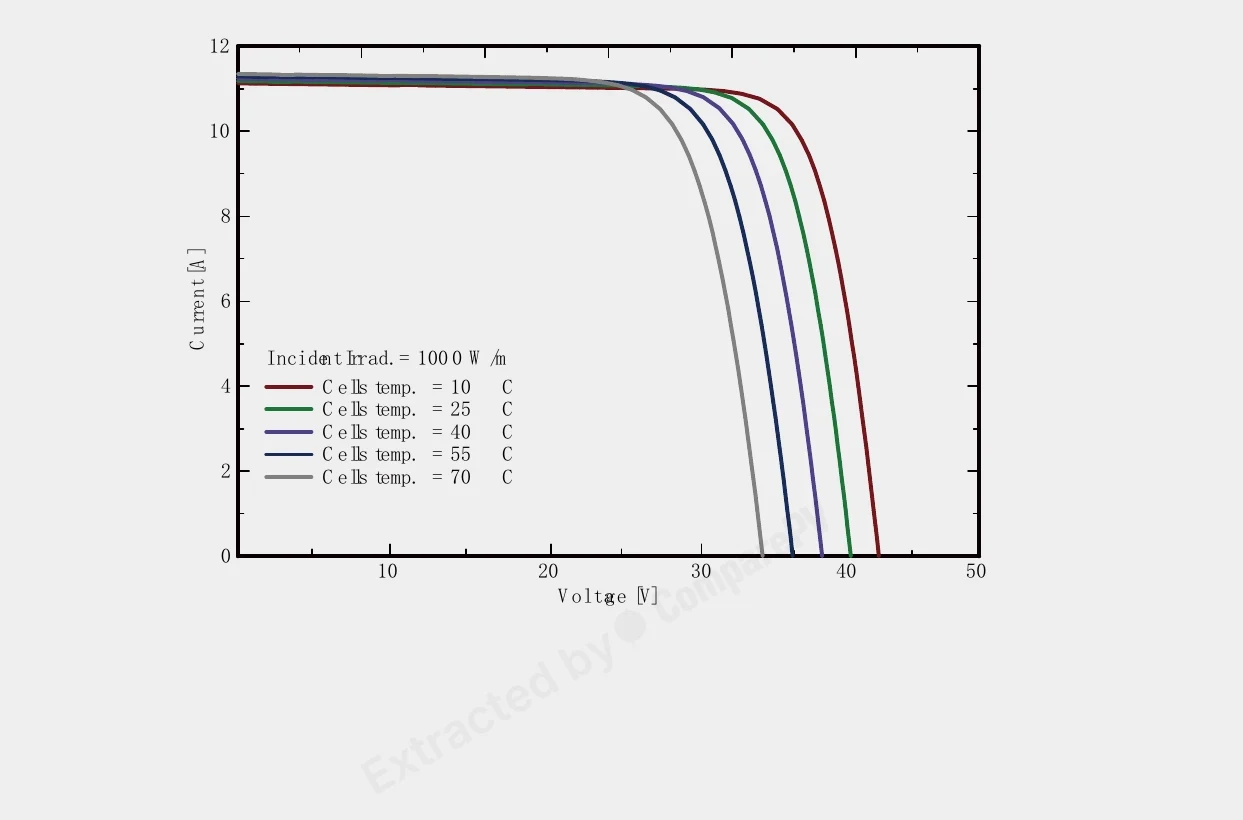
Coefficient Pmax -0.340 %/°C Typical median -0.310 of its segment
Coefficient Voc · Isc -0.250 · 0.040 %/°C
NOCT 43 °C At 800 W/m², 20 °C ambient
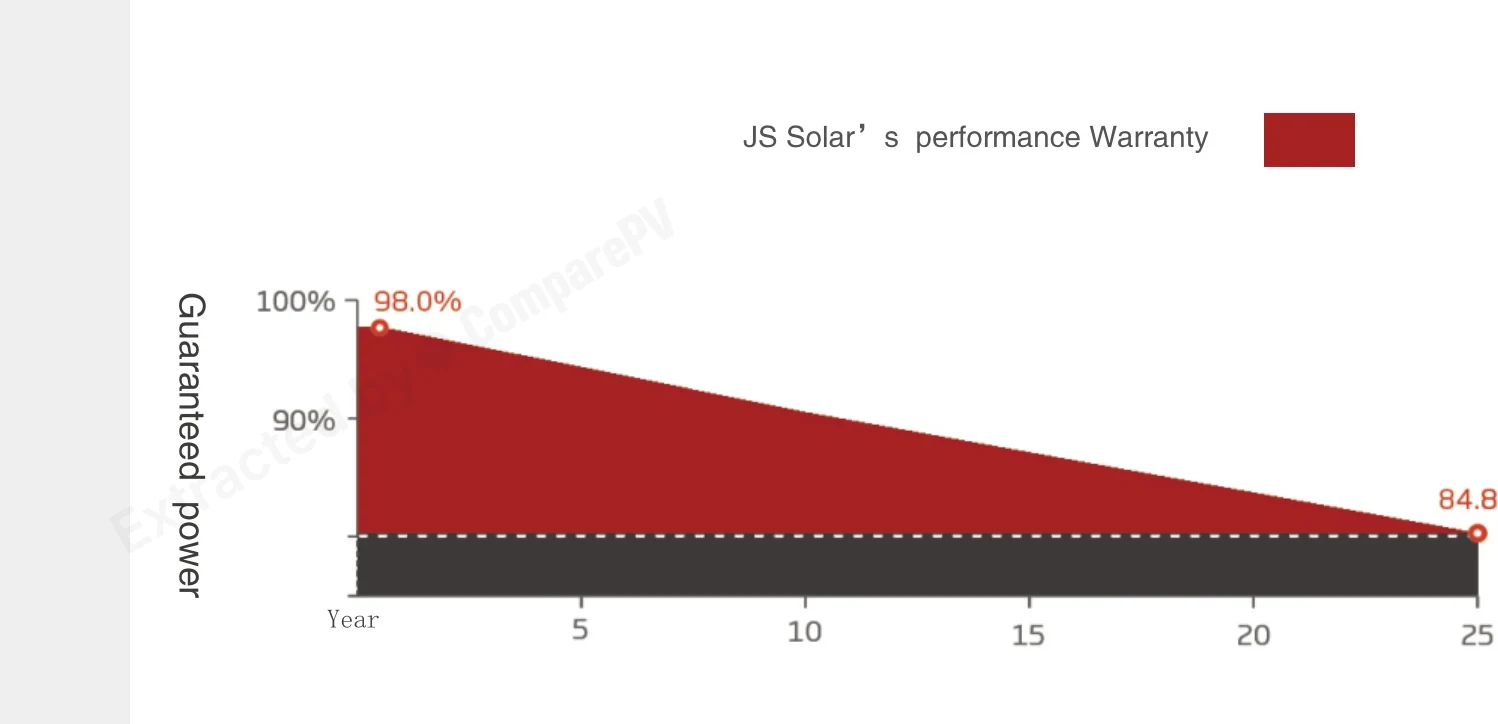
Performance warranty 25 years Weak bottom 20% · median 30 yrs
End-of-warranty output 84.8 % Equals 308 W guaranteed
Degradation 2.00 % First year

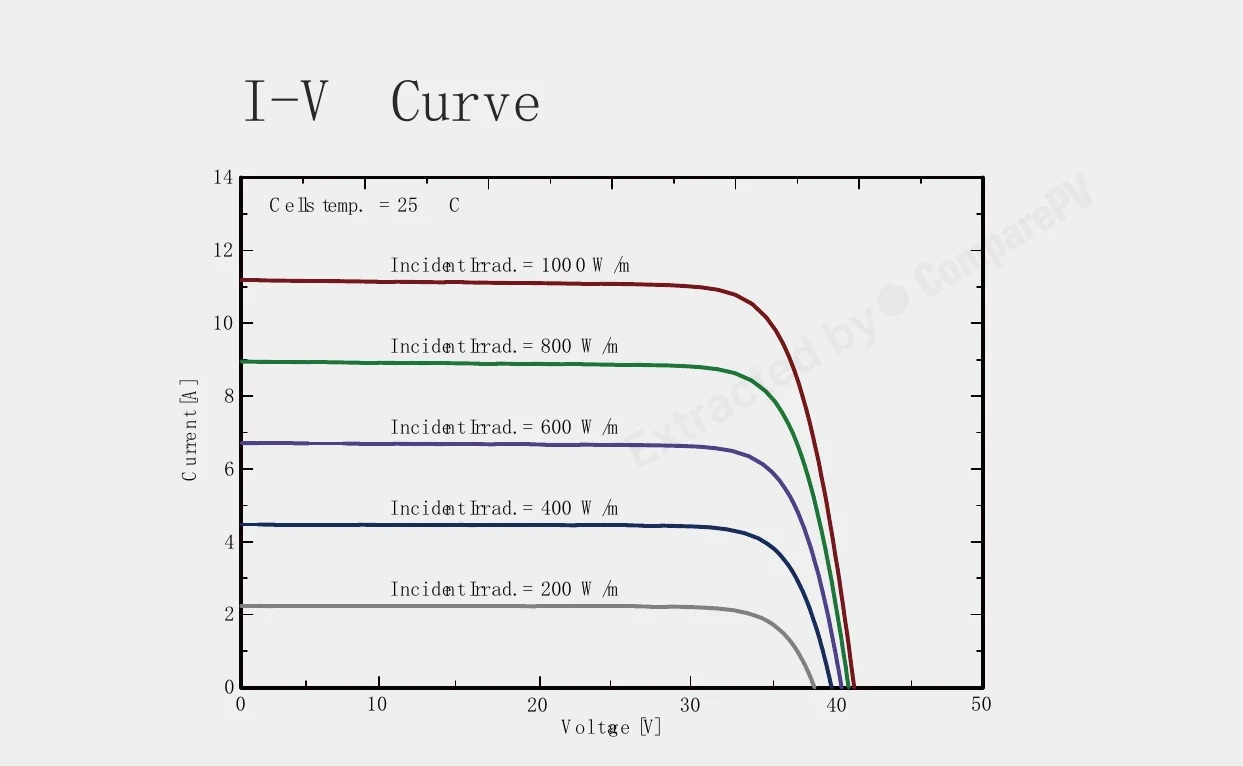
Datasheet charts

Open datasheet PDF

Measured curves published by Jinko Solar in this model's datasheet. A chart carrying a wattage was measured on that variant alone - only the ones that describe 375 Wp appear here. The rest cover the whole series.
Simulations

Live - change any input
Lifetime output & value
30 years at 1200 kWh/kWp/year and €0.50 per kWh
Power in year 30
-
Lifetime energy
-
Energy value
-

Degradation from this panel's own datasheet figures. No inverter, soiling or shading losses.

Heat losses
-0.340 %/°C against a segment median of -0.310
-
Filter these
Size
Panel Power Eff. Temp. Weight Difference
Jinko Solar JSHC166M120-375W 375 W 21.30% -0.340 34.0 kg You are here
NS-330MH-80 330 W 23.15% -0.290 15.0 kg Cooler, 19 kg lighter, +1.8 pp
GKA210M340W 340 W 23.00% - 16.2 kg 18 kg lighter, +1.7 pp, +5 yr warranty
GKA210M360W 360 W 23.00% - 16.2 kg 18 kg lighter, +1.7 pp, +5 yr warranty
GKA210M380W (1/4*4*38) 380 W 23.00% - 17.1 kg 17 kg lighter, +1.7 pp, +5 yr warranty
GKA210M400W (1/2*4*20) 400 W 23.00% - 18.0 kg 16 kg lighter, +1.7 pp, +5 yr warranty
GKA210M400W (1/4*4*40) 400 W 23.00% - 18.0 kg 16 kg lighter, +1.7 pp, +5 yr warranty
GKA210M380W (1/2*4*19) 380 W 23.00% - 17.1 kg 17 kg lighter, +1.7 pp, +5 yr warranty
SPR-MAX3-400-COM 400 W 22.60% -0.270 19.0 kg Cooler, 15 kg lighter, +15 yr warranty
SPR-MAX3-425-R 425 W 22.40% -0.270 21.2 kg Cooler, lighter, +15 yr warranty
JSHC166M120-350W 350 W 18.90% -0.340 34.0 kg -25 W, -2.4 pp
JSHC166M120-355W 355 W 20.20% -0.340 34.0 kg -20 W, -1.1 pp
JSHC166M120-360W 360 W 20.50% -0.340 34.0 kg -15 W, -0.8 pp
JSHC166M120-365W 365 W 20.70% -0.340 34.0 kg -10 W, -0.6 pp
JSHC166M120-370W 370 W 20.97% -0.340 34.0 kg -0.3 pp
LR7-54HJD-510M 510 W 25.00% -0.240 23.5 kg +135 W, lighter, +3.7 pp

Found 170 panels of the same or similar size to this one, within ±10 mm. See them here Found 257 panels of the same or similar size to this one, within ±25 mm. See them here Found 332 panels of the same or similar size to this one, within ±50 mm. See them here Found 4180 panels of the same or similar size to this one, within ±100 mm. See them here

About the JSHC166M120 series

6 answered

These answers cover the whole series. Where a figure differs, the specification above is this module's own.

How does the half-cut cell technology in the Jinko Solar JSHC166M120 series help with partial shading from a chimney or dormer?
Half-cut cells split each cell into two independent electrical halves, so shading on one part of the module limits power loss to that section only, rather than reducing the output of the entire panel. In residential installations where chimneys, dormers, or nearby trees frequently shade part of the roof, the JSHC166M120 series delivers noticeably more stable annual energy yield compared to conventional full-cell modules.
What is the power output warranty on Jinko Solar JSHC166M120 panels?
Jinko Solar provides a 25-year linear power output warranty for the JSHC166M120 series. This guarantees that after 25 years of operation the module will retain at least 80.7% of its rated 375 Wp output. In addition, a 12-year product warranty covering material and workmanship defects is included as standard across Jinko Solar's module lineup.
Is the JSHC166M120 series resistant to PID (Potential Induced Degradation)?
Yes, Jinko Solar builds PID resistance into this series. This is especially important in systems using transformerless inverters, where potential differences between the module frame and cells can gradually reduce output power over time. PID resistance ensures more predictable energy yields throughout the full 25-year operational lifespan of the installation.
Is the Jinko Solar JSHC166M120 375 Wp a bifacial module?
No, the JSHC166M120 is a monofacial module - energy is harvested exclusively from the front active surface. For typical pitched-roof or slightly tilted flat-roof residential installations this is fully sufficient. Bifacial modules offer a meaningful advantage mainly when mounted above highly reflective surfaces such as gravel or white TPO membranes on flat roofs.
Do JSHC166M120 panels perform well in winter and on overcast days?
Yes. The combination of multi-busbar cell interconnection and half-cut cell architecture improves current collection under low-irradiance conditions typical of northern European winters and overcast skies. Monocrystalline PERC cells also exhibit a better temperature coefficient than older polycrystalline technology, meaning lower power losses on hot summer days, while cooler winter temperatures actually benefit instantaneous output.
Is Jinko Solar a reliable manufacturer, and what does Tier 1 status mean for me as a buyer?
Jinko Solar is one of the world's largest PV module manufacturers and has maintained Bloomberg NEF Tier 1 status for many consecutive years. Tier 1 classification indicates that the manufacturer is bankable - financed by reputable institutions and financially stable - which significantly reduces the risk of the company disappearing from the market before the 25-year power warranty expires. For a residential prosumer, this is one of the most important factors when selecting modules.
Add to compare