
Light for its output, no clear weak spot
Jinko Solar’s Tiger Neo 54HL4R-(V) (mono-facial) series are modules designed for high energy production on limited surfaces - especially where every square meter of roof space counts. The use of N-type cells helps maintain stable performance over time and minimizes typical efficiency drops in the early years of operation, resulting in more predictable yields. The design, based on multi-busbar technology, improves current collection and resistance to micro-cracking, enabling the modules to better withstand real-world installation and transportation conditions.
These are mono-facial panels, making them the optimal choice for traditional rooftop and ground installations where simplicity in configuration and certain parameters are prioritized, without the need for backsheet reflection. An additional advantage is high temperature resistance - the modules maintain good performance in hot conditions, which is significant during periods of high solar exposure. This series is suitable for homes, small businesses, and commercial projects where high power density and reliability are key priorities.
Ranking
Signals from the data
Residential, commercial and hot-climate.
Top 17% of the N-type 450-500 W segment, against a median of 49.5.
Top 23% of the N-type 450-500 W segment, against a median of 22.52%.
N-type cells are immune to light-induced degradation (LID) and light- and elevated-temperature-induced degradation (LETID), which cause 1–3% power loss in the first weeks of operation in P-type PERC modules. This results in stable, predictable output from day one without the need to budget extra capacity margin in system design.
The highest-efficiency variant reaches 23.02%, matching the leading peer comparable (SunKean SKT440~460M12-96D4: 23.02%) and outperforming Risen RSM96-11 (23.00%) and Zonergy ZPM MH3-72 (21.16%). This translates to higher power density per square meter of roof area, which is critical when mounting space is constrained.
The temperature coefficient of Pmax is -0.29%/°C, better than typical P-type PERC modules (-0.35%/°C). At 50°C operating temperature vs. STC 25°C, power loss is approx. 7.25% vs. approx. 8.75% for PERC — a difference that is clearly visible during summer peak production hours.
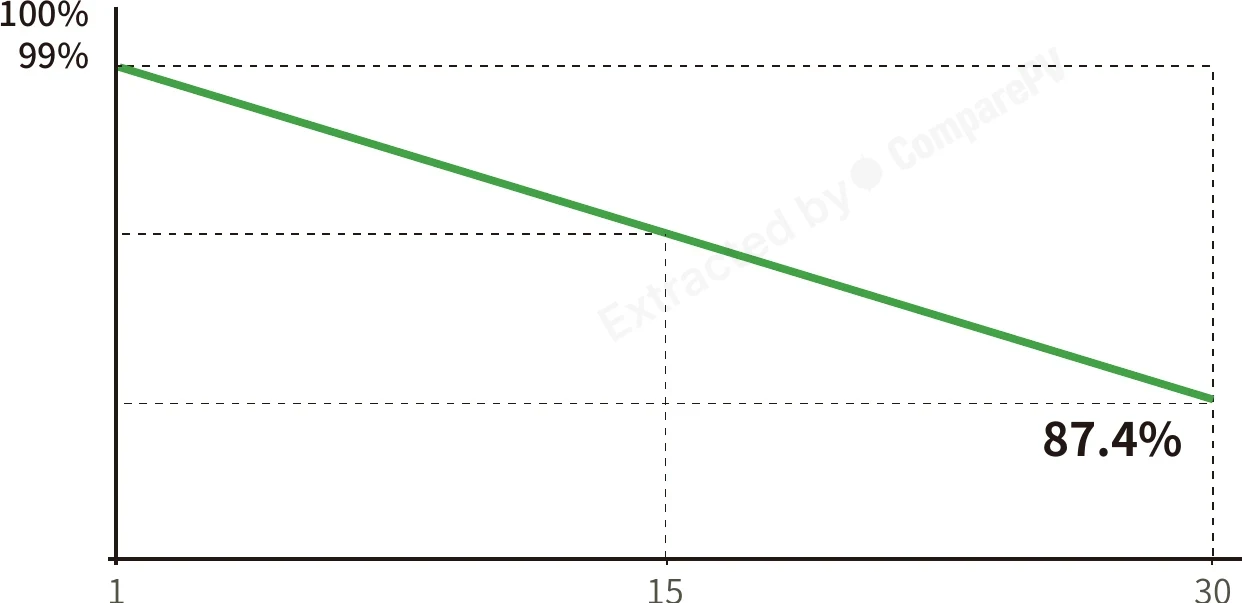
The manufacturer guarantees at least 87.4% of rated power after 30 years of operation, with an annual degradation rate of ≤0.55% (years 2–30), backed by a 15-year product warranty. The long linear warranty minimizes financial risk over the full loan or lease repayment period of the installation.
JinkoSolar is the only manufacturer with 100% bankability in the Bloomberg BNEF 2024 PV Module Bankability Survey, for the 10th consecutive year, and appears on the BNEF Tier-1 list for Q1 2026. Manufacturer bankability directly lowers the cost of financing PV projects and simplifies insurance underwriting for commercial installations.
- At 23.0% efficiency, this panel is on par with typical N-type 450-500W modules
- 230.2 W/m² power density - 5.0 W/m² more than N-type 450-500W median (225.2 W/m²), more power per roof area
- Temperature coefficient of -0.29%/°C matches the N-type 450-500W median
- 21.0 kg weight - 2.7 kg lighter than N-type 450-500W median (23.7 kg), reducing installation effort
- Ranked #1797 out of 14005 panels for efficiency in the database
Specifications
Datasheet charts
Measured curves published by Jinko Solar in this model's datasheet. A chart carrying a wattage was measured on that variant alone - only the ones that describe 460 Wp appear here. The rest cover the whole series.
Simulations
Degradation from this panel's own datasheet figures. No inverter, soiling or shading losses.




Found 1395 panels of the same or similar size to this one, within ±10 mm. See them here Found 1425 panels of the same or similar size to this one, within ±25 mm. See them here Found 3614 panels of the same or similar size to this one, within ±50 mm. See them here Found 3962 panels of the same or similar size to this one, within ±100 mm. See them here