Middle of its segment, heavy for its output
The JT SJt(B) series consists of dual-glass photovoltaic modules built on monocrystalline N-type TOPCon cells with multi-busbar technology, engineered to maximize energy yield while minimizing degradation risk. The defining feature of this series is its bifacial energy generation - thanks to a high bifaciality factor, the module captures additional energy reflected from the ground surface, meaningfully reducing the levelized cost of energy (LCOE) over the system's lifetime. The dual-glass construction eliminates the LID/LETID degradation issues typical of older technologies, while strict manufacturing quality control, including double EL inspection, reduces the risk of PID effect to near zero. These panels are built to withstand harsh weather conditions - rated for high snow and wind loads and tested against rigorous hail resistance standards, making them a solid choice for installations in climates with variable weather patterns. The JT SJt(B) series works well both in rooftop projects and ground-mounted PV farms where long-term reliability and stable output matter most. The manufacturer backs the modules with a multi-year warranty covering materials as well as linear power output degradation, adding further security to the investment.
Ranking
Signals from the data
Residential, commercial and cold-climate.
Weight-limited structures.
Bottom 5% of the TOPCon 400-450 W segment, against a median of 51.5. Ranked 12,611th in the whole database.
Multi-busbar N-type TOPCon cells deliver 21-22% efficiency with a very low degradation profile: ≤1% first-year and ≤0.4% annual thereafter. This is a clear improvement over legacy PERC degradation rates, translating into higher real-world lifetime energy yield.
The dual-glass design and high bifaciality factor enable additional rear-side energy harvest from ground-reflected light, lowering the LCOE compared to monofacial modules of similar power class, e.g. Boviet GAMMA (430 Wp, 19.8% efficiency) at the same peak power.
Jetion Solar, in operation since 2004, appears on the current BloombergNEF Tier 1 list (Q1 2026 update), confirming manufacturer bankability and easing project financing through banking institutions.
The manufacturer backs the modules with a 30-year linear power output warranty, aligning with best-in-class practice for premium TOPCon lines and giving investors predictable long-term energy production.
Double EL inspection during manufacturing keeps PID risk near zero, and the modules pass rigorous snow, wind, and hail load testing, making the series suitable for both rooftop installations and utility-scale PV farms in variable climates.
The materials and workmanship warranty is set at 12 years, whereas several competing Tier-1 TOPCon lines now standardly offer 15-25 years of product coverage alongside the same 30-year linear power warranty. This can be a differentiating factor when comparing bankable manufacturer offers.
- Efficiency of 21.8% matches the TOPCon 400-450W median
- Power density of 217.6 W/m² matches the TOPCon 400-450W median
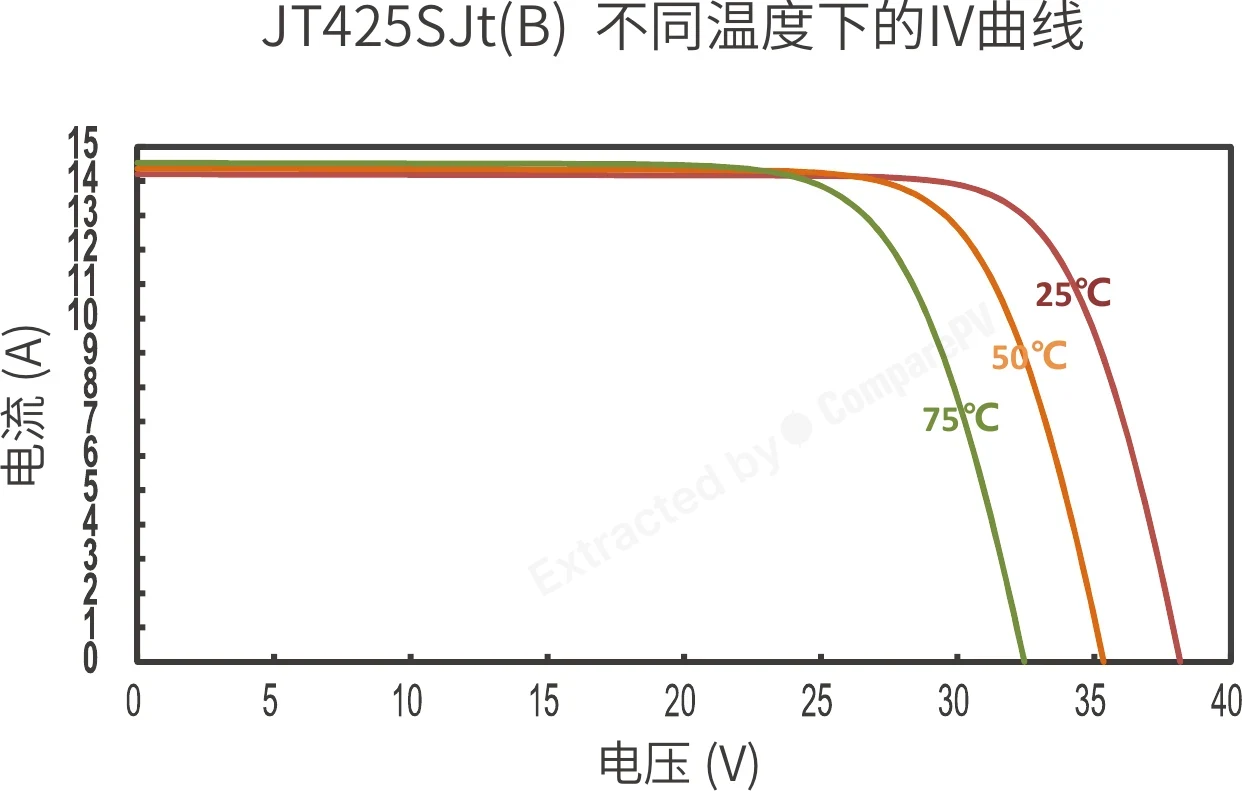
- At -0.29%/°C, hot weather performance is typical for TOPCon 400-450W panels
- At 25.8 kg (3.8 kg above TOPCon 400-450W median of 22.0 kg), requires checking roof load capacity
- 85% bifaciality enables rear-side power generation, boosting yield by 4-13% on reflective surfaces
Specifications
Datasheet charts
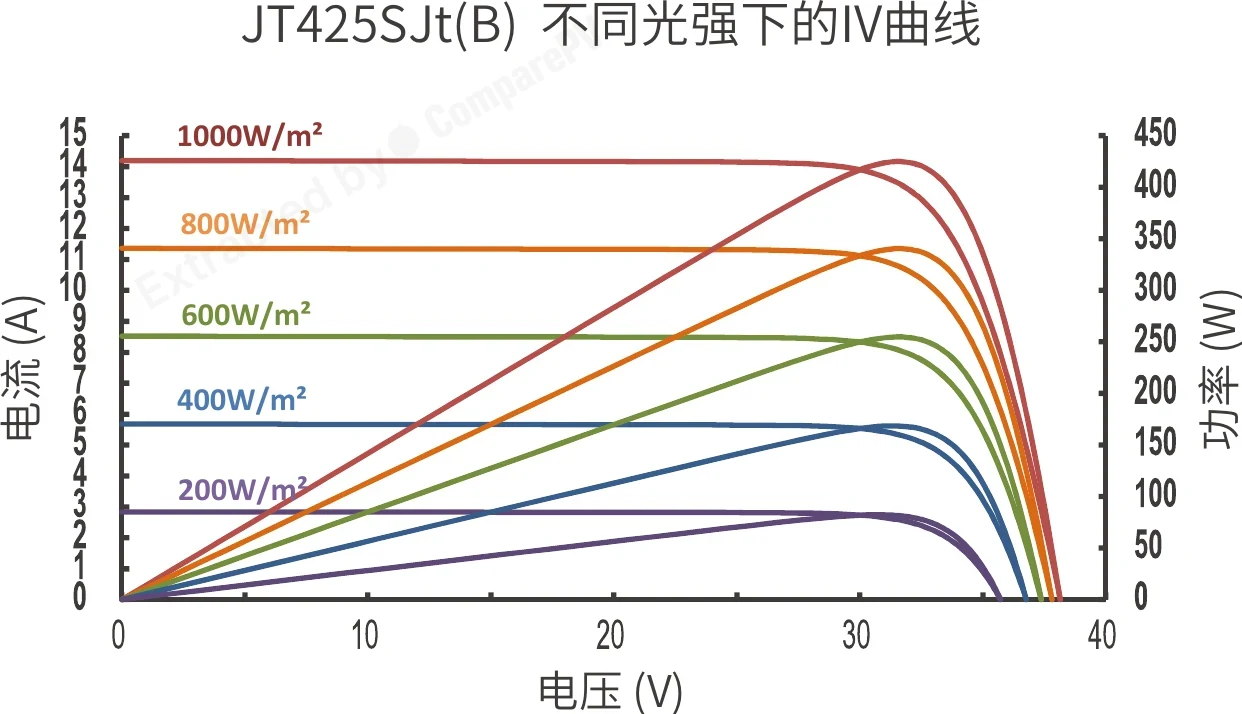
Measured curves published by Jetion in this model's datasheet. A chart carrying a wattage was measured on that variant alone - only the ones that describe 425 Wp appear here. The rest cover the whole series.

Simulations
Degradation from this panel's own datasheet figures. No inverter, soiling or shading losses.
Model: bifaciality × albedo × 0.6 view factor. A first-order estimate, not a yield simulation.








Found 1797 panels of the same or similar size to this one, within ±10 mm. See them here Found 1928 panels of the same or similar size to this one, within ±25 mm. See them here Found 3413 panels of the same or similar size to this one, within ±50 mm. See them here Found 4007 panels of the same or similar size to this one, within ±100 mm. See them here
About the JT SJt(B) series
These answers cover the whole series. Where a figure differs, the specification above is this module's own.