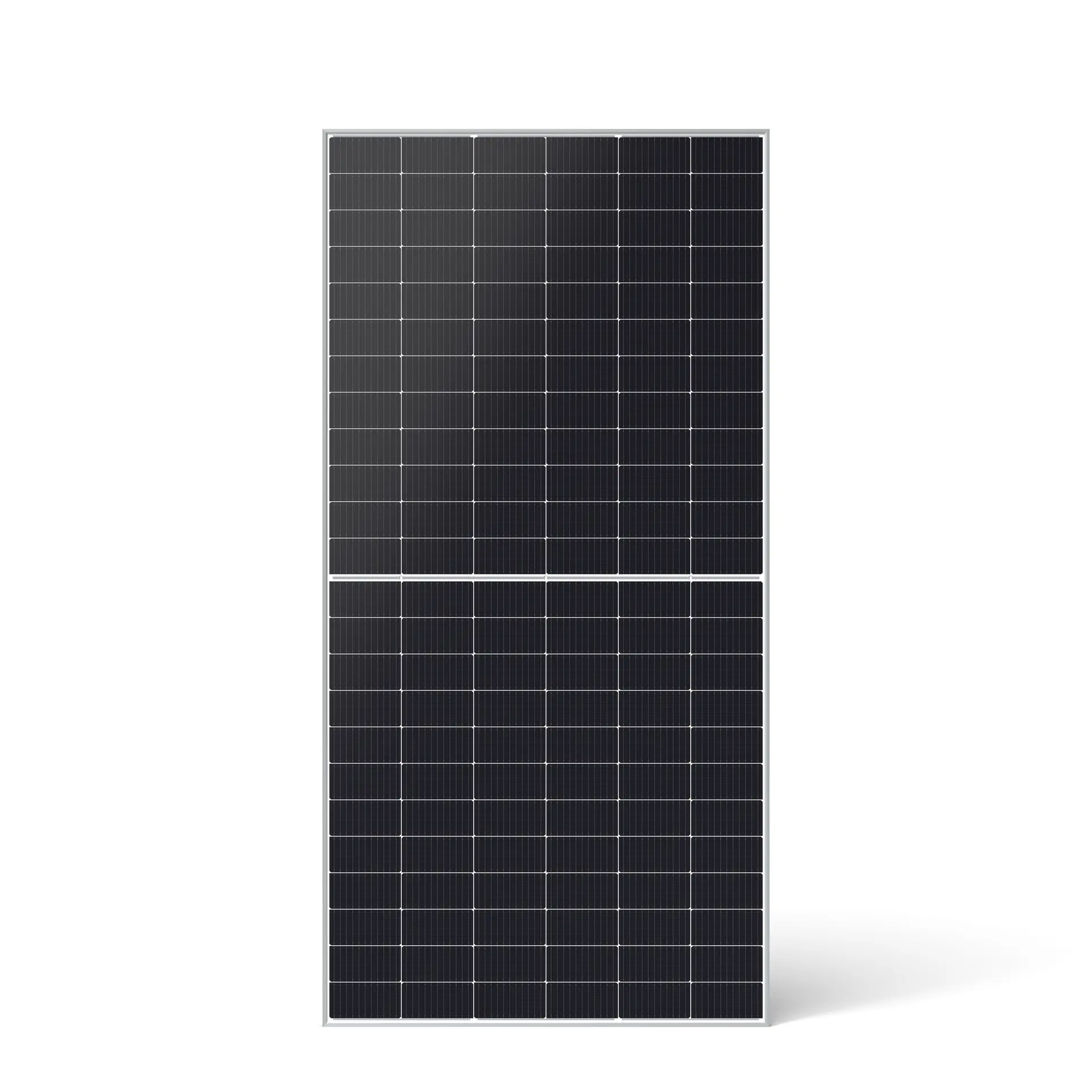
Space saver, no clear weak spot
The JA Solar M3 series comprises modules designed for high energy production under real-world conditions, including situations where the roof is partially shaded and solar irradiance is variable. The use of half-cut cell technology minimizes electrical losses and helps maintain more stable operation of the system, which translates in practice to better energy yield from the same area. Furthermore, MBB (Multi-Busbar) technology improves current collection from the cells and increases resistance to microcracks, which is important during transportation and long-term operation.
The M3 also stands out due to its higher tolerance to mechanical loads and reduced risk of hot spots, which will be appreciated by investors who prioritize long-term reliability. Depending on the variant, both classic laminate and double-glass versions are available, which are better suited to more challenging environmental conditions.
This series is particularly well-suited for rooftop and larger commercial installations, where predictable yield, durability, and resistance to partial shading are key factors.
Ranking
Signals from the data
Residential, commercial and shaded-installations.
Top 9% of the PERC 200-250 W segment, against a median of 168.0. Ranked 12,122nd in the whole database.
Top 11% of the PERC 200-250 W segment, against a median of 16.80%.
Top 23% of the PERC 200-250 W segment, against a median of 62.5.
JA Solar has continuously appeared on the BNEF Tier-1 list for over a decade and retained that status as of Q1 2026. Bankable status enables non-recourse project financing and simplifies due-diligence audits for commercial and residential installations.
Splitting cells in half reduces operating current by ~50%, lowering resistive losses and hot-spot risk. Multi Busbar (MBB) technology shortens the current path within each cell and improves resistance to microcracks caused by transport stress and long-term thermal cycling.
The M3 series spans 35 variants from 185 Wp to 520 Wp, enabling module selection for residential, commercial, and utility-scale systems without switching manufacturers. Such a broad single-series range was uncommon among PERC modules available in 2019–2021.
Selected M3 variants feature dual-glass construction, eliminating the rear EVA backsheet susceptible to degradation and improving moisture resistance (PID resistance) and UV stability — key advantages for installations in harsh climates or environments with elevated chemical exposure.
The manufacturer provides a linear power output guarantee for 25 years, consistent with the Tier-1 industry standard for the 2019–2021 vintage and ensuring predictable yield curves for LCOE modeling in long-term projects.
The M3 series ended production in 2021. This results in limited availability of new modules on the secondary market, potential difficulty matching panels for system expansions years later, and increased risk of insufficient warranty support from local distributors.
The M3 series tops out at 20.45% module efficiency using P-type PERC cells. Current peer comparables significantly outperform it: DAH Solar DHN-60R20/DG at 23%, Silfab Commercial NTC at 21.9%, and Jinko Solar Tiger Neo III (TOPCon) at 24.06%. Additionally, P-type PERC cells exhibit substantially higher first-year LID (~1.92%) compared to N-type TOPCon (~0.26%), resulting in lower lifetime energy yield.
The M3 series is strictly monofacial, while the directly comparable DAH Solar DHN-60R20/DG offers bifacial double-glass construction at 23% efficiency. On reflective surfaces (gravel, white membranes), the absence of rear-side power generation forgoes a potential 5–15% additional annual energy gain.
Depending on the variant, product warranty is either 10 or 12 years, while current Tier-1 modules — including newer JA Solar lines such as DeepBlue 4.0 — standardly offer 12–15 years. The shorter equipment protection period may be a limiting factor for project financing structures requiring a minimum 12-year product warranty.
- 20.1% module efficiency - 0.7pp better than the PERC 0-400W median of 19.4%
- At 201.0 W/m² power density, this panel generates 6.6 W/m² more per unit area than PERC 0-400W median (194.4 W/m²)
- Temperature coefficient of -0.37%/°C matches the PERC 0-400W median
- Weight of 11.3 kg (9.2 kg below PERC 0-400W median of 20.5 kg) allows easier transport and roof mounting
- #12102 for efficiency, #13081 for temperature performance out of 14005 panels
Specifications
Simulations
Degradation from this panel's own datasheet figures. No inverter, soiling or shading losses.






Found 49 panels of the same or similar size to this one, within ±10 mm. See them here Found 92 panels of the same or similar size to this one, within ±25 mm. See them here Found 103 panels of the same or similar size to this one, within ±50 mm. See them here Found 129 panels of the same or similar size to this one, within ±100 mm. See them here