Efficiency leader, weak in heat
The JAM54D40 GB series consists of advanced N-type modules that set new performance standards in the micro-installation sector. The use of DeepBlue 4.0 Pro technology allows for higher efficiency even in low sunlight, which is crucial in the Polish climate. The main distinguishing feature of this series is the glass-glass construction, which, combined with bifacial cells, significantly increases the total energy yield by absorbing light reflected from the ground. These panels effectively solve the problem of cell degradation, offering exceptional resistance to LID and PID phenomena, which translates into stable operation for decades. Thanks to the use of N-type cell technology, the modules are characterized by a lower temperature coefficient, maintaining high power even on hot days. This solution is dedicated primarily to prosumers looking for uncompromising durability and fire safety. What sets them apart from the competition is the optimized M10 cell size, which facilitates installation on pitched roofs while maintaining maximum power density. By choosing the JAM54D40 GB, the investor receives a product with an extended lifespan that maximizes the return on investment thanks to higher long-term efficiency.
Ranking
Signals from the data
Residential and shaded-installations.
Hot climates.
Top 1% of the N-type 400-450 W segment, against a median of 21.95%. Ranked 2,769th in the whole database.
Top 2% of the N-type 400-450 W segment, against a median of 218.4. Ranked 2,845th in the whole database.
Top 22% of the N-type 400-450 W segment, against a median of 51.2.
Bottom 25% of the N-type 400-450 W segment, against a median of -0.290.
The JAM54D40 GB achieves 22.5-22.8% module efficiency, outperforming all listed peer comparables: Q-Cells Q.TRON BLACK (22.3%), Solitek SOLRIF D Satin (22.06%), and SunEvo SE6-46SC (21.4%). On a typical 10 kWp residential pitched-roof system, the ~1.4 pp advantage over SunEvo translates to roughly 60-100 Wp more peak power without additional roof area.
N-type TOPCon cells limit thermal power loss to -0.29%/°C (Pmax), vs. -0.35%/°C for standard PERC modules. At a module temperature of 70°C - typical on a Polish summer afternoon - power loss is ~14.5% instead of ~17.5%, delivering measurably more energy yield over the course of a year.
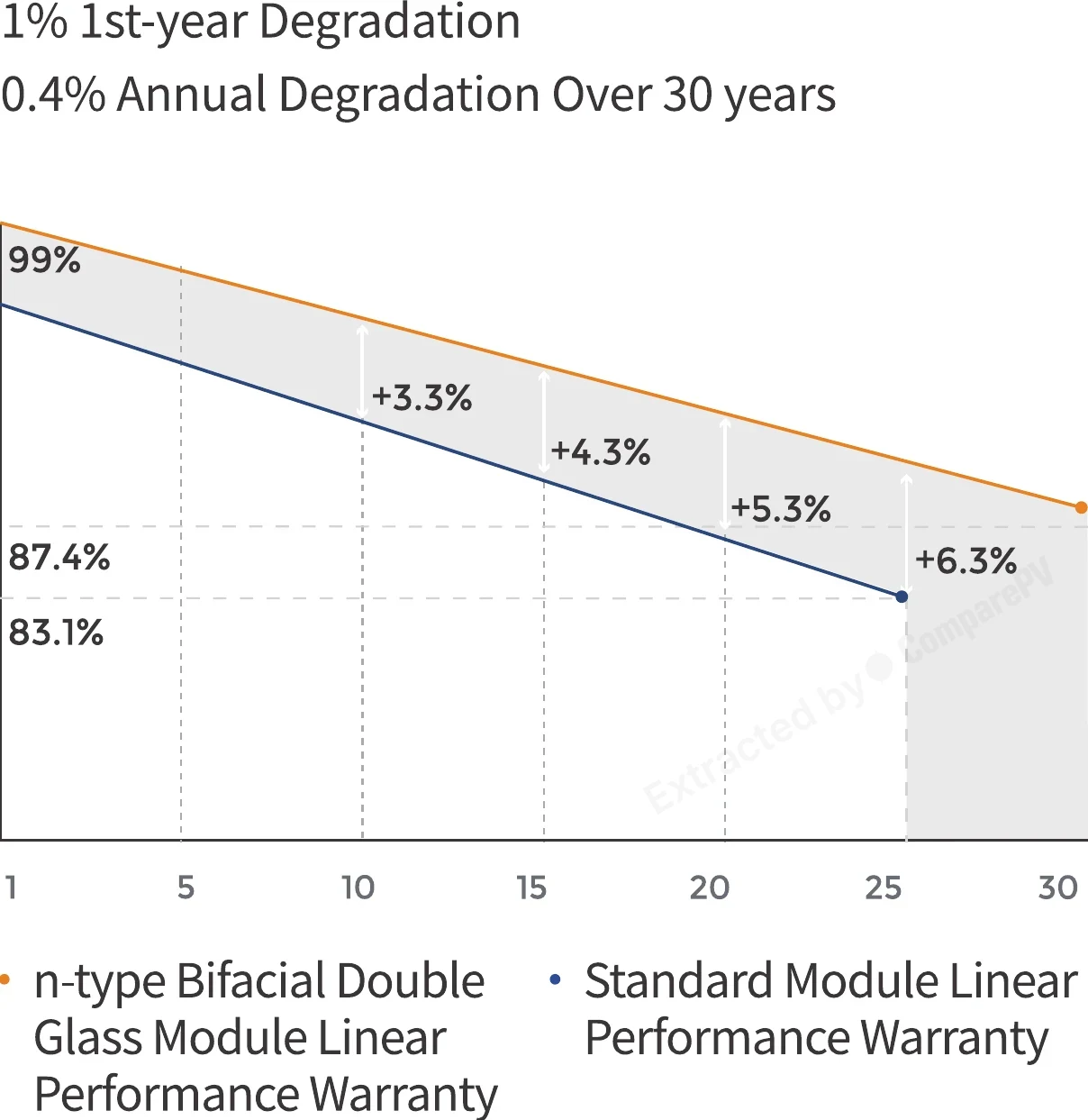
JA Solar guarantees ≤1% first-year degradation and ≤0.4%/year thereafter, ensuring ≥87.4% of rated power after 30 years. N-type cells are inherently LID-immune, and the glass-glass encapsulation blocks moisture ingress - the primary PID trigger - delivering stable output across the full warranted lifetime.
The double-glass construction eliminates the risk of backsheet delamination and polymer degradation - the most common failure mode in glass-backsheet modules after 10-15 years. The glass rear surface also improves the fire safety profile of rooftop installations compared to polymeric backsheets.
JA Solar is listed on the BNEF Tier-1 solar module manufacturer list for Q1 2026 with >100 GW/year production capacity, placing it among the top global producers. Tier-1 bankability ensures warranty service availability over the full 30-year operating horizon and financial counterparty stability for any claims.
Q-Cells Q.TRON BLACK (peer comparable, 445 Wp, 22.3%) carries a 25-year workmanship warranty, while the JAM54D40 GB covers only 12 years. Mechanical failures - frame cracking, junction-box sealing, glass delamination - occurring after year 13 fall outside the manufacturer's coverage, a meaningful LCOE and risk factor for long-horizon residential investors.
The double-glass design brings weight to 21.5 kg (1722 × 1134 × 30 mm), approximately 2-3 kg heavier than comparable glass-backsheet modules (~19 kg) in the same power class. On roofs with limited structural load capacity or aging rafter framing, a structural engineering assessment may be required, adding to overall BoS costs.
The advertised bifacial gain (up to 15-20%) applies to ground-mount or flat-roof systems with high-albedo surfaces (albedo ≥0.3: concrete, white TPO membrane). On the typical Polish single-family pitched roof covered with dark clay tiles or bituminous felt, albedo is 0.05-0.10, limiting real rear-side generation to just 2-5%. The financial premium of bifacial glass-glass technology is therefore weakened in this common residential use case.
- Efficiency of 22.8% is 0.9pp above the N-type 400-450W median (21.9%)
- Power density of 227.9 W/m² packs 9.5 W/m² more into the same footprint vs N-type 400-450W median (218.4 W/m²)
- Temperature coefficient of -0.30%/°C matches the N-type 400-450W median
- Bifacial design (80% factor) captures reflected light - adds 4-12% yield on ground-mount or white roof
- Ranked #2769 out of 14129 panels for efficiency in the database
Specifications
Datasheet charts
Measured curves published by JA Solar in this model's datasheet. A chart carrying a wattage was measured on that variant alone - only the ones that describe 445 Wp appear here. The rest cover the whole series.
Simulations
Degradation from this panel's own datasheet figures. No inverter, soiling or shading losses.
Model: bifaciality × albedo × 0.6 view factor. A first-order estimate, not a yield simulation.




Found 1797 panels of the same or similar size to this one, within ±10 mm. See them here Found 1928 panels of the same or similar size to this one, within ±25 mm. See them here Found 3413 panels of the same or similar size to this one, within ±50 mm. See them here Found 4007 panels of the same or similar size to this one, within ±100 mm. See them here
About the JAM54D40 GB series
These answers cover the whole series. Where a figure differs, the specification above is this module's own.