Space saver, no clear weak spot
Hyundai HG series photovoltaic panels base their design on innovative shingled technology, which completely eliminates traditional ribbon connections between cells. This approach allows for denser silicon packing, which translates into higher efficiency and an excellent appearance of the installation. A key benefit for the investor is exceptional shade resistance - thanks to the parallel connection of cells, these modules handle power drops much better than standard market solutions. The HG series effectively solves the problem of limited roof space, delivering the maximum amount of energy per square meter while maintaining high Full Black aesthetics. The use of conductive adhesive instead of classic soldering drastically reduces thermal stress, which minimizes the risk of micro-cracks and ensures the longevity of the entire system. These products are an ideal choice for single-family homeowners and companies looking for maximum investment security guaranteed by a powerful technological conglomerate. They are distinguished from the competition by a unique internal architecture that combines high efficiency with unprecedented resistance to extreme weather conditions, such as strong winds or heavy snow loads. This is a solution dedicated to demanding users for whom reliability for decades matters, confirmed by one of the longest product warranties in the industry.
Ranking
Signals from the data
Residential, commercial and shaded-installations.
Top 6% of the PERC 400-450 W segment, against a median of 206.2. Ranked 8,410th in the whole database.
Top 6% of the PERC 400-450 W segment, against a median of 20.60%. Ranked 8,388th in the whole database.
Top 11% of the PERC 400-450 W segment, against a median of 53.0.
Cells are interconnected in parallel using conductive adhesive instead of conventional tabbing ribbons, virtually eliminating thermal stress and the risk of microcracks. The parallel cell architecture delivers measurably better shade tolerance compared to standard series-connected PERC modules.
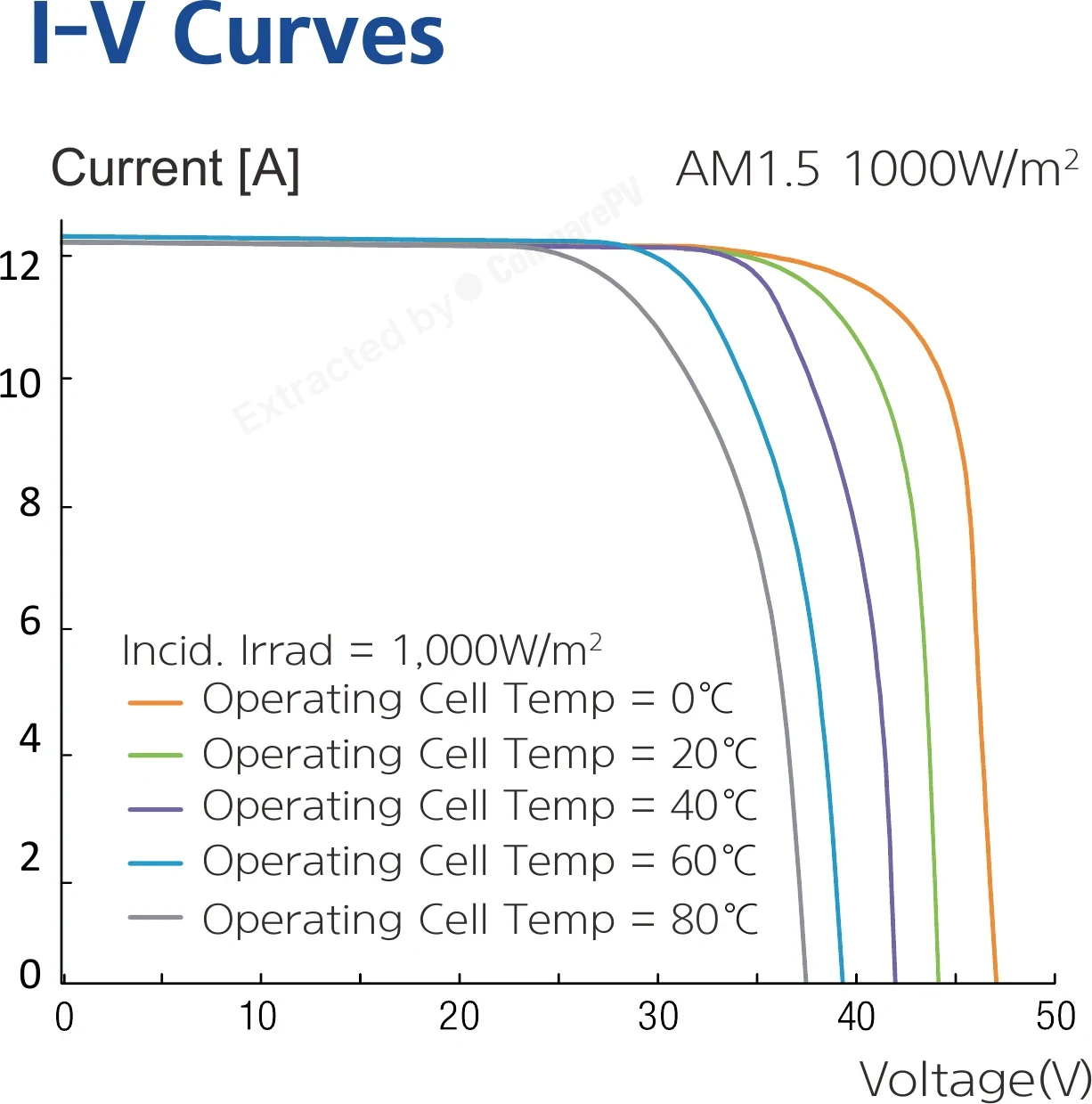
The HiE-SxxxHG datasheet confirms a Pmax temperature coefficient of -0.34%/°C, which outperforms the typical PERC median of -0.37% to -0.45%/°C. This translates into higher energy yield during summer peak hours and in warm climates.
The shingled architecture eliminates visible busbars on the cell surface, producing a uniform, deep-black panel face. This is a direct aesthetic advantage over conventional Full Black modules that retain visible contact fingers.
Hyundai Energy Solutions appears on BNEF bankable manufacturer lists, enabling project financing acceptance by lenders. The financial backing of the global Hyundai conglomerate provides meaningful security behind the 25-year product and service warranty.
The manufacturer provides a 25-year product and workmanship warranty alongside a 25-year linear power warranty guaranteeing ≥84.8% of rated power after 25 years at 0.55% annual degradation. At the time of the series launch (2019-2022), this matched the longest warranties available in the residential PV segment.
The HG Series ended production in 2023 (launched 2019). New modules are only available from distributor stock, making it impossible to source matching panels for future system expansion. Long-term service part availability is also increasingly at risk. Investors seeking multi-decade support should consider the manufacturer's currently active series.
P-type PERC cells exhibit ~2% first-year LID and ~0.55%/year ongoing degradation (per datasheet), while modern N-type TOPCon modules deliver ~1% LID and ~0.40%/year, guaranteeing 87-90% power retention after 25 years. Over the full warranty period, the cumulative energy yield of HG modules is statistically 3-5% lower than TOPCon alternatives available on the market since 2023.
The highest-efficiency HG variant reaches 21.4%, matching the SunEvo SE6-46SC (EVOX) at 445 Wp, but trailing the Solitek SOLRIF D Satin (22.06%) by 0.66 pp and the Q-Cells Q.TRON BLACK (22.3%) by 0.9 pp at the same peak power of 445 Wp. On roof areas with limited space, this efficiency gap translates into meaningfully lower energy harvest per square meter.
- 21.4% module efficiency - 0.8pp better than the PERC 400-450W median of 20.6%
- 213.8 W/m² power density - 7.6 W/m² more than PERC 400-450W median (206.2 W/m²), more power per roof area
- Temperature coefficient of -0.34%/°C matches the PERC 400-450W median
- #8388 for efficiency, #8846 for temperature performance out of 14129 panels
Specifications
Datasheet charts
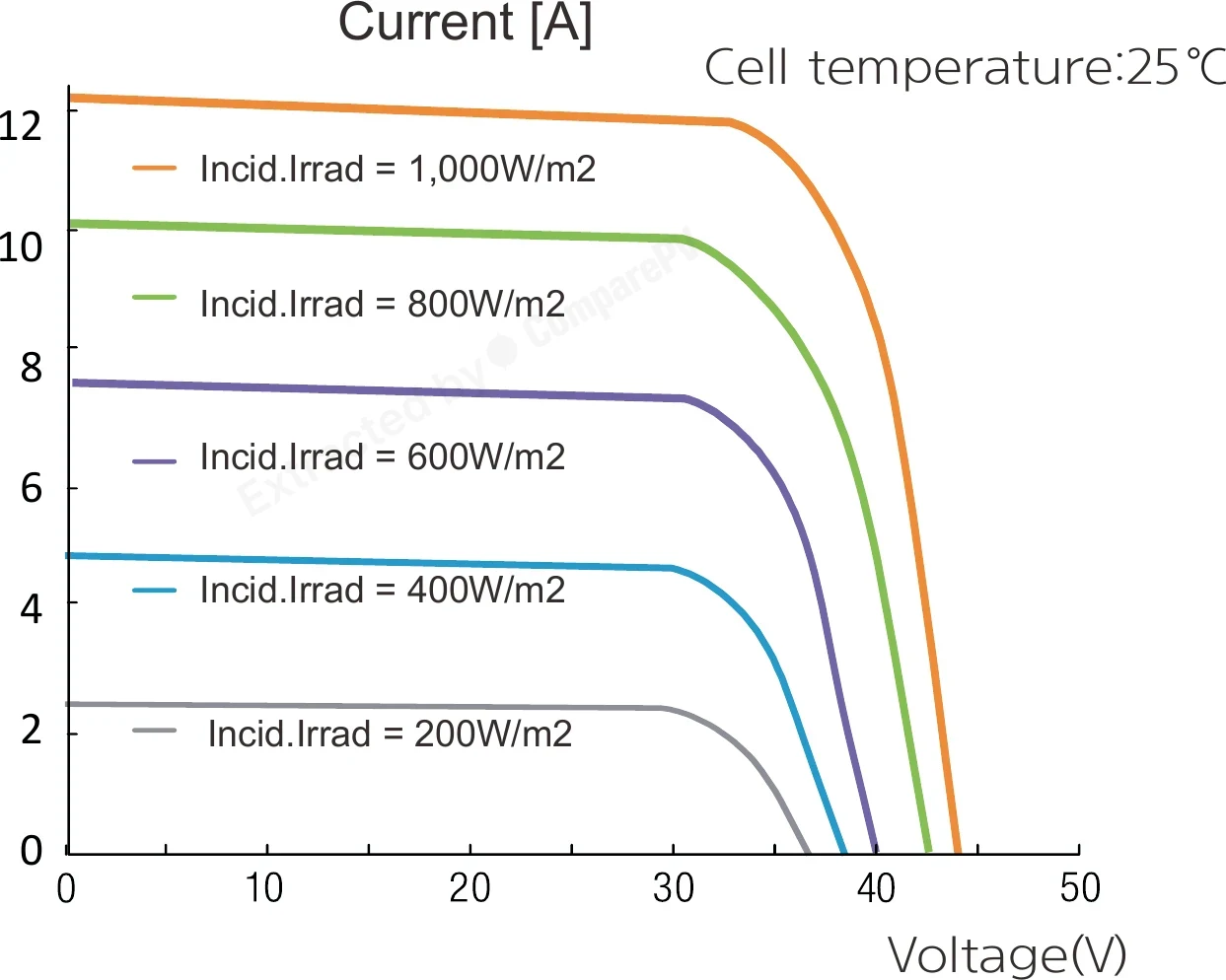
Measured curves published by Hyundai in this model's datasheet. A chart carrying a wattage was measured on that variant alone - only the ones that describe 445 Wp appear here. The rest cover the whole series.
Simulations
Degradation from this panel's own datasheet figures. No inverter, soiling or shading losses.






Found 27 panels of the same or similar size to this one, within ±10 mm. See them here Found 27 panels of the same or similar size to this one, within ±25 mm. See them here Found 799 panels of the same or similar size to this one, within ±50 mm. See them here Found 1877 panels of the same or similar size to this one, within ±100 mm. See them here
About the HG SERIES series
These answers cover the whole series. Where a figure differs, the specification above is this module's own.