Middle of its segment, modest efficiency
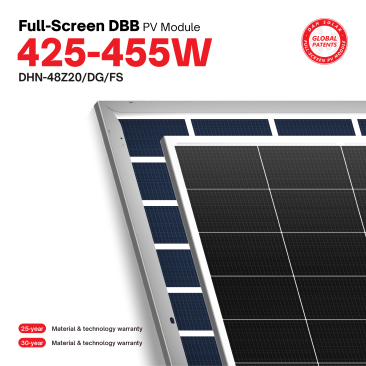
The DAH DHN-48Z20/DG (425-455W) series are glass-glass type modules designed for stable energy production over many seasons, even in less ideal mounting conditions. The use of N-type TOPCon technology helps to minimize typical power losses over time and improves performance under weaker sunlight, which is important in the Polish climate. The bifacial design further allows for the utilization of reflected light from the ground - a real advantage on roofs with light membranes, carports, and ground-mounted installations.
The double-glass construction also increases resistance to moisture, stress, and material degradation over the long term. In practice, this means a lower risk of microcracks, greater predictability in performance, and more reliable operation. The series also features long, linear power warranty, making it easier to plan the profitability of the investment.
This is a good choice for homes, businesses, and PV farms where durability, consistent performance, and high module reliability are important.
Ranking
Signals from the data
Residential and commercial.
Tight roof space, roofs where every square metre has to count and weight-limited structures.
Bottom 10% of the TOPCon 400-450 W segment, against a median of 22.00%.
Bottom 13% of the TOPCon 400-450 W segment, against a median of 220.2.
Bottom 21% of the TOPCon 400-450 W segment, against a median of 51.4.
The datasheet confirms 1% degradation in the first year and ≤0.4%/year linear degradation in subsequent years. This represents approximately 20–25% slower power loss than typical PERC modules (0.5–0.55%/year), which over a 30-year horizon translates into several percentage points of higher cumulative energy yield.
The manufacturer guarantees power output for 30 years — five years longer than the standard 25-year warranty offered by comparable products such as the Waaree ARKA SERIES in the same power class. The extended warranty simplifies project bankability assessments and LCOE calculations for commercial installations and utility-scale PV farms.
The top variant in the series achieves 22.77%, placing it virtually on par with leading competitors in its class: Sunlike Solar SKT420–455M10-108D6 (22.8%) and IBC Solar LS-TA2 (22.8%), and significantly above the Waaree ARKA (20.93%). High module efficiency is particularly critical where rooftop area is constrained.
The dual-glass construction eliminates the risk of moisture ingress through the backsheet and reduces PID degradation. For ground-mounted systems and carports with light-colored surfaces, the bifacial effect can increase annual energy yield by 5–15% compared to monofacial modules, with no additional hardware cost.
DAH Solar has appeared continuously on the BNEF Tier 1 list since at least Q1 2025, confirming the manufacturer's financial stability and facilitating project financing from lending institutions. Founded in 2009, the company brings over 15 years of manufacturing experience.
Glass-glass modules typically weigh 25–28 kg, approximately 20–25% more than their glass-backsheet counterparts (21–23 kg). For retrofits on older rooftops, a structural assessment of the load-bearing construction may be required, adding cost and extending the project timeline.
- At 21.3% efficiency, this panel is 0.7pp below the TOPCon 400-450W median of 22.0%
- Power density of 212.7 W/m² is 7.5 W/m² below TOPCon 400-450W median (220.2 W/m²) - needs more roof space
- At -0.29%/°C, hot weather performance is typical for TOPCon 400-450W panels
- At 23.9 kg, this panel is 1.9 kg heavier than the TOPCon 400-450W median (22.0 kg) - more demanding for installation crews
- Bifacial design (80% factor) captures reflected light - adds 4-12% yield on ground-mount or white roof
Specifications
Datasheet charts
Measured curves published by DAH Solar in this model's datasheet. A chart carrying a wattage was measured on that variant alone - only the ones that describe 425 Wp appear here. The rest cover the whole series.

Simulations
Degradation from this panel's own datasheet figures. No inverter, soiling or shading losses.
Model: bifaciality × albedo × 0.6 view factor. A first-order estimate, not a yield simulation.








Found 1395 panels of the same or similar size to this one, within ±10 mm. See them here Found 1425 panels of the same or similar size to this one, within ±25 mm. See them here Found 3614 panels of the same or similar size to this one, within ±50 mm. See them here Found 3962 panels of the same or similar size to this one, within ±100 mm. See them here