
Solid all-round for its segment
The AE Solar AURORA MD-132BD series are panels designed for maximum energy yield, especially when every square meter of roof or structure counts. The use of monocrystalline cells in a half-cut configuration helps to minimize losses due to partial shading and stabilizes the module's performance under real-world installation conditions. A key advantage is the bifacial design - the panel utilizes not only direct sunlight, but also reflected light from the ground, which translates into additional energy production potential in a well-chosen environment (e.g., a light-colored roof, gravel, or highly reflective membranes).
The double-glass version enhances resistance to environmental factors and promotes long-term stability of performance parameters, which is crucial for projects focused on predictable returns. This series is suitable for commercial, industrial, and larger ground-mounted installations, where reliability and operational durability are important. It stands out from the competition due to its combination of bifaciality with a refined, durable construction, without compromising the daily performance of the installation.
Ranking
Signals from the data
Commercial, utility-scale and shaded-installations.
AE Solar has been included in the BloombergNEF Tier 1 list for the 16th time, which confirms the company's financial stability and makes it easier to obtain project financing (non-recourse) without the need for additional brand credibility verification.
Double glazing enhances resistance to ammonia, salt mist, and UV radiation, while bifaciality allows for additional energy generation from reflected light - particularly important in ground-mounted installations with reflective surfaces (gravel, white membrane). The combination of these two features in the 485-505 W segment distinguishes this series from mono-facial competitors.
The use of gallium doping in silicon reduces the Light-Induced Degradation phenomenon more effectively than standard boron-doped PERC cells, resulting in more stable performance parameters during the first 1000 hours of operation.
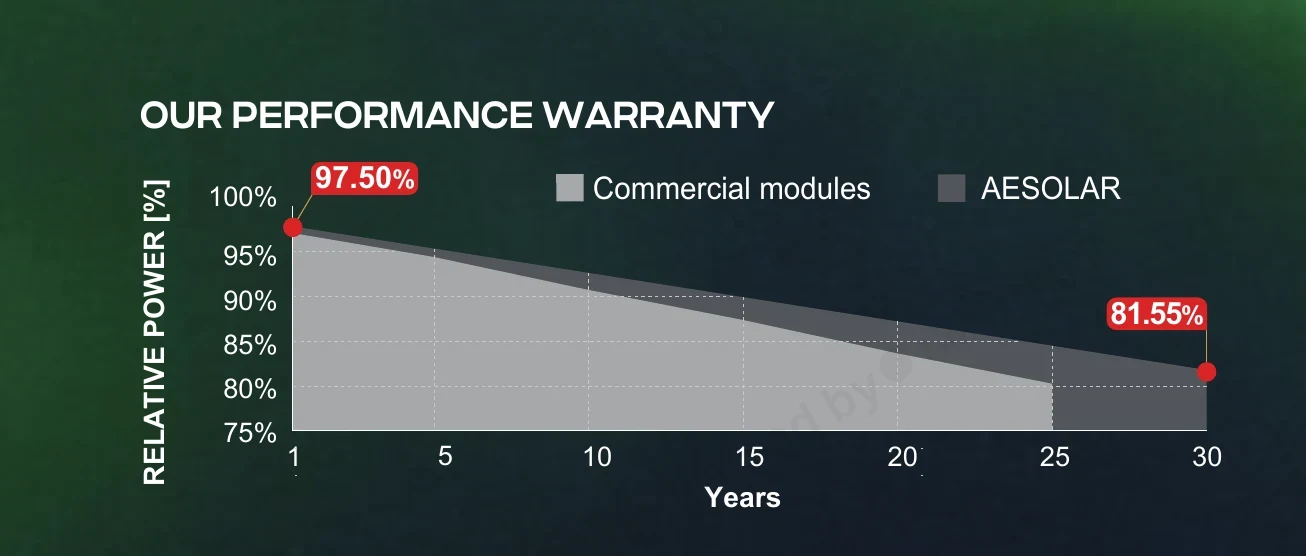
Both warranty documents (product warranty and power warranty) cover a full 30 years - which exceeds the market standard of 25 years (e.g., JA Solar, Jinko Solar). This enhances the bankability of the project and the calculation of LCOE over a 30-year horizon, without the need to purchase insurance with a warranty period that matches the project's lifespan.
The certified snow load capacity of 6000 Pa and wind load capacity of 4000 Pa places the series above the typical minimum (5400 / 2400 Pa), representing a significant advantage in mountainous areas and climates with extreme snowfall.
The maximum efficiency of 21.29% (PERC P-type) is noticeably lower than comparable TOPCon modules: Sunova Tangra M Pro HD and Q-SUN Qrystal N10 achieve 22.7% at the same power of 505 Wp - this difference of approximately 1.4% means that, for the same roof area, the series generates approximately 6% less energy than the leading competitors in the market.
A typical efficiency ratio for P-type PERC is -0.35%/°C, while N-type TOPCon cells (such as those found in Sunova Tangra M Pro HD) achieve approximately -0.31%/°C. At a temperature of 45°C, this difference represents a relative power loss of approximately 0.7% - a measurable loss in south-facing and unshaded metal roofs.
- Efficiency of 21.1% matches the PERC 500-550W median
- At 210.8 W/m² power density, roof space requirements are typical for PERC 500-550W panels
- At -0.35%/°C, hot weather performance is typical for PERC 500-550W panels
- Bifaciality factor of 70% can add 4-10% extra yield with reflective mounting surface
- #9682 for efficiency, #10489 for temperature performance out of 14129 panels
Specifications
Datasheet charts
Measured curves published by AE Solar in this model's datasheet. A chart carrying a wattage was measured on that variant alone - only the ones that describe 500 Wp appear here. The rest cover the whole series.
Simulations
Degradation from this panel's own datasheet figures. No inverter, soiling or shading losses.
Model: bifaciality × albedo × 0.6 view factor. A first-order estimate, not a yield simulation.






Found 405 panels of the same or similar size to this one, within ±10 mm. See them here Found 416 panels of the same or similar size to this one, within ±25 mm. See them here Found 433 panels of the same or similar size to this one, within ±50 mm. See them here Found 961 panels of the same or similar size to this one, within ±100 mm. See them here
About the AURORA MD-132BD series
These answers cover the whole series. Where a figure differs, the specification above is this module's own.