
Light for its output, no clear weak spot
The Aurora MD-120BS series represents a breakthrough in energy yield optimization, focusing on the total elimination of losses resulting from the natural wear of silicon components. The use of gallium doping in the cell production process allows for the near-total elimination of light-induced degradation (LID), which guarantees stable power output for decades. These modules utilize advanced half-cut cell technology, which significantly reduces internal losses and improves panel efficiency in unfavorable lighting conditions or partial shading. Thanks to the use of an anti-reflective coating and reinforced tempered glass, the panels are exceptionally resistant to mechanical damage and harsh weather conditions, such as hail or snow loads. This solution is dedicated to demanding investors who seek maximum durability in residential installations and commercial rooftop farms. What sets them apart from the competition is an exceptionally favorable temperature coefficient and increased resistance to the PID effect, ensuring safe and stable system operation even on very hot days. This is a product that combines modern engineering with high aesthetics, effectively solving the problem of performance decline over time. MD-120BS panels are a guarantee of the highest safety standards and maximum power density per square meter of surface area, making them a leader in the premium module segment.
Ranking
Signals from the data
Residential, commercial, shaded-installations and hot-climate.
Top 12% of the PERC 450-500 W segment, against a median of 53.1.
Top 19% of the PERC 450-500 W segment, against a median of 20.82%.
Top 20% of the PERC 450-500 W segment, against a median of 25 yrs.
AE Solar is the only European manufacturer included in the BNEF Tier 1 ranking for 2024 (out of 67 evaluated), with its bankability increasing from 26% (2023) to 50% (2024). This translates to easier financing of commercial projects by banks and lower counterparty risk in long-term PPAs.
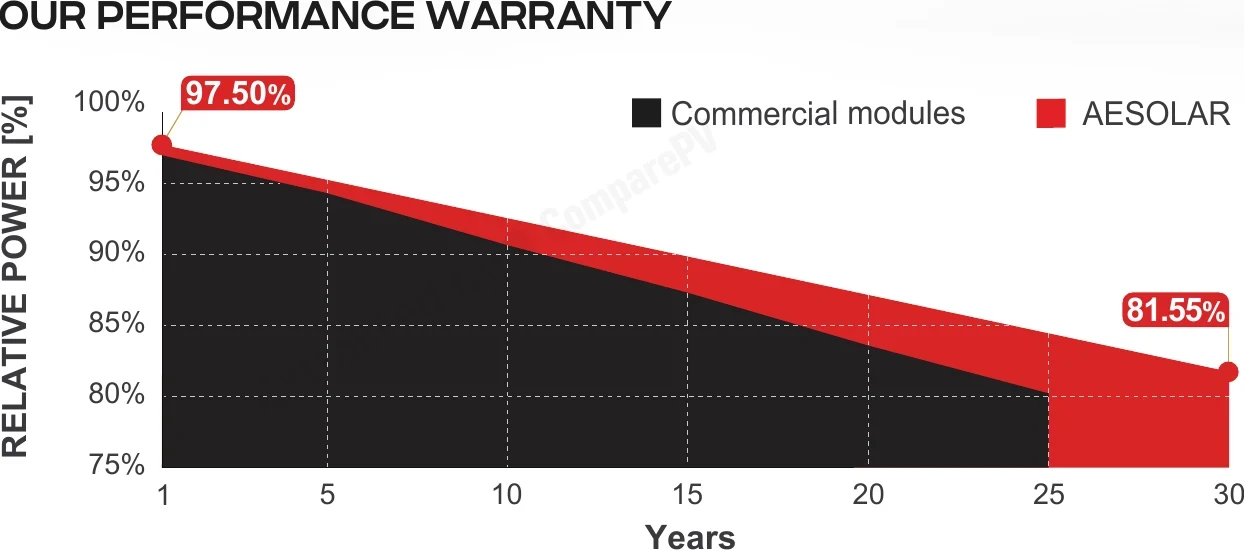
The MD-120BS series offers both a 30-year product warranty and a 30-year power warranty (≥81.55% of nominal power after 30 years). The standard in the market among Tier 1 manufacturers (Risen, Zonergy) is a 25-year power warranty, which makes AE Solar's offering stand out in the long-term installation segment.
Doping with gallium during the production process virtually eliminates light-induced degradation (LID), reducing the annual degradation rate from the typical ~0.7% to ~0.4%/year. Over a 30-year period, this translates to a few percentage points higher cumulative yield compared to standard PERC cells without gallium doping.
The upper limit of the series' efficiency (21.35%) exceeds that of the direct competitor, Zonergy ZPM MH3-72 (21.16%), placing the module among the top performers in the 440-460 Wp range of bifacial PERC panels. For a roof with an area of 30 m², this represents an additional 10-15 Wp of installed power compared to Zonergy.
The bifacial design (with a reflective coating and half-cut cell technology) reduces internal resistance losses and improves performance in diffused lighting and partially shaded conditions. Bifaciality allows for an additional power generation of 5-15% from reflected light from the ground, without increasing installation costs.
The Peers RSM96-11-440-460BNDG and SunKean SKT440~460M12-96D4 panels achieve an efficiency of 23-23.02%, compared to 21.35% for the MD-120BS. This difference of approximately 1.7% represents roughly 7-8% less power output from the same roof area, which is a significant limitation in prosumer installations with limited mounting space.
The -0.35°C/℃ performance is typical for PERC (Passivated Emitter and Rear Cell) technology, but significantly lower than TOPCon (-0.29°C to -0.32°C/℃). At a module temperature of 65°C (typical summer conditions in Poland, NOCT ~45°C + 20°C of solar heating), the difference compared to TOPCon results in approximately 1-1.5% lower energy yield during peak hours in the summer season.
- Efficiency of 21.1% matches the PERC 450-500W median
- At 211.1 W/m² power density, roof space requirements are typical for PERC 450-500W panels
- Temperature coefficient of -0.35%/°C matches the PERC 450-500W median
- Weight of 22.5 kg (2.0 kg below PERC 450-500W median of 24.5 kg) allows easier transport and roof mounting
- Bifaciality factor of 70% can add 4-10% extra yield with reflective mounting surface
Specifications
Datasheet charts
Measured curves published by AE Solar in this model's datasheet. A chart carrying a wattage was measured on that variant alone - only the ones that describe 455 Wp appear here. The rest cover the whole series.
Simulations
Degradation from this panel's own datasheet figures. No inverter, soiling or shading losses.
Model: bifaciality × albedo × 0.6 view factor. A first-order estimate, not a yield simulation.






Found 698 panels of the same or similar size to this one, within ±10 mm. See them here Found 756 panels of the same or similar size to this one, within ±25 mm. See them here Found 844 panels of the same or similar size to this one, within ±50 mm. See them here Found 1504 panels of the same or similar size to this one, within ±100 mm. See them here
About the AURORA MD-120BS series
These answers cover the whole series. Where a figure differs, the specification above is this module's own.