
Efficiency leader, heavy for its output
The AE Solar AURORA MD-120BD series features advanced bifacial double glass modules that redefine performance standards in challenging lighting conditions. Thanks to the use of gallium-doped cell technology, these panels exhibit exceptional resistance to light-induced degradation (LID), resulting in stable energy production for decades. Its unique design allows this series to handle partial shading issues perfectly, minimizing power losses that could limit the efficiency of the entire string in traditional modules. The use of tempered glass on both sides not only increases mechanical resistance to extreme loads but also allows for additional energy yield from radiation reflected off the ground. This is an ideal solution for investors seeking maximum self-consumption and system stability in the variable Polish climate. The AURORA MD-120BD series stands out from the competition with its excellent low temperature coefficient, making it an optimal choice for installations with limited space where every watt of power per square meter counts. This technology is dedicated to both demanding prosumers and commercial projects focusing on a fast return on investment through increased longevity and performance in real-world weather conditions.
Ranking
Signals from the data
Residential, commercial and hot-climate.
Weight-limited structures.
Top 19% of the PERC 450-500 W segment, against a median of 20.82%.
Top 20% of the PERC 450-500 W segment, against a median of 25 yrs.
Top 20% of the PERC 450-500 W segment, against a median of 208.5.
Bottom 24% of the PERC 450-500 W segment, against a median of 53.1.
AE Solar is the only European manufacturer on BloombergNEF's Tier-1 list (a ranking that has been uninterrupted since the 16th edition), and the only European company featured in the BNEF 2024 bankability study, where its rating increased from 26% (2023) to 50% (2024). This is a significant advantage over Asian competitors for projects requiring bankable financing.
The use of gallium-doped PERC cells eliminates the dominant light-induced degradation mechanism (LID) that is typical for standard P-type boron cells. This results in improved energy production stability in the initial years of operation compared to traditional PERC modules without gallium doping.
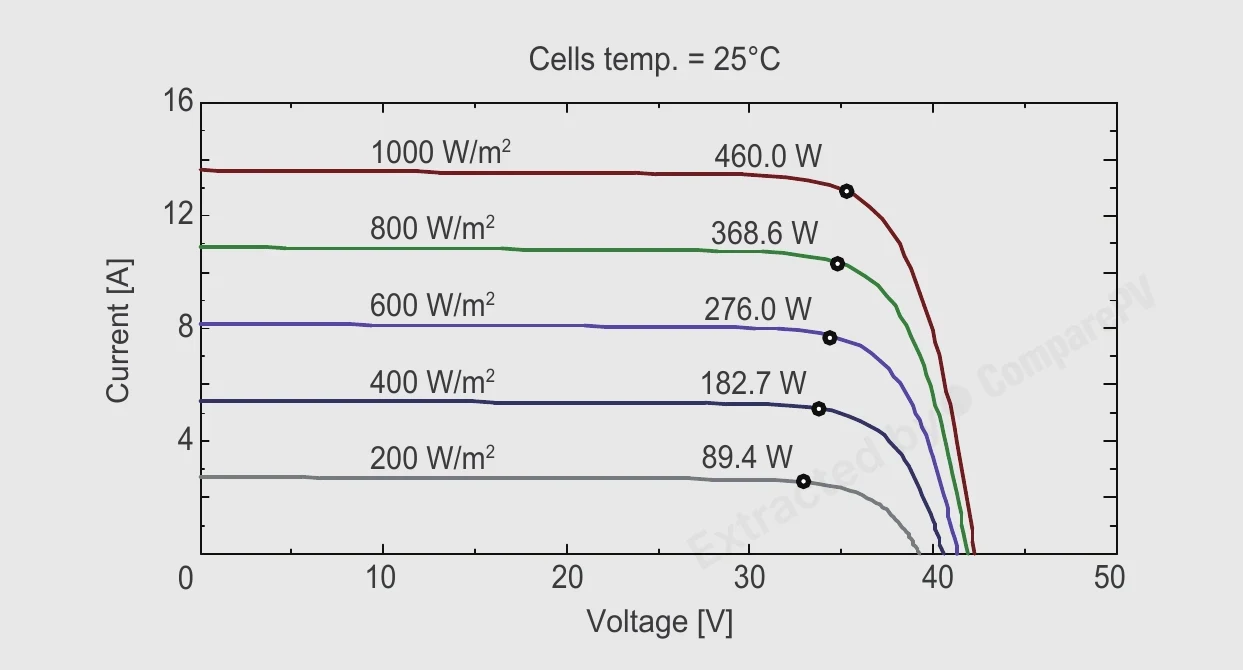
The measured Pmax-TC is -0.29%/°C, which is a significantly better value than the typical range for PERC technology (-0.34 to -0.36%/°C). In the Polish climate, where module temperatures regularly exceed 50°C in the summer, the lower temperature coefficient translates to a real increase in seasonal energy yield.
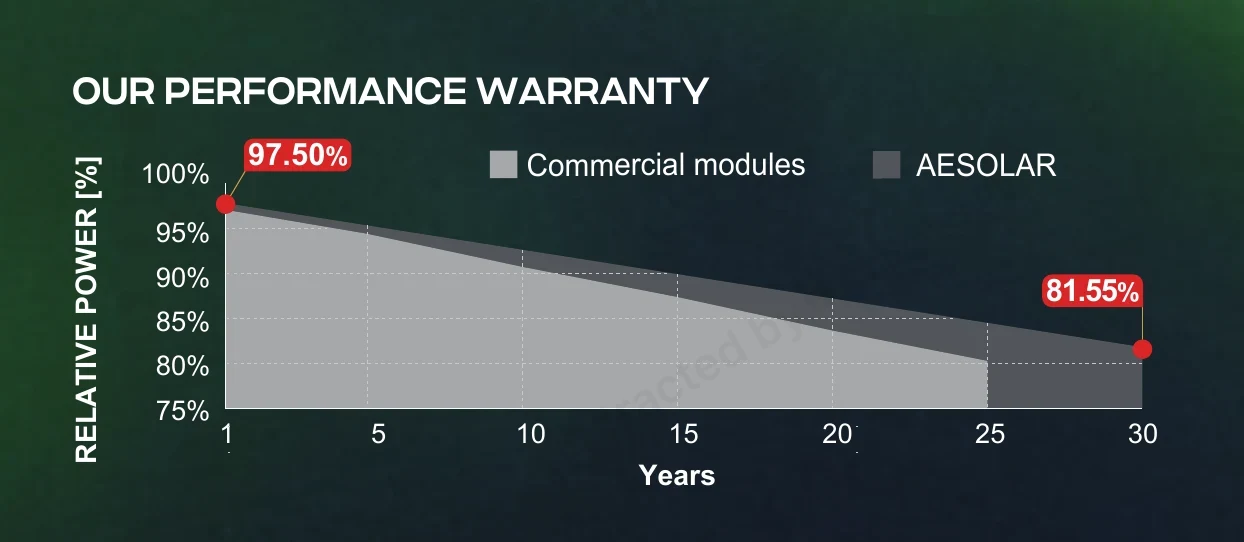
The series offers both a 30-year product warranty and a 30-year performance warranty - exceeding the industry standard, which typically ranges from 12-15 years (for the product) and 25 years (for performance). For commercial projects with long-term financing, this is a key due diligence parameter.
Confirmed fire resistance class A (IEC 61730) and double-sided 2+2 mm tempered glass allow installation in locations with strict fire safety requirements (e.g., pitched roofs in dense developments), and the double-glass construction increases mechanical durability and resistance to PID compared to a backsheet.
The maximum efficiency of the 460W model is 21.35%, while comparable, more affordable modules from Risen RSM96-11 achieve 23% (+1.65%), and SunKean SKT460 - 23.02% (+1.67%). This difference of approximately 8% represents a significant advantage for competing products, as they generate noticeably more power for the same roof area, which is particularly important for installations with limited space.
PER (Passivated Emitter and Rear Cell) solar cells exhibit higher degradation in the first year of operation (approximately 2% compared to approximately 1% for TOPCon N-type) and a lower bifaciality factor (approximately 78.8% compared to approximately 83.3% for TOPCon, according to a field study in 2025). For new installations with a long-term perspective, comparing LCoE (Levelized Cost of Electricity) may favor newer N-type technologies used by some comparable companies.
- At 21.1% efficiency, this panel is on par with typical PERC 450-500W modules
- At 211.1 W/m² power density, roof space requirements are typical for PERC 450-500W panels
- Temperature coefficient of -0.35%/°C matches the PERC 450-500W median
- At 25.5 kg, weight matches the PERC 450-500W median
- Bifacial design (70% factor) captures reflected light - adds 4-10% yield on ground-mount or white roof
Specifications
Datasheet charts
Measured curves published by AE Solar in this model's datasheet. A chart carrying a wattage was measured on that variant alone - only the ones that describe 455 Wp appear here. The rest cover the whole series.
Simulations
Degradation from this panel's own datasheet figures. No inverter, soiling or shading losses.
Model: bifaciality × albedo × 0.6 view factor. A first-order estimate, not a yield simulation.






Found 698 panels of the same or similar size to this one, within ±10 mm. See them here Found 756 panels of the same or similar size to this one, within ±25 mm. See them here Found 844 panels of the same or similar size to this one, within ±50 mm. See them here Found 1504 panels of the same or similar size to this one, within ±100 mm. See them here
About the AURORA MD-120BD series
These answers cover the whole series. Where a figure differs, the specification above is this module's own.