ZNShine ZXM7-UHLDD120-475W

ZXM7-UHLDD120-475W

475 Wp TOPCon Bifacial 80%
ComparePV verdict

Middle of its segment, heavy for its output

Rank 8,905 of 14,005
Compare panels Datasheet PDF
Power (Wp)
475
Typical for its class
Efficiency (%)
22.01
Weak · bottom 19%
Density (Wp/m²)
220.1
Weak · bottom 18%
Temp (%/°C)
-0.300
Weak · bottom 20%
Weight (kg)
26.5
Weak · 2.5 kg above median
Warranty (yrs)
30
Typical · median 30 yrs

The ZNShine ZXM7-UHLDD120 series are bifacial modules featuring a double glass construction, designed to truly boost the yield not only from the front side but also from the reflected ground light. In practice, this means higher energy production on flat-roof installations with light membranes, carports, and ground-mounted systems where albedo is significant.

The application of N-type TOPCon cells helps limit long-term losses and improves performance in poorer weather conditions - common in Poland's climate. As a result, this series performs well where stable annual performance matters more than just catalog parameters.

It also operates better than many standard P-type modules due to its PID resistance and robust construction, ensuring reliability in demanding environments (humidity, temperature fluctuations, mechanical loads). This is the choice for commercial investors and prosumers who want to maximize the yield from the same surface area and minimize the risk of performance degradation over time.

Ranking

1,089 panels in the segment TOPCon 450-500 W
Metric This panel Median Position in segment Overall rank
Module efficiency 22.01% 22.52% Weak · bottom 19% 6,491
Power density 220.1 225.2 Weak · bottom 18% 6,632
Temperature coefficient -0.300 -0.290 Weak · bottom 20% 6,093
Weight per kWp 55.8 52.2 Weak · bottom 9% 10,163
Performance warranty 30 yrs 30 yrs Typical 21
Colour key Strong - top 25% Typical - middle 50% Weak - bottom 25%

Signals from the data

0 positive · 3 caution
Best for

Residential, commercial and shaded-installations.

Not ideal for

Weight-limited structures, roofs where every square metre has to count and tight roof space.

Watch-outs
55.8 kg per kWp

Bottom 9% of the TOPCon 450-500 W segment, against a median of 52.2. Ranked 10,163rd in the whole database.

220.1 watts per square metre

Bottom 18% of the TOPCon 450-500 W segment, against a median of 225.2.

22.01% module efficiency

Bottom 19% of the TOPCon 450-500 W segment, against a median of 22.52%.

Notes from the database
  • Module efficiency of 22.0% is 0.5pp below average for TOPCon 450-500W panels (median: 22.5%)
  • Power density of 220.1 W/m² is 5.1 W/m² below TOPCon 450-500W median (225.2 W/m²) - needs more roof space
  • Temperature coefficient of -0.30%/°C matches the TOPCon 450-500W median
  • Weight of 26.5 kg is 2.5 kg above TOPCon 450-500W median (24.0 kg) - verify structural support
  • Bifacial design (80% factor) captures reflected light - adds 4-12% yield on ground-mount or white roof

Specifications

Open datasheet PDF
Nominal power (Pmax) 475 Wp Nameplate at 1000 W/m², 25 °C
Module efficiency 22.01 % Weak Segment median 22.52%
Vmpp · Impp 35.30 V · 13.46 A Operating point at max power
Voc · Isc 42.60 V · 14.24 A Sizes the string length
Max system voltage 1500 V Longer strings than 1000 V modules
Dimensions 1903×1134×30 mm · 2.16 m² of roof
Weight 26.5 kg Weak Weak · 2.5 kg above median
Cells 120 · TOPCon Monocrystalline
Bifaciality 80 % Rear output as a share of front
Coefficient Pmax -0.300 %/°C Weak bottom 20% of its segment
Coefficient Voc · Isc -0.250 · 0.046 %/°C
NOCT 44 °C At 800 W/m², 20 °C ambient
Product warranty 12 years Hardware defects only
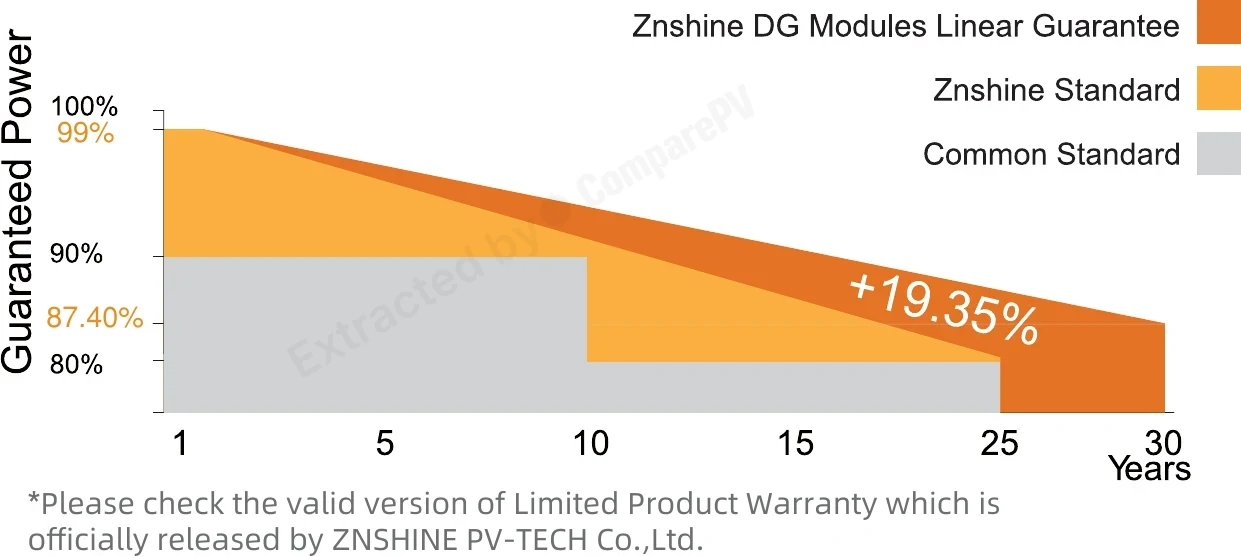
Performance warranty 30 years Typical median 30 yrs · median 30 yrs
End-of-warranty output 87.4 % Equals 415 W guaranteed
Degradation 1.00 → 0.40 % First year, then annual

Datasheet charts

Open datasheet PDF

Measured curves published by ZNShine in this model's datasheet. A chart carrying a wattage was measured on that variant alone - only the ones that describe 475 Wp appear here. The rest cover the whole series.
Simulations

Live - change any input
Lifetime output & value
30 years at 1200 kWh/kWp/year and €0.50 per kWh
Power in year 30
-
Lifetime energy
-
Energy value
-
With bifacial gain
-

Degradation from this panel's own datasheet figures. No inverter, soiling or shading losses.

Heat losses
-0.300 %/°C against a segment median of -0.290
-
Bifacial gain
Rear gain over light concrete: -
-

Model: bifaciality × albedo × 0.6 view factor. A first-order estimate, not a yield simulation.

Filter these
Size
Panel Power Eff. Temp. Weight Difference
ZNShine ZXM7-UHLDD120-475W 475 W 22.01% -0.300 26.5 kg You are here
LR7-54HJD-510M 510 W 25.00% -0.240 23.5 kg +35 W, cooler, +3.0 pp
AIKO-A495-MCE54Mw 495 W 24.80% -0.260 21.0 kg Cooler, lighter, +2.8 pp
LR7-54HJD-505M 505 W 24.70% -0.240 23.5 kg +30 W, cooler, +2.7 pp
AIKO-A490-MCE54Mw 490 W 24.50% -0.260 21.0 kg Cooler, lighter, +2.5 pp
LR7-54HJD-500M 500 W 24.50% -0.240 23.5 kg Cooler, lighter, +2.5 pp
CIPRO-TN9C54M-500W 500 W 24.50% -0.260 21.4 kg Cooler, lighter, +2.5 pp
ZXM7-SHLDD120-440 440 W 20.39% -0.350 26.5 kg -35 W, hotter, -1.6 pp
ZXM7-SHLDD120-445 445 W 20.62% -0.350 26.5 kg -30 W, hotter, -1.4 pp
ZXM7-SHLDD120-450 450 W 20.85% -0.350 26.5 kg -25 W, hotter, -1.2 pp
ZXM7-SHLDD120-455 455 W 21.08% -0.350 26.5 kg -20 W, hotter, -0.9 pp
ZXM7-SHLDD120-460 460 W 21.32% -0.350 26.5 kg -15 W, hotter, -0.7 pp
ZXM7-SHLDD120-465 465 W 21.55% -0.350 26.5 kg -10 W, hotter, -0.5 pp
LR7-60HVH-560M 560 W 24.80% -0.260 25.0 kg +85 W, cooler, +2.8 pp
LR7-60HVH-555M 555 W 24.60% -0.260 25.0 kg +80 W, cooler, +2.6 pp
LR7-60HVHL-550M 550 W 24.40% -0.260 16.3 kg +75 W, lighter, +2.4 pp
JAT60S40-540/LR 540 W 24.40% -0.260 23.5 kg +65 W, cooler, +2.4 pp

Found 725 panels of the same or similar size to this one, within ±10 mm. See them here Found 751 panels of the same or similar size to this one, within ±25 mm. See them here Found 870 panels of the same or similar size to this one, within ±50 mm. See them here Found 1499 panels of the same or similar size to this one, within ±100 mm. See them here

Common questions

6 answered
What is the difference between ZNShine ZXM7-UHLDD120 bifacial modules and standard mono-facial panels?
ZXM7-UHLDD120 series modules have active cells on both sides of the glass, capturing additional light reflected from the ground (roof, gravel, white membrane). In practice this delivers extra energy yield of several to over ten percent compared to a mono-facial panel of the same power, especially on flat roofs and ground-mount installations with a light-colored surface.
What warranty comes with ZNShine ZXM7-UHLDD120 solar panels?
The manufacturer covers the ZXM7-UHLDD120 series with a 12-year product warranty against material and workmanship defects, plus a 30-year linear power warranty guaranteeing a defined percentage of rated output over that period. This is standard for Tier 1 panels using N-type TOPCon cells and gives investors confidence in long-term system profitability.
What is TOPCon technology and why is it better than standard P-type cells?
TOPCon (Tunnel Oxide Passivated Contact) is an N-type cell technology that reduces light-induced degradation (LID) losses and performs better at higher temperatures and under weaker irradiance than typical P-type cells. In a module rated up to 485 Wp, this translates into higher efficiency and more stable annual yield, particularly relevant in climates with frequent diffuse light.
Are ZNShine ZXM7-UHLDD120 panels suitable for flat roofs or carports?
Yes, the bifacial, dual-glass construction is specifically designed for flat roofs with a light membrane, carports, and ground-mount installations, where the module can capture light reflected off the ground (albedo effect). To achieve a real production boost, modules are typically installed on racking with some clearance from the surface below.
Are ZXM7-UHLDD120 series panels resistant to PID and moisture?
Yes, the series has PID (Potential Induced Degradation) resistance, preventing power losses caused by leakage currents at high system voltages. The robust dual-glass build also protects the cells against moisture and fluctuating weather conditions, supporting stable performance throughout the warranty period.
How much power do ZNShine ZXM7-UHLDD120 panels produce and how many are needed for a typical home system?
Modules in this series reach up to 485 Wp of maximum power. For a typical residential system of 5-8 kWp, roughly 10 to 17 panels are needed, depending on the specific power variant and household energy demand. ZNShine is a Tier 1 manufacturer, which simplifies financing and insuring the installation.
Add to compare