ZNShine ZXM7-UHLD120-475/N

ZXM7-UHLD120-475/N

475 Wp TOPCon
ComparePV verdict

Middle of its segment, heavy for its output

Rank 8,905 of 14,005
Compare panels Datasheet PDF
Power (Wp)
475
Typical for its class
Efficiency (%)
22.01
Weak · bottom 19%
Density (Wp/m²)
220.1
Weak · bottom 18%
Temp (%/°C)
-0.300
Weak · bottom 20%
Weight (kg)
26.5
Weak · 2.5 kg above median
Warranty (yrs)
30
Typical · median 30 yrs

The ZNShine ZXM7-UHLD120 series is designed to maximize energy yield from limited surface areas. These modules are based on N-type monocrystalline TOPCon cells, known for their stable performance and low degradation over a long lifespan. The application of half-cut architecture combined with multi-busbar technology (MBB/SMBB) helps minimize resistive losses and improve module performance under partial shading, which translates to higher yields in Polish conditions (chimneys, window frames, trees).

In practice, this series offers three key advantages: superior energy production in low-light conditions, high resistance to Potential Induced Degradation (PID), and greater parameter predictability over time. As a result, the ZXM7-UHLD120 performs exceptionally well in both residential and commercial installations on flat and pitched roofs, where high power density and reliable operation across varying temperatures are crucial. Against the competition, this series stands out through the combination of N-TOPCon technology with a module design focused on durability and consistent yield performance.

Ranking

1,089 panels in the segment TOPCon 450-500 W
Metric This panel Median Position in segment Overall rank
Module efficiency 22.01% 22.52% Weak · bottom 19% 6,491
Power density 220.1 225.2 Weak · bottom 18% 6,632
Temperature coefficient -0.300 -0.290 Weak · bottom 20% 6,093
Weight per kWp 55.8 52.2 Weak · bottom 9% 10,163
Performance warranty 30 yrs 30 yrs Typical 21
Colour key Strong - top 25% Typical - middle 50% Weak - bottom 25%

Signals from the data

0 positive · 3 caution
Best for

Residential, commercial and shaded-installations.

Not ideal for

Weight-limited structures, roofs where every square metre has to count and tight roof space.

Watch-outs
55.8 kg per kWp

Bottom 9% of the TOPCon 450-500 W segment, against a median of 52.2. Ranked 10,163rd in the whole database.

220.1 watts per square metre

Bottom 18% of the TOPCon 450-500 W segment, against a median of 225.2.

22.01% module efficiency

Bottom 19% of the TOPCon 450-500 W segment, against a median of 22.52%.

Notes from the database
  • Efficiency of 22.0% is 0.5pp below the TOPCon 450-500W median (22.5%)
  • At 220.1 W/m², this panel generates 5.1 W/m² less per unit area than TOPCon 450-500W median (225.2 W/m²)
  • At -0.30%/°C, hot weather performance is typical for TOPCon 450-500W panels
  • Weight of 26.5 kg is 2.5 kg above TOPCon 450-500W median (24.0 kg) - verify structural support
  • Ranked #6491 out of 14005 panels for efficiency in the database

Specifications

Open datasheet PDF
Nominal power (Pmax) 475 Wp Nameplate at 1000 W/m², 25 °C
Module efficiency 22.01 % Weak Segment median 22.52%
Vmpp · Impp 35.30 V · 13.46 A Operating point at max power
Voc · Isc 42.50 V · 14.19 A Sizes the string length
Max system voltage 1500 V Longer strings than 1000 V modules
Dimensions 1903×1134×30 mm · 2.16 m² of roof
Weight 26.5 kg Weak Weak · 2.5 kg above median
Cells 120 · TOPCon Monocrystalline
Coefficient Pmax -0.300 %/°C Weak bottom 20% of its segment
Coefficient Voc · Isc -0.250 · 0.046 %/°C
NOCT 44 °C At 800 W/m², 20 °C ambient
Product warranty 12 years Hardware defects only
Performance warranty 30 years Typical median 30 yrs · median 30 yrs
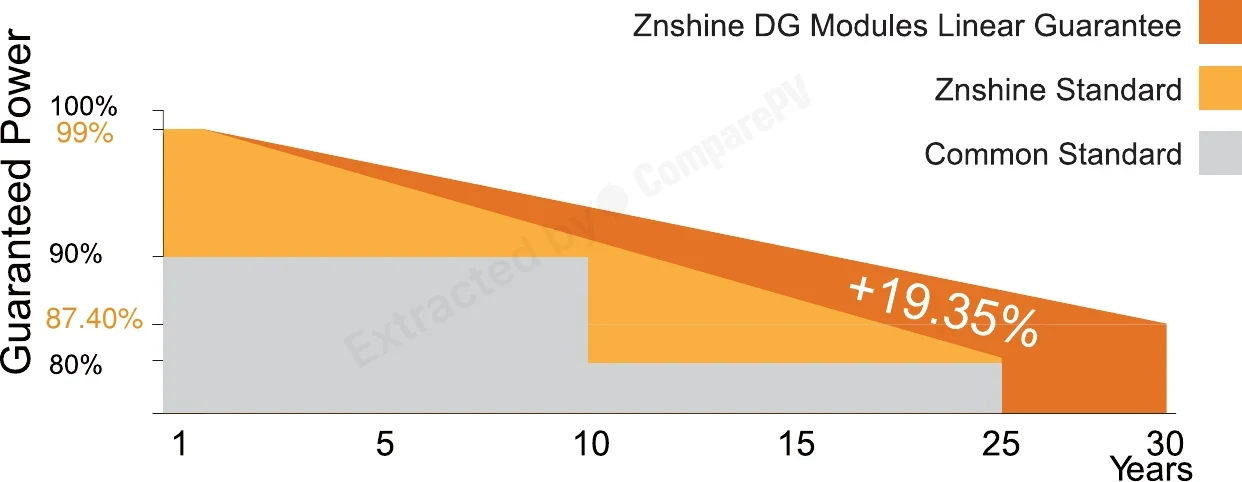
End-of-warranty output 87.4 % Equals 415 W guaranteed
Degradation 1.00 → 0.40 % First year, then annual

Datasheet charts

Open datasheet PDF

Measured curves published by ZNShine in this model's datasheet. A chart carrying a wattage was measured on that variant alone - only the ones that describe 475 Wp appear here. The rest cover the whole series.
Simulations

Live - change any input
Lifetime output & value
30 years at 1200 kWh/kWp/year and €0.50 per kWh
Power in year 30
-
Lifetime energy
-
Energy value
-

Degradation from this panel's own datasheet figures. No inverter, soiling or shading losses.

Heat losses
-0.300 %/°C against a segment median of -0.290
-
Filter these
Size
Panel Power Eff. Temp. Weight Difference
ZNShine ZXM7-UHLD120-475/N 475 W 22.01% -0.300 26.5 kg You are here
LR7-54HJD-510M 510 W 25.00% -0.240 23.5 kg +35 W, cooler, +3.0 pp
AIKO-A495-MCE54Mw 495 W 24.80% -0.260 21.0 kg Cooler, lighter, +2.8 pp
LR7-54HJD-505M 505 W 24.70% -0.240 23.5 kg +30 W, cooler, +2.7 pp
AIKO-A490-MCE54Mw 490 W 24.50% -0.260 21.0 kg Cooler, lighter, +2.5 pp
LR7-54HJD-500M 500 W 24.50% -0.240 23.5 kg Cooler, lighter, +2.5 pp
CIPRO-TN9C54M-500W 500 W 24.50% -0.260 21.4 kg Cooler, lighter, +2.5 pp
ZXM7-SHLDD120-440 440 W 20.39% -0.350 26.5 kg -35 W, hotter, -1.6 pp
ZXM7-SHLDD120-445 445 W 20.62% -0.350 26.5 kg -30 W, hotter, -1.4 pp
ZXM7-SHLDD120-450 450 W 20.85% -0.350 26.5 kg -25 W, hotter, -1.2 pp
ZXM7-SHLDD120-455 455 W 21.08% -0.350 26.5 kg -20 W, hotter, -0.9 pp
ZXM7-SHLDD120-460 460 W 21.32% -0.350 26.5 kg -15 W, hotter, -0.7 pp
ZXM7-SHLDD120-465 465 W 21.55% -0.350 26.5 kg -10 W, hotter, -0.5 pp
LR7-60HVH-560M 560 W 24.80% -0.260 25.0 kg +85 W, cooler, +2.8 pp
LR7-60HVH-555M 555 W 24.60% -0.260 25.0 kg +80 W, cooler, +2.6 pp
LR7-60HVHL-550M 550 W 24.40% -0.260 16.3 kg +75 W, lighter, +2.4 pp
JAT60S40-540/LR 540 W 24.40% -0.260 23.5 kg +65 W, cooler, +2.4 pp

Found 725 panels of the same or similar size to this one, within ±10 mm. See them here Found 751 panels of the same or similar size to this one, within ±25 mm. See them here Found 870 panels of the same or similar size to this one, within ±50 mm. See them here Found 1499 panels of the same or similar size to this one, within ±100 mm. See them here

Common questions

6 answered
What is the maximum power output of the ZNShine ZXM7-UHLD120 panel?
The ZXM7-UHLD120 series reaches up to 485 Wp of maximum power. This is achieved through N-type monocrystalline TOPCon cells combined with a half-cut architecture and multi-busbar metallization (MBB/SMBB), which reduce resistive losses and deliver high power density from a limited roof area without increasing module dimensions.
What warranty comes with the ZNShine ZXM7-UHLD120 series?
The manufacturer provides a 12-year product warranty along with a 30-year power performance warranty. This means the module maintains a guaranteed output level for three decades, while any material or manufacturing defects within the first 12 years are covered by the manufacturer. This is a standard offering from tier-1 manufacturers focused on N-TOPCon cell durability.
Are the ZXM7-UHLD120 panels bifacial?
No, the ZXM7-UHLD120 series consists of monofacial modules, optimized for maximum yield from the front side only. This makes them well suited for typical pitched and flat roof installations, where rear-side mounting wouldn't generate the meaningful extra energy gain that bifacial modules provide in open-ground setups.
Do ZNShine ZXM7-UHLD120 panels perform well under partial shading, such as from a chimney or antenna?
Yes, the half-cut architecture combined with multi-busbar metallization (MBB/SMBB) limits power losses under partial shading, common on Polish roofs due to chimneys, dormers, or antennas. Splitting each cell in half reduces current losses in the shaded section, so the rest of the panel keeps generating power instead of the whole module losing output at once.
How does the N-TOPCon technology in the ZXM7-UHLD120 differ from standard PERC panels?
N-type TOPCon cells offer lower annual degradation and better long-term parameter stability compared to conventional P-type PERC cells. An additional passivation layer reduces electron recombination, resulting in higher efficiency and a smaller power drop over years of operation, giving more predictable energy yields throughout the 30-year power warranty period.
Are the ZXM7-UHLD120 panels PID-resistant and suitable for large commercial installations?
Yes, the series features high resistance to potential-induced degradation (PID), which matters for longer module strings typical of commercial installations. Combined with high power density and stable N-TOPCon cell performance, these modules work well on both flat commercial rooftops and larger residential installations.
Add to compare