ZXM7-SHLD120-470/N

470 Wp TOPCon
ComparePV verdict

Middle of its segment, heavy for its output

Rank 9,295 of 14,005
Compare panels Datasheet PDF
Power (Wp)
470
Typical for its class
Efficiency (%)
21.78
Weak · bottom 11%
Density (Wp/m²)
217.8
Weak · bottom 11%
Temp (%/°C)
-0.300
Weak · bottom 20%
Weight (kg)
26.5
Weak · 2.5 kg above median
Warranty (yrs)
30
Typical · median 30 yrs

This ZNShine ZXM7-SHLD120 series is designed for installations where long-term, stable energy production and durability in challenging conditions are key. These are double glass modules, offering superior protection against moisture, micro-cracking, and accelerated aging - a feature appreciated by investors prioritizing predictable yields. The use of half-cut cells minimizes heating losses and helps maintain higher operational efficiency even under partial shading, common in roof installations with chimneys or urban setups. Furthermore, multi-busbar technology supports stable performance and better current collection from the cell surface, while anti-PID resistance reduces the risk of power drops in demanding environments. This series is ideal for residential rooftops, commercial installations, and other projects where module longevity and trouble-free operation in the Polish climate are essential.

Ranking

1,089 panels in the segment TOPCon 450-500 W
Metric This panel Median Position in segment Overall rank
Module efficiency 21.78% 22.52% Weak · bottom 11% 7,206
Power density 217.8 225.2 Weak · bottom 11% 7,046
Temperature coefficient -0.300 -0.290 Weak · bottom 20% 6,093
Weight per kWp 56.4 52.2 Weak · bottom 7% 10,619
Performance warranty 30 yrs 30 yrs Typical 21
Colour key Strong - top 25% Typical - middle 50% Weak - bottom 25%

Signals from the data

0 positive · 3 caution
Best for

Residential, commercial and shaded-installations.

Not ideal for

Weight-limited structures, tight roof space and roofs where every square metre has to count.

Watch-outs
56.4 kg per kWp

Bottom 7% of the TOPCon 450-500 W segment, against a median of 52.2. Ranked 10,619th in the whole database.

21.78% module efficiency

Bottom 11% of the TOPCon 450-500 W segment, against a median of 22.52%.

217.8 watts per square metre

Bottom 11% of the TOPCon 450-500 W segment, against a median of 225.2.

Notes from the database
  • At 21.8% efficiency, this panel is 0.7pp below the TOPCon 450-500W median of 22.5%
  • 217.8 W/m² power density is 7.4 W/m² below TOPCon 450-500W median (225.2 W/m²) - requires larger installation area
  • At -0.30%/°C, hot weather performance is typical for TOPCon 450-500W panels
  • At 26.5 kg, this panel is 2.5 kg heavier than the TOPCon 450-500W median (24.0 kg) - more demanding for installation crews
  • #7206 for efficiency, #6093 for temperature performance out of 14005 panels

Specifications

Open datasheet PDF
Nominal power (Pmax) 470 Wp Nameplate at 1000 W/m², 25 °C
Module efficiency 21.78 % Weak Segment median 22.52%
Vmpp · Impp 35.10 V · 13.40 A Operating point at max power
Voc · Isc 42.40 V · 14.11 A Sizes the string length
Max system voltage 1500 V Longer strings than 1000 V modules
Dimensions 1903×1134×30 mm · 2.16 m² of roof
Weight 26.5 kg Weak Weak · 2.5 kg above median
Cells 120 · TOPCon Monocrystalline
Coefficient Pmax -0.300 %/°C Weak bottom 20% of its segment
Coefficient Voc · Isc -0.250 · 0.046 %/°C
NOCT 44 °C At 800 W/m², 20 °C ambient
Product warranty 12 years Hardware defects only
Performance warranty 30 years Typical median 30 yrs · median 30 yrs
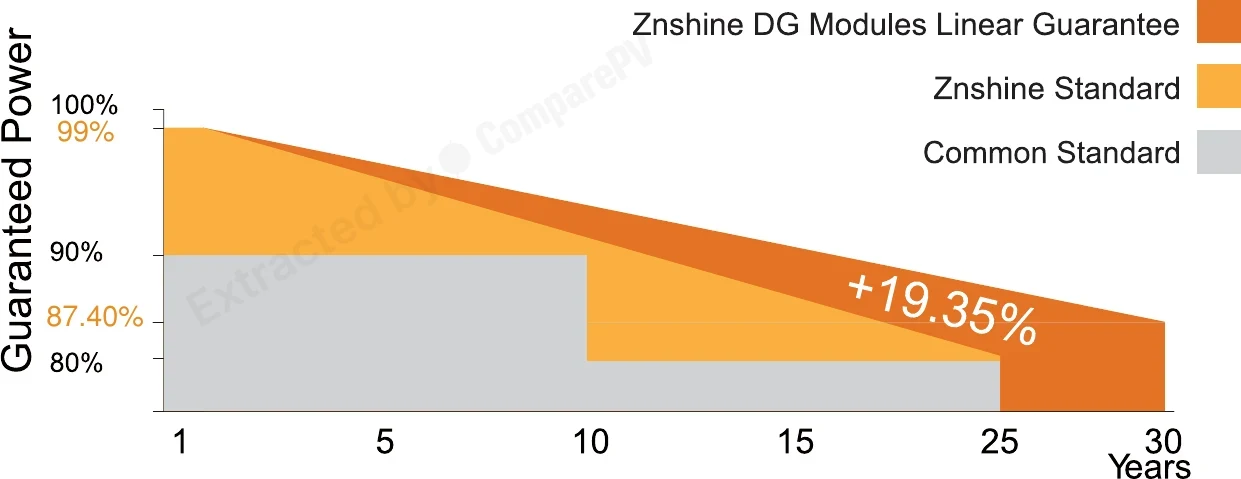
End-of-warranty output 87.4 % Equals 411 W guaranteed
Degradation 1.00 → 0.40 % First year, then annual

Datasheet charts

Open datasheet PDF

Measured curves published by ZNShine in this model's datasheet. A chart carrying a wattage was measured on that variant alone - only the ones that describe 470 Wp appear here. The rest cover the whole series.
Simulations

Live - change any input
Lifetime output & value
30 years at 1200 kWh/kWp/year and €0.50 per kWh
Power in year 30
-
Lifetime energy
-
Energy value
-

Degradation from this panel's own datasheet figures. No inverter, soiling or shading losses.

Heat losses
-0.300 %/°C against a segment median of -0.290
-
Filter these
Size
Panel Power Eff. Temp. Weight Difference
ZNShine ZXM7-SHLD120-470/N 470 W 21.78% -0.300 26.5 kg You are here
LR7-54HJD-510M 510 W 25.00% -0.240 23.5 kg +40 W, cooler, +3.2 pp
AIKO-A495-MCE54Mw 495 W 24.80% -0.260 21.0 kg Cooler, lighter, +3.0 pp
LR7-54HJD-505M 505 W 24.70% -0.240 23.5 kg +35 W, cooler, +2.9 pp
AIKO-A490-MCE54Mw 490 W 24.50% -0.260 21.0 kg Cooler, lighter, +2.7 pp
LR7-54HJD-500M 500 W 24.50% -0.240 23.5 kg +30 W, cooler, +2.7 pp
CIPRO-TN9C54M-500W 500 W 24.50% -0.260 21.4 kg Cooler, lighter, +2.7 pp
ZXM7-SHLDD120-440 440 W 20.39% -0.350 26.5 kg -30 W, hotter, -1.4 pp
ZXM7-SHLDD120-445 445 W 20.62% -0.350 26.5 kg -25 W, hotter, -1.2 pp
ZXM7-SHLDD120-450 450 W 20.85% -0.350 26.5 kg -20 W, hotter, -0.9 pp
ZXM7-SHLDD120-455 455 W 21.08% -0.350 26.5 kg -15 W, hotter, -0.7 pp
ZXM7-SHLDD120-460 460 W 21.32% -0.350 26.5 kg -10 W, hotter, -0.5 pp
ZXM7-SHLDD120-465 465 W 21.55% -0.350 26.5 kg Hotter, -0.2 pp
LR7-60HVH-560M 560 W 24.80% -0.260 25.0 kg +90 W, cooler, +3.0 pp
LR7-60HVH-555M 555 W 24.60% -0.260 25.0 kg +85 W, cooler, +2.8 pp
LR7-60HVHL-550M 550 W 24.40% -0.260 16.3 kg +80 W, lighter, +2.6 pp
JAT60S40-540/LR 540 W 24.40% -0.260 23.5 kg +70 W, cooler, +2.6 pp

Found 725 panels of the same or similar size to this one, within ±10 mm. See them here Found 751 panels of the same or similar size to this one, within ±25 mm. See them here Found 870 panels of the same or similar size to this one, within ±50 mm. See them here Found 1499 panels of the same or similar size to this one, within ±100 mm. See them here

Common questions

6 answered
Are ZNShine ZXM7-SHLD120 panels still available for purchase?
The ZXM7-SHLD120 series has been discontinued from current production and is being replaced by newer ZNShine models. Availability is now limited to remaining stock at distributors, so it's worth checking with the seller for current inventory and manufacturing dates. The manufacturer's warranty remains valid regardless of production discontinuation, provided the module was purchased new and registered per ZNShine's terms.
What is the warranty on ZNShine ZXM7-SHLD120 panels?
The manufacturer provides a 12-year product warranty covering material and workmanship defects, along with a 30-year power output warranty with linear degradation over time. This is a standard offering for Tier 1 modules using TOPCon cells. It's advisable to keep the purchase invoice and register the module, as this simplifies any warranty claims in later years of operation.
What advantage does the double glass construction of the ZXM7-SHLD120 offer over a standard backsheet panel?
Glass instead of a backsheet better protects the cells from moisture, microcracks, and PID degradation, resulting in more stable energy yield throughout the module's lifetime. Double glass also increases mechanical rigidity, improving resistance to snow and wind loads. The tradeoff is a somewhat heavier module, which should be factored into the choice of roof mounting structure.
Does TOPCon technology in the ZXM7-SHLD120 mean higher efficiency than panels with PERC cells?
Yes, TOPCon cells achieve higher conversion efficiency than older PERC cells, mainly due to improved rear-side passivation that reduces recombination losses. This translates to higher module power at the same surface area and better performance at elevated summer temperatures. The ZXM7-SHLD120 model reaches a maximum power of 485 Wp, a competitive figure for this panel class.
Do ZXM7-SHLD120 panels handle partial shading well, e.g., from a chimney on the roof?
The half-cut cells used in this series reduce power losses under partial shading, since each cell half operates independently within its own string. This means shading of a small section of the panel, such as from a chimney or antenna, causes a smaller overall power drop than in panels with full cells. This does not eliminate the need for power optimizers in cases of persistent, heavy shading.
How does anti-PID resistance in the ZXM7-SHLD120 differ from standard panels, and does it matter for a residential installation?
Anti-PID resistance means the module is designed to limit potential-induced degradation, i.e., power loss caused by leakage currents between the cells and the frame or ground. This matters especially in installations with high system voltage, high humidity, or longer panel strings. For a typical residential installation on a sloped roof, it provides an added safeguard for long-term production stability.
Add to compare