VSUN510N-132BMH

510 Wp TOPCon Bifacial 80%
ComparePV verdict

Middle of its segment, modest efficiency

Rank 5,301 of 14,005
Compare panels Datasheet PDF
Power (Wp)
510
Typical for its class
Efficiency (%)
21.48
Weak · bottom 8%
Density (Wp/m²)
214.8
Weak · bottom 8%
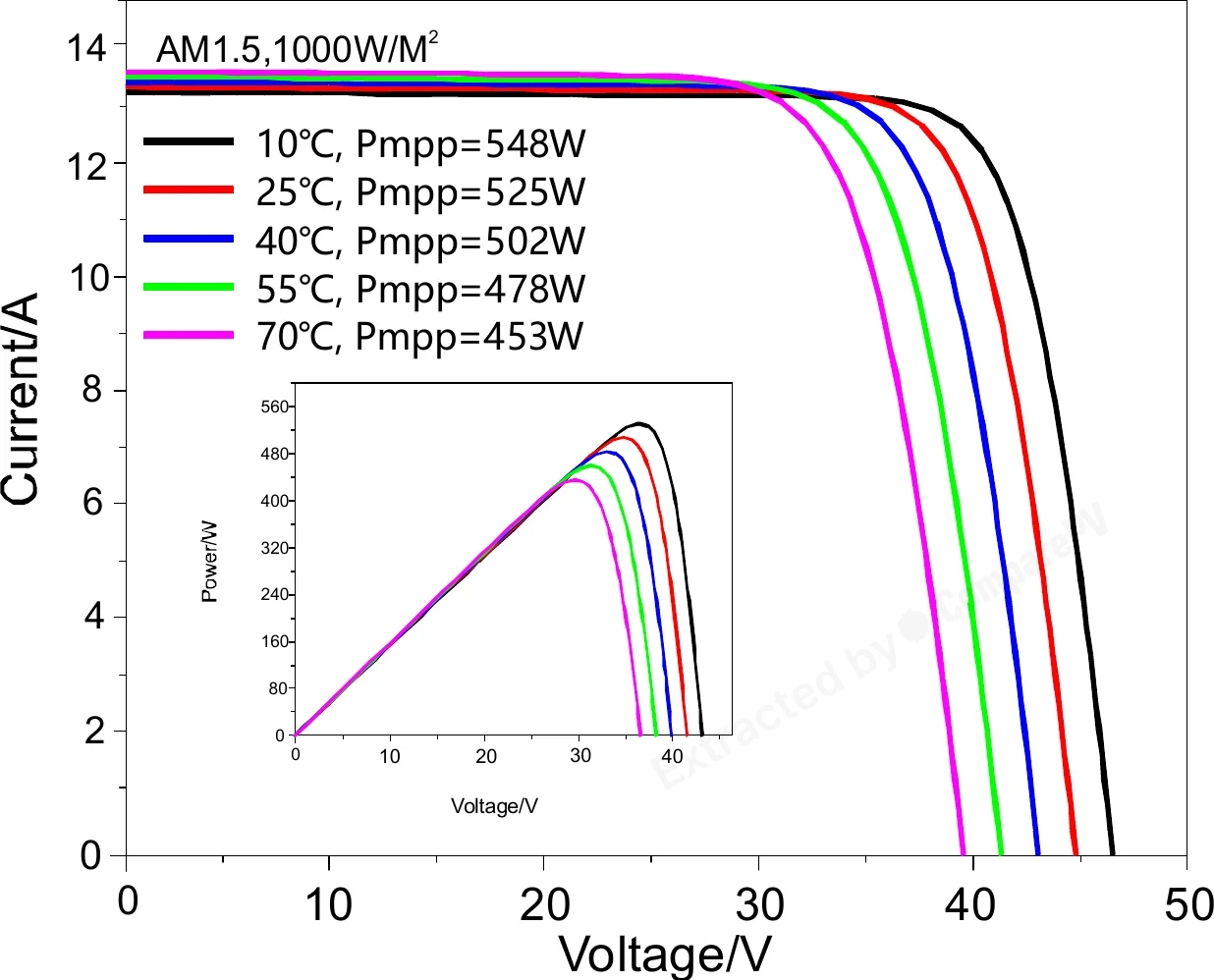
Temp (%/°C)
-0.300
Weak · bottom 20%
Weight (kg)
26.2
Typical · median 27.0 kg
Warranty (yrs)
30
Typical · median 30 yrs

The VSUN N-132BMH panel series is based on advanced N-type TOPCon technology, which sets new standards in energy efficiency. Thanks to the use of bifacial cells, these modules maximize energy yield by absorbing light reflected from the ground, making them an ideal choice for investors seeking the highest profitability. A characteristic feature of this series is an excellent bifaciality factor, allowing for a significant increase in electricity production without expanding the installation area. This solves the problem of limited mounting space, offering higher power density compared to older P-type modules. The design based on half-cut technology with 132 cells minimizes resistance losses and improves module performance in partial shading conditions. VSUN N-132BMH stands out from the competition with exceptional resistance to LID and LeTID degradation, which translates into stable power output for decades. It is a solution dedicated primarily to large photovoltaic farms and demanding commercial systems, where a low levelized cost of energy (LCOE) is of key importance. The use of multi-busbar technology further shortens the electron flow path, reducing the risk of micro-cracks and ensuring full reliability in difficult weather conditions.

Ranking

432 panels in the segment TOPCon 500-550 W
Metric This panel Median Position in segment Overall rank
Module efficiency 21.48% 22.73% Weak · bottom 8% 8,152
Power density 214.8 227.4 Weak · bottom 8% 8,130
Temperature coefficient -0.300 -0.290 Weak · bottom 20% 6,093
Weight per kWp 51.4 52.4 Typical 4,752
Performance warranty 30 yrs 30 yrs Typical 21
Colour key Strong - top 25% Typical - middle 50% Weak - bottom 25%

Signals from the data

0 positive · 3 caution
Best for

Commercial and shaded-installations.

Not ideal for

Tight roof space, roofs where every square metre has to count and hot climates.

Watch-outs
21.48% module efficiency

Bottom 8% of the TOPCon 500-550 W segment, against a median of 22.73%. Ranked 8,152nd in the whole database.

214.8 watts per square metre

Bottom 8% of the TOPCon 500-550 W segment, against a median of 227.4. Ranked 8,130th in the whole database.

-0.300 %/°C temperature coefficient

Bottom 20% of the TOPCon 500-550 W segment, against a median of -0.290.

Notes from the database
  • At 21.5% efficiency, this panel is 1.2pp below the TOPCon 500-550W median of 22.7%
  • At 214.8 W/m², this panel generates 12.6 W/m² less per unit area than TOPCon 500-550W median (227.4 W/m²)
  • Temperature coefficient of -0.30%/°C matches the TOPCon 500-550W median
  • 80% bifaciality enables rear-side power generation, boosting yield by 4-12% on reflective surfaces
  • Ranked #8152 out of 14005 panels for efficiency in the database

Specifications

Open datasheet PDF
Nominal power (Pmax) 510 Wp Nameplate at 1000 W/m², 25 °C
Module efficiency 21.48 % Weak Segment median 22.73%
Vmpp · Impp 38.50 V · 13.25 A Operating point at max power
Voc · Isc 46.48 V · 13.99 A Sizes the string length
Max system voltage 1500 V Longer strings than 1000 V modules
Dimensions 2094×1134×30 mm · 2.37 m² of roof
Weight 26.2 kg Typical Typical · median 27.0 kg
Cells 132 · TOPCon Monocrystalline
Bifaciality 80 % Rear output as a share of front
Coefficient Pmax -0.300 %/°C Weak bottom 20% of its segment
Coefficient Voc · Isc -0.260 · 0.046 %/°C
NOCT 45 °C At 800 W/m², 20 °C ambient
Product warranty 25 years Hardware defects only
Performance warranty 30 years Typical median 30 yrs · median 30 yrs
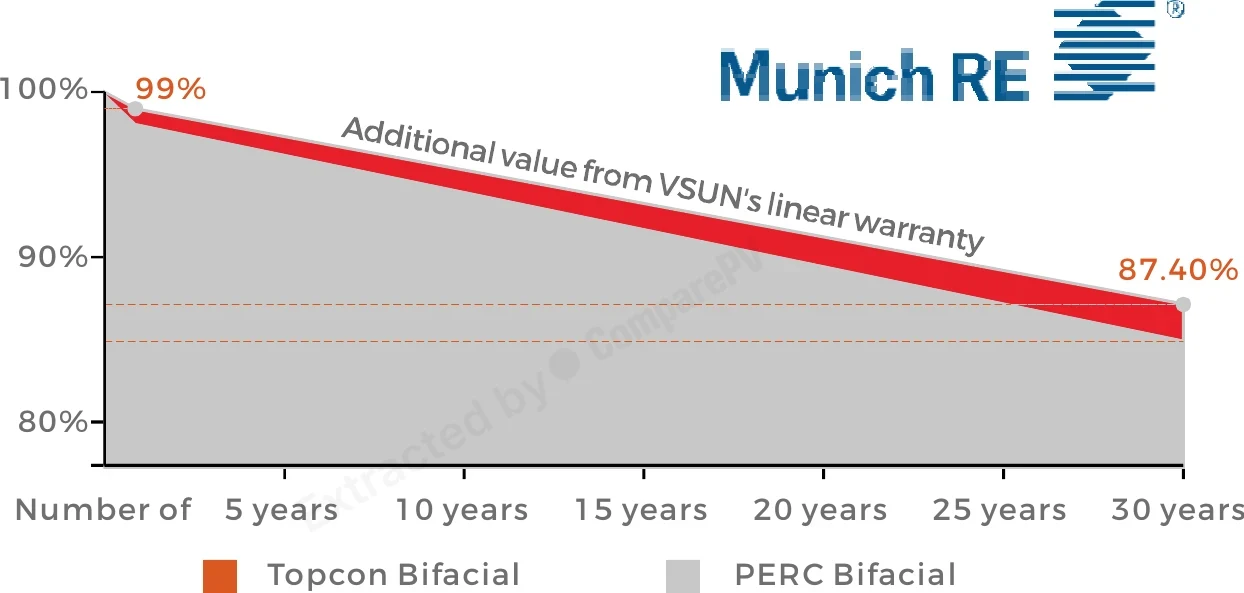
End-of-warranty output 87.4 % Equals 446 W guaranteed
Degradation 1.00 → 0.40 % First year, then annual

Datasheet charts

Open datasheet PDF

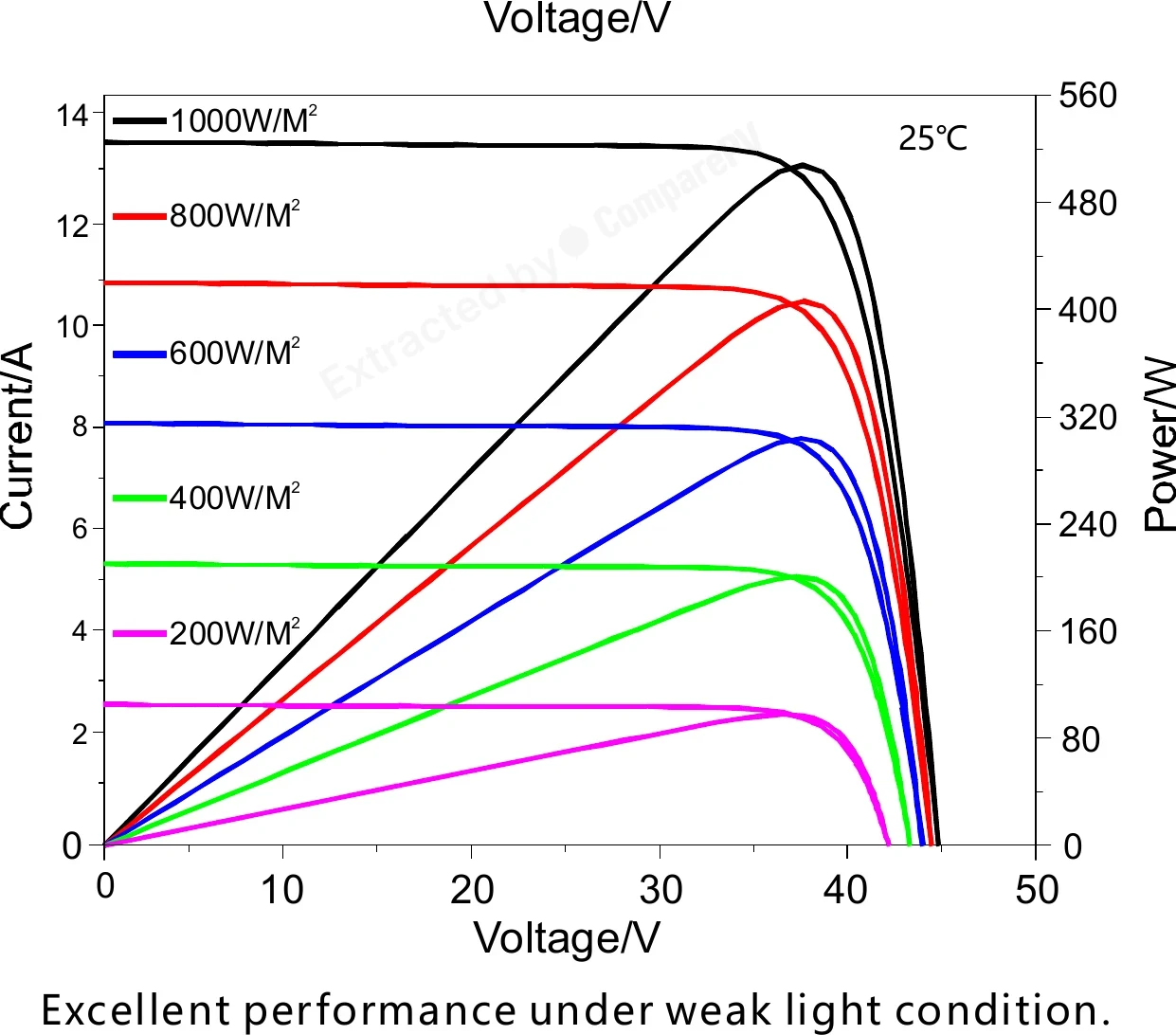
Measured curves published by VSUN in this model's datasheet. A chart carrying a wattage was measured on that variant alone - only the ones that describe 510 Wp appear here. The rest cover the whole series.
Simulations

Live - change any input
Lifetime output & value
30 years at 1200 kWh/kWp/year and €0.50 per kWh
Power in year 30
-
Lifetime energy
-
Energy value
-
With bifacial gain
-

Degradation from this panel's own datasheet figures. No inverter, soiling or shading losses.

Heat losses
-0.300 %/°C against a segment median of -0.290
-
Bifacial gain
Rear gain over light concrete: -
-

Model: bifaciality × albedo × 0.6 view factor. A first-order estimate, not a yield simulation.

Filter these
Size
Panel Power Eff. Temp. Weight Difference
VSUN VSUN510N-132BMH 510 W 21.48% -0.300 26.2 kg You are here
LR7-54HJD-510M 510 W 25.00% -0.240 23.5 kg Cooler, lighter, +3.5 pp
AIKO-A495-MCE54Mw 495 W 24.80% -0.260 21.0 kg Cooler, lighter, +3.3 pp
LR7-60HVH-560M 560 W 24.80% -0.260 25.0 kg +50 W, cooler, +3.3 pp
LR7-54HJD-505M 505 W 24.70% -0.240 23.5 kg Cooler, lighter, +3.2 pp
LR7-60HVH-555M 555 W 24.60% -0.260 25.0 kg +45 W, cooler, +3.1 pp
AIKO-A490-MCE54Mw 490 W 24.50% -0.260 21.0 kg Cooler, lighter, +3.0 pp
LR7-54HJD-500M 500 W 24.50% -0.240 23.5 kg Cooler, lighter, +3.0 pp
VSUN515N-132BMH 515 W 21.69% -0.300 26.2 kg +0.2 pp
VSUN520N-132BMH 520 W 21.90% -0.300 26.2 kg +10 W, +0.4 pp
VSUN525N-132BMH 525 W 22.11% -0.300 26.2 kg +15 W, +0.6 pp
GKA120N-PRO-590W 590 W 23.82% -0.300 26.7 kg +80 W, +2.3 pp
GKA120N-PRO-585W 585 W 23.62% -0.300 26.7 kg +75 W, +2.1 pp
BGO 580 580 W 23.50% -0.290 26.0 kg +70 W, cooler, +2.0 pp
GKA120N-PRO-580W 580 W 23.42% -0.300 26.7 kg +70 W, +1.9 pp

Found 397 panels of the same or similar size to this one, within ±10 mm. See them here Found 408 panels of the same or similar size to this one, within ±25 mm. See them here Found 425 panels of the same or similar size to this one, within ±50 mm. See them here Found 953 panels of the same or similar size to this one, within ±100 mm. See them here

Common questions

6 answered
How does the TOPCon technology used in VSUN N-132BMH panels differ from older PERC cells?
TOPCon (Tunnel Oxide Passivated Contact) adds an extra passivation oxide layer beneath the rear-side contacts, significantly reducing electron recombination and boosting module efficiency compared to conventional PERC cells. As a result, VSUN N-132BMH panels deliver higher output power for the same surface area and show lower power degradation over time, translating into higher energy yield across the entire lifespan of the installation.
How much extra energy do bifacial VSUN N-132BMH panels generate?
Thanks to their bifacial cell design, VSUN N-132BMH panels also capture light reflected from the ground, which, depending on surface albedo (light gravel, snow, or a white roof membrane), can boost energy production by as much as 5-20% compared to monofacial modules of the same power rating. This delivers higher power density on the same mounting area without enlarging the installation footprint.
What warranty covers VSUN N-132BMH panels – product and power?
The manufacturer backs the N-132BMH series with a 25-year product warranty and a 30-year linear power degradation warranty. This means that after three decades of operation the panel should still deliver a significant share of its initial output, with first-year and annual degradation kept low thanks to TOPCon technology resistant to LID and LeTID. This is one of the longer warranties currently available on the market.
Are VSUN N-132BMH panels suitable for a single-family home roof, or only for large PV farms?
The N-132BMH series was primarily designed for large-scale solar farms and commercial installations where minimizing the levelized cost of energy (LCOE) is the priority. Its large format and power output up to 525 Wp also make it a good fit for large industrial roofs, but for typical pitched roofs on single-family homes, smaller and lighter residential panels are usually a better match.
Is VSUN a Tier 1 manufacturer, and does that matter when choosing panels?
VSUN Solar does not currently appear on the Tier 1 manufacturer list according to the BloombergNEF classification, which mainly reflects bank financing scale rather than technical product quality. N-132BMH panels hold standard industry certifications (IEC, TÜV) and competitive technical specifications. Lacking Tier 1 status may, however, make it harder to secure certain bank loans for large installations, so it's worth checking before purchase.
What is the maximum power output of a VSUN N-132BMH panel, and how many are needed for a 10 kWp installation?
Panels in the VSUN N-132BMH series reach a maximum power output of up to 525 Wp. To build a roughly 10 kWp system, you would need approximately 19 such panels (19 × 525 W ≈ 9.98 kWp). The exact number of modules depends on available mounting area, roof pitch, and choosing an inverter matched to the panel string voltage.
Add to compare