
Middle of its segment, weak in heat
The Sunova Aurora Series has been designed with the goal of maximizing energy yield in real-world conditions, even when the roof is not perfectly aligned and the weather in Poland can be unpredictable. The use of modern monocrystalline and multi-busbar (multi-busbar) solar panels results in better performance under partial shading and lower internal losses. This translates to more predictable energy production and easier adaptation of the installation to the user's profile.
A key feature is the high resistance to microcracks and mechanical stress, which is important in windy conditions and with heavy snowfall. The different versions also ensure durability in demanding environments, helping to minimize the risk of degradation over time. For investors, stable operating parameters and aesthetic appearance are also important, especially on modern roofs.
The Aurora Series is ideal for single-family homes, small businesses, and commercial and industrial (C&I) projects, where reliability is more important than just meeting specifications.
Ranking
Signals from the data
Residential, commercial and shaded-installations.
Hot climates, tight roof space and roofs where every square metre has to count.
Bottom 12% of the N-type 400-450 W segment, against a median of -0.290.
Bottom 15% of the N-type 400-450 W segment, against a median of 21.91%.
Bottom 17% of the N-type 400-450 W segment, against a median of 218.3.
- Module efficiency of 21.2% is 0.7pp below average for N-type 400-450W panels (median: 21.9%)
- Power density of 212.5 W/m² is 5.8 W/m² below N-type 400-450W median (218.3 W/m²) - needs more roof space
- -0.31%/°C temperature coefficient - 0.02pp worse than N-type 400-450W median (-0.29%/°C), expect higher hot weather losses
- Weight of 21.0 kg is typical for N-type 400-450W panels
- Bifaciality factor of 80% can add 4-12% extra yield with reflective mounting surface
Specifications
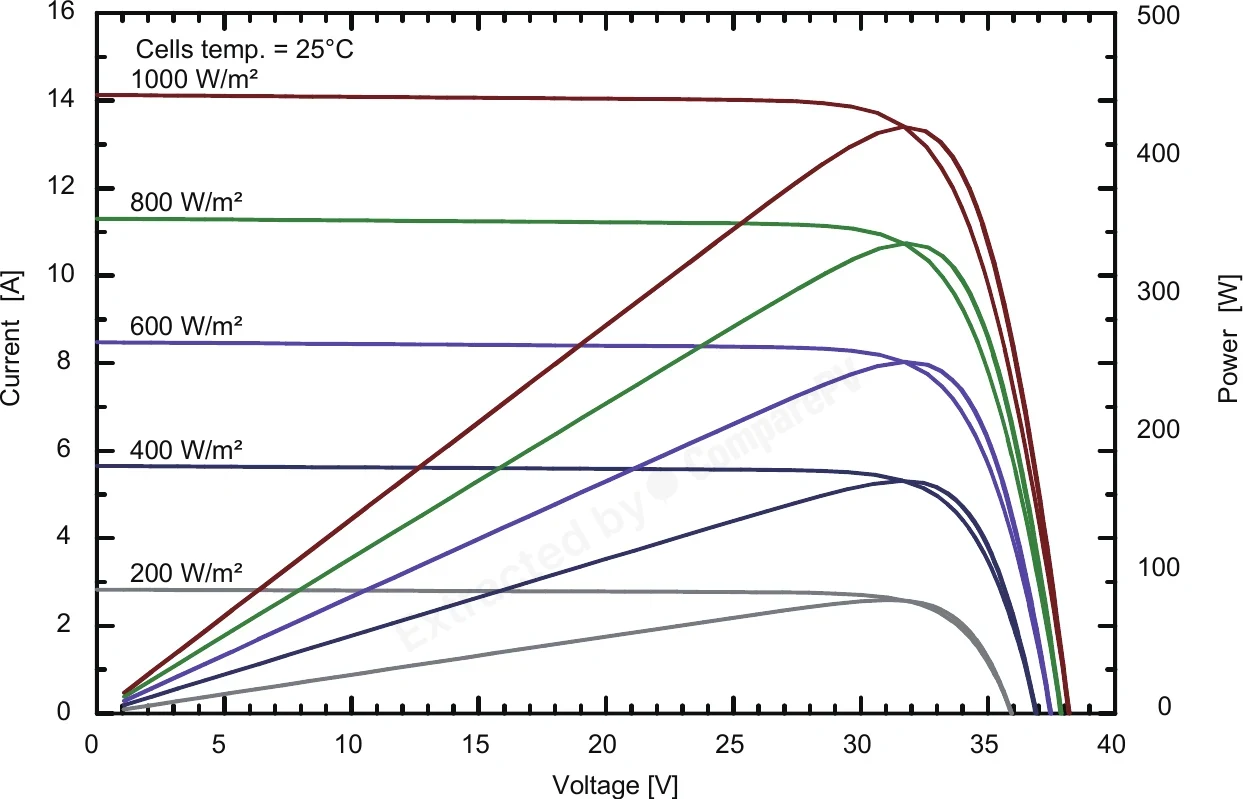
Datasheet charts
Measured curves published by Sunova in this model's datasheet. A chart carrying a wattage was measured on that variant alone - only the ones that describe 415 Wp appear here. The rest cover the whole series.
Simulations
Degradation from this panel's own datasheet figures. No inverter, soiling or shading losses.
Model: bifaciality × albedo × 0.6 view factor. A first-order estimate, not a yield simulation.
Alternatives







Found 1783 panels of the same or similar size to this one, within ±10 mm. See them here Found 1914 panels of the same or similar size to this one, within ±25 mm. See them here Found 3392 panels of the same or similar size to this one, within ±50 mm. See them here Found 3970 panels of the same or similar size to this one, within ±100 mm. See them here